Thursday, August 15, 2024

August 15, 1994: The NFL's Biggest Crowd

Herschel Walker

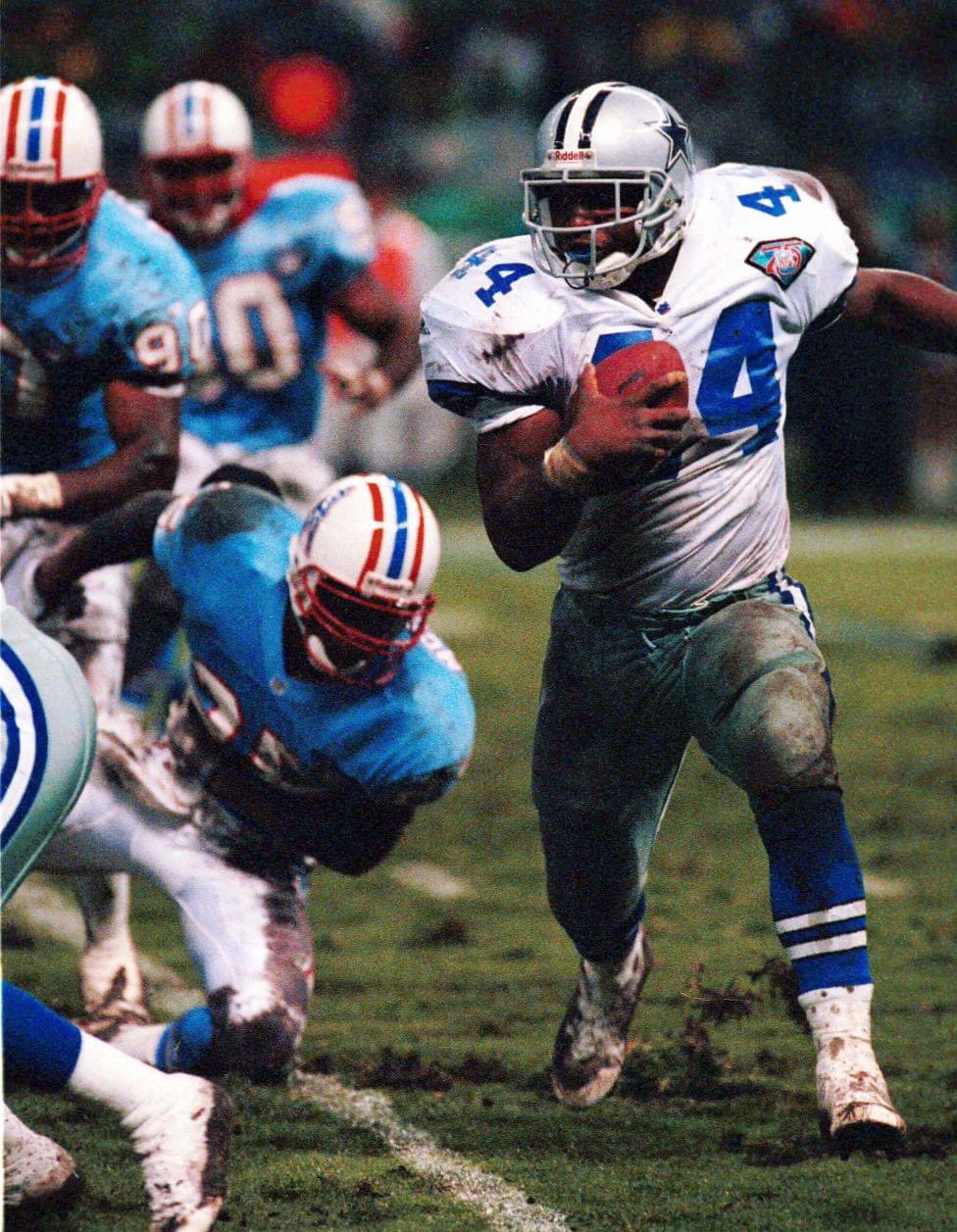
August 15, 1994, 30 years ago: The Houston Oilers beat the Dallas Cowboys, 6-0 in a preseason exhibition game. A pair of field goals by Oiler kicker Al Del Greco served as all the scoring.

The game isn't played in Houston, or in Dallas, or anywhere else in Texas. Instead, it is played at the Estadio Azteca in Mexico City, and it has the highest attendance of any NFL game ever: 112,376.

The biggest crowd for a regular-season game was also played by the Cowboys, on September 20, 2009, with 105,121 coming into AT&T Stadium in the Dallas suburb of Arlington, Texas, to see the Cowboys lose to the New York Giants, 33-31. The biggest postseason crowd was 103,985, to see the Pittsburgh Steelers beat the Los Angeles Rams, 31-19 in Super Bowl XIV, at the Rose Bowl in the Los Angeles suburb of Pasadena, California.

From 1967, the beginning of AFL-NFL preseason crossover games, until 1996, their last season, the Oilers played the Cowboys in a preseason game every year, for a trophy called the Governor's Cup. The Cowboys won the 1st game, 30-17 at Rice Stadium in Houston. After the full merger in 1970, they also played each other in regular-season games. The Cowboys won in 1970, 1974, 1982, 1985 and 1994. The Oilers won in 1979, 1988 and 1991.

In 1992, this game was played outside of the Houston and Dallas metropolitan areas for the 1st time: The Oilers won, 34-23, at the Tokyo Dome in Japan. In 1993, it was played at the new Alamodome in San Antonio, and the Oilers won, 23-20. It was played at the Alamodome again in 1995, and the Cowboys won, 10-0. The last such game was played in 1996, at the Citrus Bowl in Orlando, and the Cowboys won, 24-19.

The Oilers moved after the 1996 season, becoming the Tennessee Titans. The expansion Houston Texans began play in 2002, and the Governor's Cup preseason game was renewed. The game was not played in 2011 or 2012, but was resumed in 2013, and has been played every year since, except in 2017, when it was canceled due to Hurricane Harvey; and and in 2020, when it was canceled due to COVID restrictions. In regular-season play, the Texans have won in 2002 and 2018; while the Cowboys have won in 2006, 2010, 2014 and 2022.

Monday, August 12, 2024

Trying to Get Healthy

What a week. While the Olympics were being held in Paris, I was struck down by a terrible cold, feeling like the flu, wondering if COVID had finally gotten me after 4 1/2 years. As usual, the flu-like symptoms only lasted 4 days. But the cough usually lasts for about 2 months. One upside: Having not felt like eating through much of it, I'm down 11 pounds from my peak. It helps, but I need to lose at least that much again.

The Yankees are also trying to get healthy. Last Tuesday night, they were supposed to begin a home series with the Los Angeles Angels, with Mike Trout injured and Shohei Ohtani having been let get away. It should have been a series they could handle. But it rained, forcing a Wednesday doubleheader. In the opener, Luis Gil pitched 5 shutout innings. Oswaldo Cabrera hit a home run, the bullpen didn't blow it, and the Yankees won, 5-2.

The nightcap wasn't so good. Will Warren got tagged for 8 runs in less than 5 innings. What is he even doing on the Yankee roster? The Yankees could get nothing going, and lost, 8-2.

The Thursday night game was no better. Nestor Cortés didn't get out of the 5th inning. Cabrera hit another homer, and Jazz Chisholm hit one, but the Yankees lost, 9-4.

*

The Texas Rangers came in. It's still hard to believe they're the defending World Champions, especially since, like the Angels, they are currently well below .500. But, again, the series opener was rained out, forcing a doubleheader the next day. The 1st game went all the Yankees' way. Carlos Rodón pitched 5 2/3rds innings, allowing just 3 hits. Ron Marinaccio pitched through the 8th, and Tim Hill pitched the 9th, to finish a 5-hit shutout. Chisholm hit another home run, Austin Wells went 2-for-5 with 4 RBIs, and the Yankees won, 8-0.

The 2nd game started off pretty well. Gerrit Cole pitched 5 innings, allowing 1 run on 6 hits and 2 walks, striking out 10. He got the 1st out in the 6th. But he'd thrown 90 pitches, and, presumably on orders from Brian Cashman, Aaron Boone took him out, and brought in Luke Weaver. This was an incredibly stupid thing to do. When the decision was made, the score was 1-1. Two innings later, after Weaver and Michael Tonkin had stunk up the joint, it was 9-1 Rangers. Chisholm and Giancarlo Stanton hit home runs, but the Yankees got no closer in the end than 9-4.

So the inconsistent Marcus Stroman was sent out to pitch yesterday. Five innings, 89 pitches, 1 run. No more. Stick to the Cashman Plan.

Juan Soto hit 2 home runs, including a back-to-back with Judge, giving them 30 and 42, respectively, on the season. Stanton also hit one, giving him 20 in an abbreviated season.

But in the 8th, Mark Leiter Jr. mixed 2 homers in with 2 strikeouts. He was like the Joey Gallo of pitchers. In the 9th, Clay Holmes was shaky again, doing an Aroldis Chapman impression, with the tying and go-ahead runs on, but he nailed it down. Yankees 8, Rangers 7.

*

We are now 59 percent of the way through the regular season. The Yankees are 70-49, tied with the Baltimore Orioles for 1st place in the American League Eastern Division, and also for the best record in baseball. Despite the long slump, the Orioles had one, too, and could not take advantage.

Injury issues are significantly improved. Jose Trevino is playing rehab games at Class AA Somerset, but, with Austin Wells finally hitting, Trevino's return is less of a priority. Clarke Schmidt will make a rehab start on August 22. He could be back by the time rosters expand on September 1. Cody Poteet, originally called up to replace him, could be back from his own injury by then.

Jasson Domínguez will probably stay at Class AAA Scranton until then, as an additional hitter and outfielder is not a team priority at the moment. Anthony Rizzo may not return this season -- or to Pinstripes at all. Jonathan Loáisiga is out until next Opening Day, recovering from Tommy John surgery.

Tonight, the Yankees head out to play the Chicago White Sox, who are having one of the worst seasons in baseball history, and without the excuses of being an expansion team or having an injury crisis. They are 28-91. To put that in perspective, they are on a pace to lose 124 games. The record is 134 by the 1899 Cleveland Spiders; since then, 120 by the 1962 New York Mets; in the American League, 119 by the 2003 Detroit Tigers.

My cold will go on, but, for the Yankees, the White Sox might be just what the doctor ordered.

Sunday, August 11, 2024

August 11, 1984: Two Political Hot Buttons: Ronald Reagan and Zola Budd

August 11, 1984, 40 years ago: President Ronald Reagan is preparing for his weekly Saturday morning radio address, with a remote hookup from his home-away-from-home, his Rancho del Cielo (Ranch in the Sky) in Goleta, California.

He was scheduled, as usual, to go on the air at 12:00 Noon, Eastern Time. Since he was in California, on Pacific Time, this meant the address would begin at 9:00 AM. Usually, since Reagan started the weekly tradition in 1982, it started a few minutes late, to give the national networks time to give a short introduction.

Sure enough, this address began at 9:06. It wasn't especially memorable. It began, "My fellow Americans: I'm pleased to tell you that today I signed legislation that will allow student religious groups to begin enjoying a right they've too long been denied: The freedom to meet in public high schools during nonschool hours, just as other student groups are allowed to do."

It was typical Reagan garbage: Pandering to the religious right with something that was blatantly unconstitutional. After all, the Republican was running for re-election, with the Democratic nominee being former Vice President Walter Mondale.

What was not typical was what happened a few minutes before the broadcast. A live feed was being transmitted to radio stations around the country. Many rebroadcasters were already recording the feed, to be ready for the official transmission. Many in the media heard Reagan's impromptu remarks as he gave them, but they were not broadcast live.

Reagan, known for his sense of humor, decided to have a little fun. He said, "All right. My fellow Americans, I'm pleased to tell you today that I've signed legislation that will outlaw Russia forever. We begin bombing in five minutes."

Laughter could be heard. It's not clear who in the room was laughing. Maybe it was everyone.

Ironic: The 1st former actor to become President, the most media-savvy President ever, failed to notice that this joke was being recorded.

He also failed to notice that it wasn't funny at all. War is not funny. Nuclear destruction is not funny. And this son of a bitch was joking about starting World War III.

It took 2 days for the recording to reach the outside world. Mondale took the high road, saying, "A President has to be very, very careful with his words." He did not suggest that Reagan was mentally unstable, or in the throes of dementia. But Reagan's 1994 admission of Alzheimer's disease seemed to confirm what many people were already suspecting 10 years earlier.

On August 14, the Soviet government announced that Reagan's remarks were "unprecedentedly hostile." Soviet forces were placed on high alert, and it took some very careful words from the U.S. Department of State to calm the Soviets down.

I was 14 years old. I couldn't vote for another 4 years. I was convinced that there might not be an election in 4 years. I was hoping that America would recognize that a 73-year-old man either evil enough, crazy enough, or impaired enough to make just such a joke was unacceptable, and that they would then vote for Mondale.

When I went to bed on November 6, 1984, every State except Minnesota had been called, all for Reagan. Minnesota was Mondale's home State, and it hadn't yet been called for him. Only the majority-black District of Columbia had. Or, as comedian Jay Leno put it, "When I went to bed, Mondale had only 3 more Electoral Votes than I did, and I wasn't even running!" Mondale eventually won the State by just 4,000 votes. I have had a great deal of respect for Minnesota ever since.

But Reagan had won, and I was very, very scared.

As it turned out, Reagan's 2nd term was terrible, full of scandal and a hollow prosperity, but did not include a World War III.

Rancho del Cielo is 124 miles northwest of Los Angeles, 90 miles northwest of Reagan's Presidential Library in Simi Valley, 30 miles northwest of Santa Barbara, and 6 miles north of the Pacific Ocean at Refugio Beach. The house was built in 1871, and Reagan bought the ranch in 1974, as his 2nd term as Governor of California was winding down. (While Governors of California are now limited to 2 terms, that was not the case then, but he didn't run for a 3rd term, anyway.)

Reagan had signed his disastrous 1981 tax cut there, and had also entertained many world leaders there, including Britain's Queen Elizabeth II and Prime Minister Margaret Thatcher, and Soviet President Mikhail Gorbachev.

Friends would say of Ronald and Nancy Reagan that the ranch was his house, while any home they had near Hollywood was her house. Due to Reagan's advancing Alzheimer's disease, Nancy sold the property in 1998, to the Young America's Foundation, a conservative group, which maintains it and holds conferences there. It is now open by appointment.

After Reagan, both George Bushes, Bill Clinton and Barack Obama continued the weekly radio address. After 9 months in office, Donald Trump stopped doing it. He thought he was too good to speak to us one Noon a week, every week. Joe Biden resumed the tradition.

*

August 11, 1984 was also the day of one of the most anticipated matchups of the 1984 Olympic Games, at the Los Angeles Memorial Coliseum. The result was one that no one could have anticipated.

Mary Decker, a 26-year-old native of the suburbs of L.A., had been one of the top middle-distance runners in the world, winning a Gold Medal in the 1979 Pan American Games. Unable to compete in the 1980 Olympics in Moscow because of the U.S. boycott, she just kept going.

At the 1983 World Championships of Track & Field, she won Gold in both the 1,500 meters and the 3,000 meters. Sports Illustrated named her its Sportswoman of the Year -- before the adoption of the title "Sportsperson," this meant that she was named ahead of all male athletes as well -- and, with the Olympics coming to America the next year, she was considered a favorite to win Gold.
And yet, there was an unexpected foreshadowing on that cover.
The Dreaded SI Cover Jinx?

Zola Budd was only 18. Early in 1984, she set the women's world record in the 5,000 meters. But it was not accepted as a world record by the IAAF, the world governing body for track & field, because she was from South Africa, which had been excluded from various sports competitions due to its apartheid government. And she would be excluded from the Olympics as well.

That wasn't Budd's fault, but, due to her grandfather being a British citizen, the International Olympic Committee's rules allowed her to apply for British citizenship and compete for Great Britain in Los Angeles. She did, and this angered many people.

It shouldn't have: She wasn't breaking any rules by doing this. Instead, she was a victim of the rules, who was now using the rules to allow herself to compete. Not to guarantee victory, but just to be allowed to compete. After all, she was, thus far, too young to have even voted in a South African election, so she had nothing to do with their evil racist government.

There was also an element of weirdness in that she competed barefoot. At the time, this was legal, but has since been banned. Imagine, in 1984, the year that Nike first began offering huge sneaker contracts, competing in the Olympic Games, and its preparatory events, without even wearing shoes! But she did, including setting an officially-recognized world record in the 2,000 meters. As the renowned British sportscaster David Coleman put it, "The message will now be flashed around the world: Zola Budd is no myth."

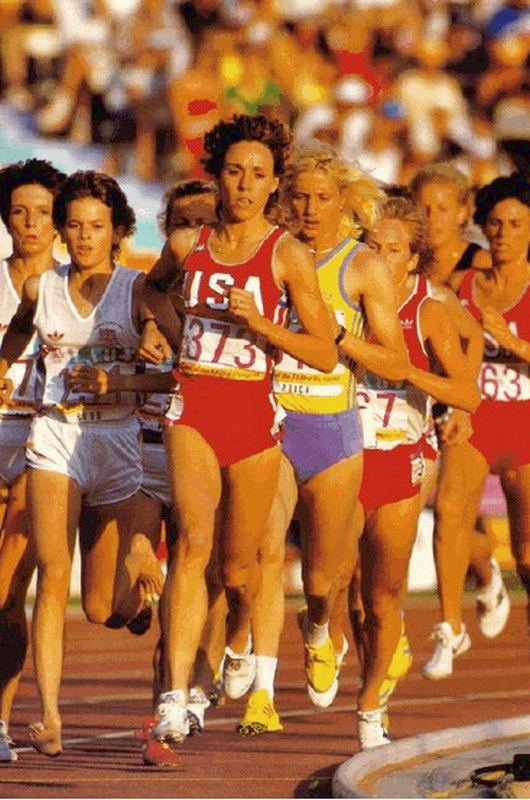
Decker and Budd were entered into one race together, the 3,000 meters. Decker had specialized in shorter distances, Budd in longer ones. Decker led early, but after the 1,500-meter mark, Budd took the lead. Running as a group was an unusual situation for both of them, as they were each used to running in front and well ahead of other competitors.
Decker at center, Budd to the left

At 1,700 meters, the first collision occurred. Decker came into contact with one of Budd's legs, knocking Budd slightly off balance. However, both women maintained their close position. Five strides on, at the race time of 4:58, Budd and Decker again made contact, with Budd's left foot brushing Decker's thigh, causing Budd to lose her balance, and sending her into Decker's path.

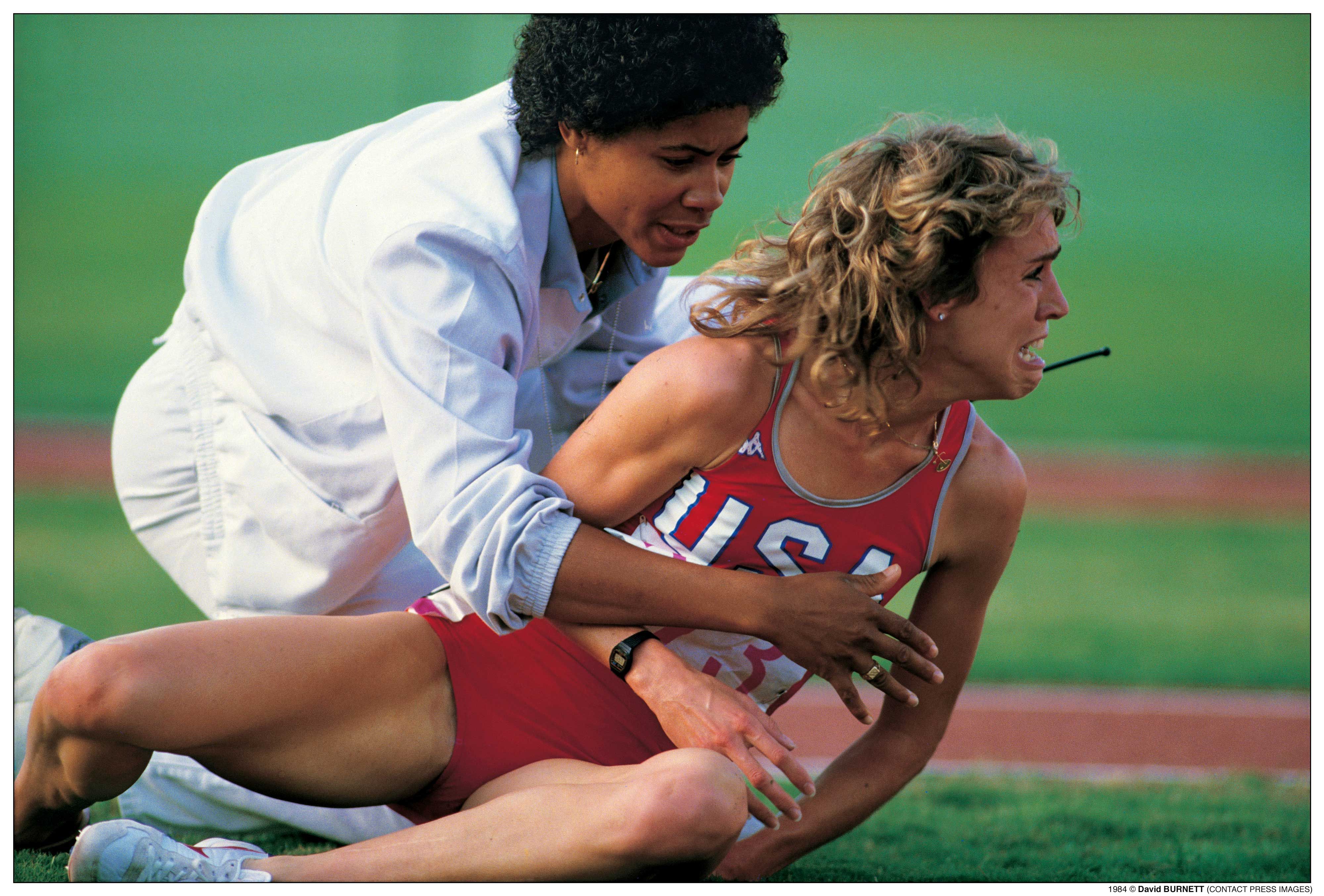
Decker's spiked running shoe came down hard into Budd's ankle, just above the heel, drawing blood. Videotapes later examined by Olympic officials showed Budd visibly in pain. However, she maintained equilibrium and kept stride.

Decker did not: She fell to the curb, injuring her hip. The fall ended her race, and she was carried off the track in tears by her boyfriend and later, husband, British discus thrower Richard Slaney.
Budd, deeply affected by the occurrence, continued to lead for a while, but faded, finishing 7th. Her finishing time of 8:48 was well outside her best of 8:37. The race was won by of Maricica Puică of Romania, who also won a Bronze Medal in the 1,500 meters. Wendy Sly of Britain won the Silver Medal, and Lynn Williams of Canada won the Bronze Medal.

Budd tried to apologize to Decker in the tunnel after the race, but Decker was upset, and replied, "Don’t bother!" She was now unable to compete in any other races.

Having married Slaney, Decker gave birth to a daughter in 1986, and missed the 1987 World Championships due to injury. She ran in the 1,500 and 3,000 meters in the 1988 Olympics in Seoul, Korea, but was past her prime, and wasn't close. She retired without ever winning an Olympic Medal.

Budd returned to South Africa in 1989, and, with its eligibility restored after the release of Nelson Mandela the next year, was able to represent her home country at the 1992 Olympics in Barcelona. (Unlike soccer, for most of FIFA's history, anyway, there is no rule against competing for 2 different countries in the Olympics.) But she never won an Olympic Medal, either. She married and had 3 children.

In 2016, Decker and Budd reunited, and collaborated on a documentary about the event, The Fall. "Looking back on it now, I see it as an unlucky accident," Decker said. She also apologized to Budd for shunning her in the tunnel and after the race, and in a separate interview she said, "I was hurting, both physically and emotionally."

Budd is now coaching at her local university, and still runs long distance. She and Decker got along well when making the documentary and, as well as still sharing a passion for running, they discovered their respective husbands share a birthday.

Budd (left) and Decker, 2016

"Looking back at both our lives," she said, "neither of us had a fair chance of achieving what we really wanted to. Both of us were victims of something that was beyond our control."
August 11, 1934: Alcatraz Federal Penitentiary Opens

August 11, 1934, 90 years ago: The United States Penitentiary, Alcatraz Island, opens on an island in San Francisco Bay. It had been a U.S. Army fort since 1859, and had included a military prison since 1912.

"Alcatraz" is a Spanish word meaning "the gannet," for the pelican-like birds that the original Spanish settlers found on the island. As a military prison, among those housed there were conscientious objectors from serving in World War I, including Philip Grosser, who called it "America's Devil's Island," after the French island prison off the coast of French Guiana in South America.

Alcatraz was intended for prisoners who continuously caused trouble at other federal prisons. It would be a "last resort prison," to hold "the worst of the worst," from whom there was no hope of rehabilitation. The island became adapted and used as a prison after the buildings were modernized and security increased.

Given this high security and the island's location in the cold waters and strong currents of San Francisco Bay, prison operators believed Alcatraz to be escape-proof and America's strongest prison. On August 11, 1934, the first batch of 137 prisoners arrived at Alcatraz from the U.S. Penitentiary in Leavenworth, Kansas.

The three-story cellhouse included the four main cell blocks – A-block through D-block, the warden's office, visitation room, the library, and the barber shop. The prison cells typically measured 9 feet by 5 feet and 7 feet high. They were primitive and lacked privacy, furnished with a bed, desk, washbasin, a toilet on the back wall, and few items other than a blanket.

Black prisoners were segregated from other inmates in cell designation. D-Block housed the worst inmates, and 6 cells at its end were designated "The Hole." Prisoners with behavioral problems were sent to these for periods of often brutal punishment.

The dining hall and kitchen extended from the main building. Prisoners and staff ate three meals a day together, and, contrary to tradition, many prisoners said Alcatraz had considerably better food than other prisons in which they'd served. The prison hospital was located above the dining hall.

Working at the prison was considered a privilege for inmates. Those who earned privileges were employed in the Model Industries Building and the New Industries Building during the day, actively involved in providing for the military in jobs such as sewing and woodwork, and performing various maintenance and laundry chores.

The best-known inmate was former Chicago organized crime boss Al Capone. He had served in the federal prison in Atlanta from 1931 to 1934, and had paid off guards to allow him to continue running his rackets. There was no chance of that at Alcatraz. But it turned out to be unnecessary: He developed symptoms of tertiary syphilis, and was given compassionate release in late 1939, after a psychologist determined that he now had the mind of a 12-year-old boy. He lived another 7 years. Other notable crime figures from the 1930s that got sent to "The Rock" were Alvin "Creepy" Karpis and George Barnes, a.k.a. Machine Gun Kelly.

As Capone ran things in Chicago, so did Meyer "Mickey" Cohen run them in Los Angeles. Like Capone, the charge on which he was eventually nailed was income tax evasion. He also didn't serve in Alcatraz for long, from 1961 to 1963. After that, he was transferred to Atlanta, and was released in 1972 after developing cancer. He died 4 years later. Ellsworth "Bumpy" Johnson was the "Godfather of Harlem," and was in Alcatraz from 1954 to 1963, at which point he was paroled. He lived another 5 years.

In 1962, Burt Lancaster starred in the film Birdman of Alcatraz, as convicted murderer Robert Stroud. In fact, the title was a misnomer: As the film makes clear, while Stroud had been allowed to keep and study birds in his cell at Leavenworth, he was not allowed to do so at Alcatraz. And while the film portrayed him as alternating between psychotic and sympathetic, he was far from it.

He was in Alcatraz from 1942 to 1959, at which point his ill health got him transferred to the United States Medical Center for Federal Prisoners in Springfield, Missouri, where he died in 1963, a day before the assassination of President John F. Kennedy.

An escape attempt on May 2, 1946 resulted in what became known as "The Battle of Alcatraz": Six men attempted to escape, but, seeing the odds against them, three turned back. The other three were killed by U.S. Marines stationed on the island.

No one ever escaped from Alcatraz. The legend that anyone did comes from an attempt on June 11, 1962: Armed robber Frank Morris, and bank-robbing brothers John and Clarence Anglin, made their way through a ventilation shaft, slid down a kitchen vent pipe, then climbed perimeter fences lined with barbed wire, before making their way to an inflated raft. They tried to reach Angel Island, 2 miles to the north.

On June 14, a U.S. Coast Guard cutter found a paddle about 200 yards off Angel Island. Later that day, in the same area, workers on a private boat found a wallet, whose contents suggested it belonged to one of the Anglins. On June 21, shreds of cloth believed to be remnants of the raft were found on a beach near the Golden Gate Bridge. The FBI's report stated, "The individuals' personal effects were the only belongings they had, and the men would have drowned before leaving them behind." The reason people still cling to the belief that the escape was successful is that the bodies were never found. They are likely at the bottom of the Bay.

A 1959 report indicated that the facility was over 3 times more expensive to run than the average American prison. The problem was made worse by the buildings' structural deterioration from exposure to salt spray, which would require $5 million to fix. Major repairs began in 1958, but by 1961, engineers considered the prison a lost cause. Attorney General Robert F. Kennedy submitted plans for a new maximum-security institution at Marion, Illinois. Alcatraz was closed on March 21, 1963, and its prisoners moved to other federal pens.

Alcatraz has been reopened as a public museum. It is one of San Francisco's major tourist attractions, operated by the National Park Service's Golden Gate National Recreation Area, attracting some 1.5 million visitors annually. Visitors arrive by boat and are given a tour of the cellhouse and island, and a slide show and audio narration with anecdotes from former inmates, guards and rangers on Alcatraz.

Friday, August 9, 2024

August 9, 1974: President Richard Nixon Resigns

August 9, 1974, 50 years ago today: Richard Nixon resigns as President of the United States, due to the crimes he committed that fell under the umbrella term "Watergate."

We may never know for sure if Nixon authorized the break-in of the offices of the Democratic National Committee at the Watergate hotel and office complex on the Potomac River in Washington, D.C. on June 17, 1972. What we do know, thanks to the audiotaping system he had in the Oval Office at the White House, is that, on June 23, 6 days after the break-in, he told his White House Chief of Staff, H.R. "Bob" Haldeman, to tell the FBI to back off on their investigation of the break-in.

That was obstruction of justice. On July 27, 1974, the Committee on the Judiciary of the U.S. House of Representatives approved an Article of Impeachment against Nixon, on the charge of obstruction of justice. On July 29, they approved another, on the charge of abuse of power. On July 30, they approved a third, for contempt of congress.

On August 5, in United States v. Nixon, the U.S. Supreme Court ruled unanimously that Nixon had to turn over all the tapes. This 8-0 vote included 3 of the 4 Justices that Nixon himself had appointed: Chief Justice Warren Burger, Harry Blackmun and Lewis Powell. Nixon had also appointed William Rehnquist, who recused himself, because he had worked in the U.S. Department of Justice for the 1st 3 years of the Nixon Administration.

And the tape of the June 23, 1972 order from Nixon to Haldeman was made public. It became known as "the Smoking Gun Tape." On August 7, Republican Congressional leaders visited Nixon at the White House, and told him they didn't have the votes to save from from being impeached by the House, or convicted in a trial by the Senate. He would be removed from office, unless he did it by himself, by resigning.

On August 8, at 9:01 PM Eastern Time, he addressed the nation in prime time, and spoke for 16 minutes, telling the nation what it was more than ready to hear:

I have never been a quitter. To leave office before my term is completed is abhorrent to every instinct in my body. But as President, I must put the interest of America first.
America needs a full-time President and a full-time Congress, particularly at this time with problems we face, at home and abroad.
To continue to fight through the months ahead for my personal vindication would almost totally absorb the time and attention of both the President and the Congress in a period when our entire focus should be on the great issues of peace abroad and prosperity without inflation at home.
Therefore, I shall resign the Presidency effective at noon tomorrow. Vice President Ford will be sworn in as President at that hour in this office.
The next day, at 9:00 AM Eastern, Nixon gave a tearful Farewell Address to his staff in the East Room of the White House. After it, the President and First Lady Pat Nixon were escorted to a waiting helicopter, Marine One, by Vice President Ford and his wife Betty. Mrs. Nixon got in. Mr. Nixon got to the top step, gave a wave to his staff, and did one more "V for Victory" salute before boarding.

At 11:35 AM, a letter arrived at the office of U.S. Secretary of State Henry Kissinger, reading, in its entirety: "Dear Mr. Secretary: I hereby resign the office of President of the United States. Sincerely, Richard Nixon." As soon as Nixon received it, officially, Nixon was no longer in office, and Vice President Gerald Ford was now the President, regardless of whether there was an actual swearing-in.

At 12:05 PM, in the East Room, Gerald Rudolph Ford Jr. was sworn in as the 38th President of the United States by Chief Justice Warren Burger. He told the nation, "My fellow Americans, our long national nightmare is over. Our Constitution works. Our great republic is a government of laws, and not of men. Here, the people rule."

Nixon had been nominated at 5 different Republican Conventions: In 1952 and 1956 for Vice President; and in 1960, 1968 and 1972 for President. After 1972, he could never attend another. It would take until 2004, and Governor Arnold Schwarzenegger of California, for a speaker at a Republican Convention, to even mention him again, so toxic was his name considered to be, even in his own Party.

By 2004, of course, the Republicans had lurched so far to the right that, not only was it possible for Nixon's name to be both spoken aloud and cheered at a Republican Convention, but for people in the Republican Party to come to a consensus that Nixon did nothing wrong, except get caught.

UPDATE: It took me until 2024 to think of this, but the 1970s were Schrödinger's Decade. There was too much Republican competence, and too much crimefighting; and, at the same time, not enough of either of those things.

Nixon's Presidential Library was built adjacent to his birthplace in Yorba Linda, California, 30 miles southeast of downtown Los Angeles. Yorba Linda also has a Richard M. Nixon Parkway and a Richard M. Nixon Elementary School.

Comedians David Frye and Rich Little became famous for their impersonations of Nixon, among other political figures. Frye leaned on the phrase, "Let me just say this," while Little preferred, "Let me make this perfectly clear." Dan Aykroyd played Nixon as a bitter former President on Saturday Night Live, although he refused to shave the mustache he had at the time.

Nixon frequently features in time-travel and alternate-history pieces. These include Robert Wisdom as an alternate-history 5th-term Nixon in 1985 in the superhero film Watchmen in 2009, Stuart Milligan on Doctor Who in 2011, John H. Tobin in Transformers: Dark of the Moon the same year, Mark Camacho in X-Men: Days of Future Past in 2014, and Paul Ganus on DC's Legends of Tomorrow in 2019. Two films have been made about Nixon's 1970 meeting with Elvis Presley: He was played by Bob Gunton in Elvis Meets Nixon in 1997, and Kevin Spacey in Elvis & Nixon in 2016.

Among the other actors to play Nixon have been Rip Torn in Blind Ambition (based on the memoir of John Dean) in 1979, Philip Baker Hall in Secret Honor in 1984, Lane Smith in The Final Days in 1989, Anthony Hopkins in Oliver Stone's film Nixon in 1995,  Dan Hedaya in the comedy Dick in 1999, Frank Langella reprising his Tony Award-winning Broadway role in Frost/Nixon in 2008, and John Cusack in The Butler in 2013.

Ford is the only President whose Presidential Library and Presidential Museum are in 2 different locations: The former is at his alma mater, the University of Michigan; while the latter is in his hometown, Grand Rapids, Michigan. He has a statue in the Capitol Rotunda in Washington, and a House of Representatives Office Building is named for him, due to his service as House Minority Leader.

Despite looking and sounding nothing like Ford, Chevy Chase played him on Saturday Night Live. He was also played by Dick Crockett in The Pink Panther Strikes Again in 1976, Josef Sommer in The Betty Ford Story in 1987, Larry Lindsay in Hot Shots! Part Deux in 1993, Drew Snyder in Dark Skies in 1997, Jeffrey Ventimilia in That '70s Show in 1998, Corbin Bernsen in The Commission in 2003, and Bill Camp in Vice (about Ford's former Chief of Staff, Dick Cheney) in 2018.

The State where he was born, Nebraska, and the State where he grew up, Michigan, both have a Gerald R. Ford Freeway, and Interstate 70 in Eagle County in Colorado is the Gerald Ford Memorial Highway. In 2017, the USS Gerald R. Ford, a nuclear-powered aircraft carrier, CVN-78, was launched, and is the largest warship ever built. So far, despite also having served in the Navy during World War II, Nixon doesn't have a ship named for him. Maybe he'll get a pirate ship.

Wednesday, August 7, 2024

August 7, 1974: The Republican Leaders Tell President Nixon the Truth

Senator Hugh Scott addresses the media after the meeting.
Behind him is Senator Barry Goldwater.
Facing Scott is Representative John Rhodes.

August 7, 1974, 50 years ago: President Richard Nixon sees 3 leaders of the Republican Party at the White House: Representative John Rhodes of Arizona, the House Minority Leader; Senator Hugh Scott of Pennsylvania, the Senate Minority Leader Hugh Scott; and Senator Barry Goldwater of Arizona, the Party's 1964 nominee for President, and the unofficial leader of what had come to be known as "the conservative movement."

They had bad news for him.

On June 17, 1972, 5 men working for the Committee to Re-Elect the President had broken into the headquarters of the Democratic National Committee, at the Watergate hotel and office complex in Washington. Whether Nixon knew that this was going to happen, and approved of it, or not, only he knew for sure.

But, 6 days later, on June 23, he met with his White House Chief of Staff, Harry Robbins "Bob" Haldeman. The conversation was captured on an audiotape, in a system Nixon had installed in the Oval Office of the White House, for the purpose of historical records, because he didn't want anything to be distorted by outside historians. Ironically, this taping system would, instead, be his downfall, as it recorded these words, among others:

Haldeman: That the way to handle this now is for us to have Walters call Pat Gray and just say, "Stay the hell out of this… This is ah, business here, we don't want you to go any further on it."

Nixon: Just say this is sort of a comedy of errors, bizarre, without getting into it, "The President believes that it is going to open the whole Bay of Pigs thing up again. And, ah, because these people are plugging for, for keeps, and that they should call the FBI in and say that we wish for the country, don't go any further into this case, period!"

Haldeman: OK.

"Walters" was Vernon C. Walters, a former 3-star General in the U.S. Army, who was then the Deputy Director of the CIA. "Pat Gray" was L. Patrick Gray III, the Acting Director of the FBI following the death of J. Edgar Hoover on May 2, 1972.

In other words, Haldeman had suggested to Nixon that he tell the FBI to back off on investigating the scandal that had become known as "Watergate," Nixon had agreed to it, and Haldeman understood that Nixon had agreed to it. This was obstruction of justice. Given that there were two men discussing it, this was also conspiracy to obstruct justice. Each of these was a felony; and, in Nixon's case, an impeachable offense.

But no one else knew that at the time, and Nixon was overwhelmingly re-elected. But the scandal broke out at the start of his 2nd term, and the Senate began holding hearings. Alexander Butterfield, Director of the Federal Aviation Administration and a former Nixon White House aide, was asked by the Senate committee if he had installed a taping system in the Oval Office. He told the truth: He had.

The fight by Congress to get those tapes, and the fight by Nixon to keep Congress from getting them, went all the way to the Supreme Court. On August 5, 1974, the Court unanimously ruled that they had to be released. When the tape featuring Nixon agreeing to Haldeman's plan to get the FBI to back off was released, it was proof of felonious guilt. It became known as "The Smoking Gun Tape."

On July 27, the House Judiciary Committee voted 27-11 to approve 3 Articles of Impeachment against Nixon. All 11 voting against it were Republicans, On August 5, having heard the tape, all 11 of those Republicans said they would vote to impeach him when the Articles came to a vote before the full House.

And so, Rhodes, Scott and Goldwater went to see Nixon at the White House. Rhodes said he couldn't save Nixon from impeachment in the House, since only 30 Republicans were willing to vote against impeachment. Scott told him there might be half a dozen Senators willing to acquit, and that was with the remaining segregationist Democrats, a.k.a. Dixiecrats, being counted. And Goldwater told him the conservative movement, which had stopped trusting him during the 1960 Presidential campaign, wouldn't save him.

Upon leaving the White House, the three men then told the media that impeachment and conviction were a near-certainty, and that the only thing that could prevent it was if Nixon resigned the Presidency, and that they had told him this. They didn't tell Nixon that they thought he should resign, only that it was the only way to avoid impeachment and removal.

After talking it over with his family and his remaining loyalists the next day, August 8, Nixon spoke to the nation that night, and announced his resignation, effective at 12:00 Noon the next day, August 9.

Scott served out his term in the Senate, and left after the 1976 election. He died in 1994, 3 months after Nixon. Rhodes retired after the 1980 election, and lived until 2003. Goldwater was running for re-election in 1974, and won, and won again in 1980. He retired after the 1986 election, and died in 1998.

In 1998, when it looked like Bill Clinton might be impeached at the height (or depth, depending on your point of view) of the Monica Lewinsky scandal, there was speculation that Clinton might receive a similar visit: House Minority Leader Dick Gephardt of Missouri, Senate Minority Leader Tom Daschle of South Dakota, and Ted Kennedy of Massachusetts, the Senate's leading liberal and the brother of Clinton's hero, President John F. Kennedy.

But that delegation never came together, because Clinton was never in danger of being removed from office: The Republican-controlled house had enough hatred to impeach him, but the Senate had neither enough evidence nor enough Republicans to convict him.

In 2019, Donald Trump was impeached. But there would be no Republican delegation of House Minority Leader Kevin McCarthy of California, Senate Minority Leader Mitch McConnell of Kentucky, and the leader of the conservative movement, whoever that was then believed to be, going to tell Trump he had to resign -- not for the good of the country, not for the good of the Republican Party, not for the good of the conservative movement, and not even for Trump's own good. There didn't have to be: McConnell had a hammerlock on the Senate's Republican caucus, and the Senate acquitted Trump.

Trump got to serve out his term. He even got to come back and be nominated for another in 2024. Nobody in the Republican Party has had the courage -- moral or otherwise -- to tell him that he is unacceptable. For America, for the Party, for anything. We, the people, must show him that. We've done it before. We must do it again.

Billy Bean, 1964-2024

Most baseball fans, when they hear the name "Billy Beane," they think of William Lamar Beane III, a weak-hitting outfielder in the major leagues from 1984 to 1989, who served as the general manager of the Oakland Athletics from 1997 to 2015, and achieved success through a philosophy that became known as "Moneyball." This became the title of a book and a movie about the team, and Beane became hailed as a genius.

A "senior adviser" to the A's franchise since 2015, Billy Beane was not a genius. A genius would have won at least one Pennant in those 19 seasons. He didn't. The argument that he didn't have the payroll to do so is stupid, because other teams that didn't spend much have won Pennants. If Beane was the man his fans think he is, he would have quit on his cheapskate bosses, and offered his services to the highest bidder.

He never has. Because then, he would have been expected to deliver. Instead, he keeps his cushy post with the A's. Billy Beane is a coward.

The same could be said of a man with almost the same name, and roughly the same talent level, and even the same position as a player, at the same time. But his cowardice had a very different cause, one forced on him, and on far too many others, by American society. And, eventually, he overcame it, and became something more important than a genius: A hero.

William Daro Bean was born on May 11, 1964 outside Los Angeles in Santa Ana, California. An outfielder, he led Santa Ana High School to a State Championship. He went to nearby Loyola Marymount University, and after his junior year, he was drafted by the Yankees. He turned them down, and helped LMU to the College World Series.

The Yankees' draft rights ran out, and the Detroit Tigers drafted him. He signed with them, and made his major league debut on April 25, 1987. It couldn't have gone much better: Leading off, playing left field, and wearing Number 4, he went 4-for-6 with an RBI, helping the Tigers beat the Kansas City Royals, 13-2 at Tiger Stadium in Detroit.

But it never got any better than that. The Tigers won the American League Eastern Division that season but he didn't make the postseason roster. He spent most of the 1988 season in the minor leagues. In 1989, he was traded to the Los Angeles Dodgers, but was stuck in their farm system, too. He played in Japan in 1992, and was signed by the San Diego Padres in 1993. He played half a season's worth of games in 1993, and again in 1994, but only 4 games in 1995, spending most of the season with the Padres' top farm team, the Las Vegas Stars of the Pacific Coast League. After that season, he retired. He was only 31 years old.

That's what the public knew at the time. Billy Bean was keeping a secret: He was gay. He had married a woman, but, by his own admission, "I wasn't fulfilled. I had a fear of not being understood, not being totally accepted. I was looking for a soul mate, someone I could let my guard down with. I only found that with men.''

He found it after being traded to San Diego, with an immigrant who had left his homeland due to being gay. Billy was worried others would find out about their relationship. Years later, he told an interviewer, “I lived 20 miles from the stadium to keep people from that casual drop-by. My partner had faith that everyone would be fine with it, but I didn't. The double life was exhausting.”

His partner was HIV-positive, and just before the 1995 season began, Billy found him unconscious in their home. Billy rushed him to the closest hospital, but remembered he had recently appeared there as a member of the Padres. Fearing that he would be outed, Bean drove an extra half-hour to a different hospital. Whether it made a difference is unclear, as his partner may have died anyway, but it was a cowardly act. So was not showing up for his partner's funeral, for fear of being exposed.

His moral failing -- not his homosexuality, but his cowardice about it -- weighed on him, and it affected his playing. He finally accepted that he could not be both a professional baseball player and a gay man, and he retired -- although, given the way he was stuck in Class AAA for most of the 1995 season, and didn't seem likely to be acquired by another team, the choice might have been less in his hands than he believed.

*

Bean came out to his family that November. He came out publicly in 1999, in an article in the Miami Herald. To this point, only 1 former player had come out, former Angeles and Oakland outfielder Glenn Burke. He had been out to his teammates, but came out publicly only after leaving baseball, in 1982, and had died in May 1995, shortly before Bean retired. Bean reached out to the Burke family, and advocated for MLB and the Dodgers to embrace him in a larger way.

He met Judy Shepard, whose son Matthew had been murdered for being gay in 1998. "She said, 'Matthew would've loved you, and he loved baseball.' I realized there's a responsibility. Sports can help people to become more accepting. I feel I've been a part of that, and I'm proud of it."

In 2014, he published a memoir, Going the Other Way. He was subsequently hired by MLB Commissioner Bud Selig as MLB’s first-ever Ambassador for Inclusion. As a senior advisor to Manfred, Bean’s role focused on player education, LGBTQ inclusion, and social justice initiatives.

MLB promoted Bean to Vice President and Special Assistant to the Commissioner in March 2017, adding anti-bullying efforts to his plate. Five years later, Bean was promoted to Senior Vice President of Diversity, Equity and Inclusion.

"Nowadays, there's so much more information," Bean said in 2018. "Self-identification happens a lot earlier, and open-hearted families and parents teach their children about everything in the world. It allows for an earlier evolution. I was living in a very stone-age space."

He wasn't kidding. I went to East Brunswick High School, then as now one of the largest in New Jersey. Doing the math, I discovered that, over my 3 years there -- East Brunswick keeps its 9th graders at a lower school -- there were 3,000 separate students there. To this day, 40 years (minus a few weeks) after I first attended EBHS, out of those 3,000, the number I now know to have been gay is 2.

Two, out of three thousand. There were more teachers suspected of being gay than students. And neither could be open about it. Because it was a terrifying time for gay people. Actor Rock Hudson died from AIDS early in my junior year, and the jokes were cruel. Students, especially boys, who were suspected of being gay were tormented. Although I had no personal stake in gay rights, I had been bullied for my disability, so I knew what it was like to be mistreated for something that wasn't my fault, and it made me a sympathizer on the issue.

And they had no heroes to look up to. Elton John, David Bowie and Freddie Mercury? Now, they are icons of a movement, as well as superstars on merit. But at the time, it was as if their talent and their achievements didn't matter: They weren't just "homos," they were "drug fiends" -- and the fact that they weren't even American was a factor in their unacceptability as heroes for teenage American boys. But all those "hair metal" bands, with their long hair and makeup? Somehow, that was "macho." Not like what today's conservatives say about drag shows. God DAMN, the Eighties was a stupid decade.)

Actors? None that were both alive and out. Athletes? Not male ones, and the establishment was still treating the top openly lesbian athlete of the time, Martina Navratilova, as practically an alien. (Coming from Czechoslovakia, a Communist country that is now two free countries, didn't help, never mind that she chose to escape from it.)

No, gay kids weren't allowed to have heroes. They weren't allowed to accept themselves as themselves, let alone be accepted by others. Someone once joked that, for gay people, the Seventies were their "Sixties." If that's true, then the Eighties were another "Fifties." And that would have been true even if AIDS had never happened. I was there, and I know what the bigots said. It was the bigotry against it that was the "ugly," "deviant," "unnatural," "abnormal," "aberrant," "repulsive" lifestyle.

And so, boys like Billy Bean, Glenn Burke, Jerry Smith, Greg Louganis, Jason Collins and Robbie Rogers couldn't have the heroes they needed. They had to become the heroes their successors would need. For Burke and Smith, who died from the effects of AIDS, it was too late. The others, including Bean, have made the most of their time.

Late last year, Bean was diagnosed with leukemia. He died yesterday, August 6, 2024, at the age of 60. He had more to do. But he can rest with the knowledge that his work will be continued, and that it has not only made up for what he could have done earlier, but didn't, but that he may end up having a more lasting impact upon baseball and American life than players who did far more on the field.