Friday, June 28, 2019

Yankees vs. Red Sox, The Defining Moments, Part II, 1939-1966

April 20, 1939, Yankee Stadium. Opening Day, and while one legend, Lou Gehrig, is fading, another debuts. Ted Williams strikes out against Ruffing in his 1st 2 major league at-bats. But in his 3rd, he strokes a double, and "Teddy Ballgame" is underway. In spite of Ted's debut, the Yankees win, 2-0, and go on to win the World Series.

From 1938 to 1949, the Red Sox would finish 2nd to the Yankees 6 times, and would finish 3rd an additional 3 times in the 1950s. But only twice did they finish ahead of the Yankees in any season from 1919 to 1965: In 1946 and 1948.

April 23, 1941, Yankee Stadium. Rookie Phil Rizzuto -- not exactly a musclebound slugger -- hits his 1st major league home run, taking Charlie Wagner deep in the bottom of the 11th inning. It was the 1st of only 38 big-league round-trippers for the Scooter, and none of the 37 to come was a walkoff. I wonder if he yelled, "Holy cow!"

July 2, 1941, Yankee Stadium. Joe DiMaggio beats the Sox, and the 95-degree heat, and hits a home run to extend his hitting streak to a record 45 games. Yankees 8, Red Sox 4.

Williams goes on to hit .406, the last man to hit over .400 (or even over .390 in a full season), but DiMaggio's streak reaches 56 games, he leads the Yankees to win the World Series over the Brooklyn Dodgers, and he, rather than Williams, deservedly wins the AL's Most Valuable Player award.

August 12, 1942, Yankee Stadium. Charlie Keller clobbers a Mike Ryba pitch for a grand slam in the bottom of the 9th, giving the Yankees an 8-4 win.

August 10, 1946, Yankee Stadium. Aaron Robinson is not especially remembered, but someone had to be the Yankee catcher between Bill Dickey and Yogi Berra. He took Clem Dreiswerd deep in the bottom of the 9th to win, 7-5.

However, several Yankees, including Joe DiMaggio, Tommy Henrich and Phil Rizzuto, hadn't found their batting stroke just yet, after returning from World War II. And Charlie Keller hurt his back, curtailing what could have been a Hall of Fame career. The result was that the Yankees never seriously challenged for the Pennant, and the Sox won a Boston sports record 104 games.
The left field Wall, 1946. The next year, the ads were taken off,
and it became known as the Green Monster.
As with a sign at the Phillies' Baker Bowl, a joke was made:
"The Red Sox use Lifebuoy" -- and they still stink!
Note the Cities Service sign. In 1965, the company's name changed,
and it became the CITGO sign.

However, they lost the World Series to the St. Louis Cardinals, although the Cards were a much more experienced team, having been in 3 of the previous 4 World Series, winning 2 of them, including a 1942 win and a 1943 loss to the Yankees.

May 12, 1947, Fenway Park. Berra turns 22, and hits a home run. He becomes the 3rd Yankee to hit a home run against the Red Sox on his birthday. He remains the youngest. I guess it never occurred to him to say, "I was the youngest one to do it, but that's because all the other guys were older." At any rate, the Sox win anyway, 4-3. But the Yankees go on to dethrone the Sox as Pennant winners, and win the World Series.

October 3, 1948, Fenway Park. The Sox beat the Yankees, 10-5, clinching at least a tie for the AL Pennant, and knocking the Yanks out of a chance for it, in the 154th and final game of the regular season. (The AL adopted the current 162-game schedule after it expanded in 1961; the National League did the same the following season.)

Williams went 2-for-4 with 2 RBI doubles. Sox center fielder Dom DiMaggio, Joe's brother, goes 3-for-4, including a solo home run. Joe goes went 4-for-5 with 2 doubles and 3 RBIs -- meaning that, between them, the DiMaggios go 7-for-9 with 3 extra-base hits and 4 RBIs. And brother Vince, who also reached the majors, wasn't even in this game! Although he was there, as were their parents.

Joe gets a standing ovation from the Boston fans during this game, and later called it one of the biggest thrills of his life. Boston fans, showing class? It used to happen all the time.

The next day, the Sox lost a playoff for the Pennant to the Cleveland Indians, 8-3, as Tribe shortstop-and-manager Lou Boudreau hit 2 home runs to cement his place as the AL's MVP, ahead of the Yankee Clipper and the Splendid Splinter.

April 30, 1949, Yankee Stadium. Tommy Henrich was nicknamed "Ol' Reliable" by Yankee broadcaster Mel Allen, and he lived up to that name on this day, by taking Tex Hughson downtown in the bottom of the 9th, to win, 4-3.

Five months later, Henrich would do it to Don Newcombe in Game 1 of the World Series, becoming the 1st MLB player to hit a walkoff homer in postseason play. He lived to the age of 96, but never really got the credit he deserved for his clutch play.

June 28, 29 and 30, 1949, Fenway Park. After missing the entire season thus far with a heel spur, DiMaggio is ready to play again. In a 3-game series, he goes 5-for-9, with 4 home runs and 9 RBIs. The Yankees sweep, winning 5-4, 9-7 and 6-3. During the 3rd game, a fan flies a plane over Fenway, trailing a banner reading "THE GREAT DIMAGGIO."
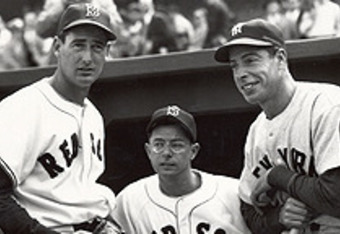
Ted Williams, Dom DiMaggio, Joe DiMaggio.

The Pennant race chronicled by Peter Golenbock in his book Dynasty: The New York Yankees, 1949-1964, and by David Halberstam in his book Summer of '49, is well and truly on.

October 1, 1949, Yankee Stadium. Believe it or not, the Yankees blew a 12-game lead, and trailed the Sox by 1 game with 2 to play -- and these 2 were against the Sox at The Stadium. The Yanks hold Joe DiMaggio Day, since his brother Dom plays for the Sox, and thus the whole family can attend. Joe has been ill with pneumonia, but has kept playing, and says, "I'd like to thank the Good Lord for making me a Yankee." (I guess he didn't have an agent back in 1934.)

The Sox, acting like more recent Red Sox teams, blow a 4-0 lead, Johnny Lindell hits an 8th-inning homer, and the race is tied. Yankees 5, Red Sox 4. In fact, in the 1901 to 1968 era of 2 single-division leagues, 1949 was the only season in which both leagues' races were unresolved as the final day of the regular season dawned.

October 2, 1949, Yankee Stadium. This is for the Pennant. The Yanks lead 1-0 in the 8th, when Joe McCarthy, managing the Sox after all those Pennants with the Yankees, relieves starter Ellis Kinder. Big mistake, as a Jerry Coleman double clears the loaded bases. But Vic Raschi falters a bit in the 9th, partly due to DiMaggio, still sick, dropping an easy fly ball. Normally so good out there, Joe walks off the field, taking himself out of the game.

The tying runs are on, the run that could win the Pennant is at the plate, and Yogi Berra goes out to talk to Raschi. "The Springfield Rifle" angrily says, "Gimme the goddamned ball, and get the hell out of here!" Yogi does as he's told, and Raschi gets the final out, as Birdie Tebbetts pops up to 1st base, and Henrich, playing out of position, catches it. Yankees 5, Red Sox 3.

The Yanks beat the Dodgers in the World Series. In the last 2 seasons, the Sox had won 192 games, and didn't even win a Pennant.

April 17, 1951, Yankee Stadium. The Yankees open the season at home against the Red Sox. Although it isn't obvious yet, it will be the final season for DiMaggio. It is the 1st season, and the 1st game, for Mickey Mantle -- who will also end up playing his last game against the Red Sox. His 1st at-bat is a groundout against Sox starter Mickey McDermott. This is also the debut as Yankee public address announcer for Bob Sheppard, who stays for 57 years.

In the 6th inning, Mantle gets his 1st hit and his 1st RBI, singling home Jackie Jensen against Bill Wight, helping the Yankees win 5-0. DiMaggio goes 1-for-4 with an RBI. Williams goes 1-for-3. Raschi pitches a shutout.
Joe DiMaggio, Mickey Mantle, Ted Williams

September 28, 1951, Yankee Stadium. The Yanks can clinch the Pennant with a win, and need just 1 more out. Even more, Allie Reynolds needs one more out for his 2nd no-hitter of the year. But who's at bat? Ted Williams. "The Superchief" gets "the Splendid Splinter" to hit an easy popup... which Yogi drops! Fortunately, it's in foul territory, but you don't give Ted Williams a second chance.

Incredibly, Ted pops it up again, and this time, Yogi catches it. Yankees 8, Red Sox 0. The Yanks go on to beat the Giants in the World Series.
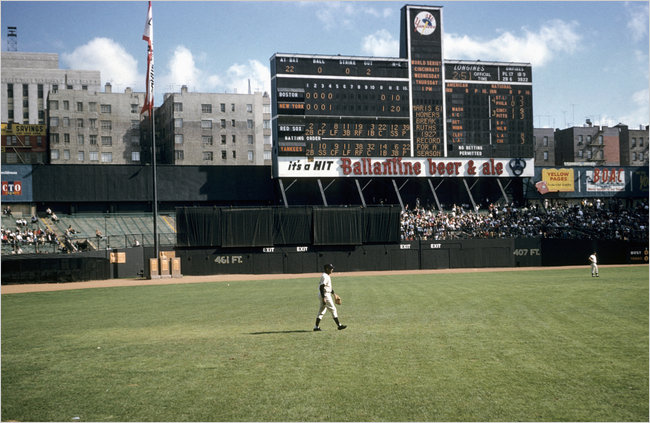
Yankee Stadium. Judging by the scoreboard, the green seats,
and the off-white outer wall, this has to be between 1959 and 1966.

Early in the 1952 season, Williams was called back into the Marine Corps for the Korean War, as he had been in World War II.  He would miss the rest of '52 and all but the last few weeks of '53, and by the time he came back the Red Sox "glory years" of 1946-51 were over, as most of the other good players had retired or been traded away.

The Yanks-Sox rivalry went dormant as a result, leading Boston Globe columnist Dan Shaughnessy, born in 1953, to later remark that it had become like a conversation between Humphrey Bogart and Peter Lorre in the film Casablanca, a script written by the grandfather and great uncle of future Sox general manager Theo Epstein:

Ugarte: "You despise me, don't you, Rick?"
Rick: "Well, if I gave you any thought, I probably would."

April 23, 1953, Yankee Stadium. For the 1st time in his career, Mantle hits a walkoff home run. It's a 3-run job off Ellis Kinder, and the Yankees beat the Red Sox, 6-3. They had led 3-1 after 8, but the Sox scored 3 in the 9th to tie it. Mickey won it.

April 14, 1955, Fenway Park. The Red Sox host the Yankees in their home opener, and win, 8-4. This game is notable as the major league debut of Elston Howard, who thus becomes the 1st black player for the Yankees in a regular season game. In the bottom of the 6th inning, he replaces Irv Noren in left field, and in his first at-bat, drives in Mickey Mantle with a single in the 8th.

At this time, there were still 3 major league teams that had not introduced a black player: The Philadelphia Phillies, the Detroit Tigers, and the Red Sox, who would be the last, with Elijah "Pumpsie" Green in 1959. 

September 16, 1955, Yankee Stadium. Yogi Berra is remembered as one of the best clutch hitters ever, and he backed that up with 7 walkoff home runs, including this one, also off Ellis Kinder, for a 5-4 Yankee win.

April 28, 1957, Yankee Stadium. Yogi does it against the Sox again, off Ike Delock in the 10th inning, giving the Yankees a 3-2 win.

September 5, 1957, Yankee Stadium. Bob Grim becomes the 2nd Yankee pitcher to hit a walkoff home run -- and the 2nd to do it against Boston. He decides Nixon's the one -- Willard Nixon, that is -- and homers off him to give the Yankees a 5-2 win.

September 3, 1958, Yankee Stadium. Yogi torments the Sox again. This time, the walkoff victim is Leo Kelly, and the Yankees win, 8-5.

October 2, 1960, Yankee Stadium. Dale Long is remembered for hitting home runs in 8 straight games in 1956 (with the Pittsburgh Pirates), and being one of baseball's rare lefthanded catchers in 1958 (with the Chicago Cubs). For the Yankees, he hits a walkoff homer against Arnold Early of the Red Sox.

It had been exactly 11 years since the Yankees had won a Pennant by beating the Sox, and it would be exactly 18 years later that Sox fans would come to hate Bucky Dent.

Ted Williams had made his last appearance for the Sox in their home finale on September 28, hitting a home run, the 521st of his career, in his last at-bat.

October 1, 1961, Yankee Stadium. The Yankees beat the Red Sox 1-0. The only run of the game comes in the 4th inning, on a home run by Roger Maris. It is Maris' 61st home run of the season, breaking the record that Babe Ruth set in 1927.
The Yankee Stadium scoreboard, right after Maris' 61st

July 7, 1966, Yankee Stadium. The Mick strikes again, with his 10th career walkoff home run, off Don McMahon, a relief pitcher who gave the Yankees trouble with the Milwaukee Braves in the 1957 and '58 World Series. The Yankees win, 5-2, and the winning pitcher, as 1960s Yankee pitcher Jim Bouton would say, was "Dooley Womack. The Dooley Womack!"

September 10, 1966, Fenway Park. Roger Maris turns 32, and hits a home run, the 4th Yankee to do so on his birthday. The Yankees win 5-1.

By this point, the Yankees had collapsed, but no one knew that, in the following season, the Sox were in for the defining season in their history, the one that took them from an afterthought -- and very nearly moved, at least out of Fenway Park, possibly to the suburbs, maybe out of the Boston area altogether -- to being New England's most beloved sports team.

Part III follows.

Yankees vs. Red Sox, The Defining Moments, Part I, 1903-1938

In commemoration of the start of the Yankees-Red Sox series in London tomorrow afternoon, I reprint and update a series of posts that I first wrote in April 2010.

May 7, 1903, Huntington Avenue Grounds, Boston. For the 1st time, the New York and Boston franchises of the American League play each other. The result is a 6-2 win for the Boston Americans (a.k.a. the Boston Pilgrims, the Boston Puritans, or, for their owner, Charles Somers, the Boston Somersets) over the New York Highlanders (a.k.a. the New York Hilltoppers, the New York Americans, or, for manager-pitcher Clark Griffith, the New York Griffins).

The New York team's name was awfully long, and tough to fit into a newspaper headline. But George M. Cohan's musical Little Johnny Jones would debut on Broadway in 1904, and its signature song (along with "Give My Regards to Broadway"), "Yankee Doodle Dandy," would become the Theodore Roosevelt era's equivalent of a Number 1 hit.

Since the Highlanders were in the American League, it was an easy jump from "Americans" to "Yankees," which could fit in a headline -- and, to the papers' delight, could be further shortened to "Yanks."

In 1907, the Boston team would adopt the name formerly used by the city's National League team, the Red Stockings, but shorten it to Red Sox. This was also done in Chicago: The NL team we know as the Cubs started out as the White Stockings, and the AL team became the White Sox.
Huntington Avenue Grounds, during the 1903 World Series

May 8, 1903, Huntington Avenue Grounds. The Highlanders win the 2nd game between the teams, 6-1.

June 1, 1903, Hilltop Park, Manhattan. For the 1st time, they play each other in New York. Boston also wins this one, 8-2, and will sweep a 3-game series. The Highlanders will finish 4th, while the Sox-to-be will win the Pennant, and then win the 1st-ever World Series by beating the Pittsburgh Pirates.
Hilltop Park

October 10, 1904, Hilltop Park. The 1st great race between the franchises ends in a doubleheader. The Highlanders of Clark Griffith, Jack Chesbro and Willie Keeler need to sweep to win the AL Pennant against the defending World Champions, led by 3rd baseman-manager Jimmy Collins and pitcher Cy Young.

Chesbro won 41 games for the Highlanders that season, likely to forever remain a record from the 60 feet, 6 inches pitching distance. But he's more remembered for the 1st game of this twinbill, which he lost, when his wild pitch allowed the winning run to score in the 9th. Red Sox 3, Yankees 2.
Before the Red Sox, Cy Young pitched for
a National League team named the Cleveland Spiders.

The NL Champion New York Giants, already terrified of the prospect of losing New York to the Highlanders, had announced that they would not play the AL Champs. This is the only time the World Series has ever been forfeited, although the Red Sox are not allowed to officially call themselves "1904 World Champions." (Which would give them 9 World Championships, not 8 -- 3 of which, of course, are illegitimate.)

April 20, 1912, Fenway Park, Boston. The Back Bay ballyard officially opens. Mayor John F. "Honey Fitz" Fitzgerald, grandfather of 3 U.S. Senators, one of whom went on to become President, throws out the ceremonial first ball. The game goes 11 innings, and the home team wins. Red Sox 7, Yankees 6.
The Yanks go on to lose 102 games and finish last, something they've done only twice since. The Red Sox go on to win the World Series.

June 24, 1914, Polo Grounds, New York. Roy Hartzell is not remembered as a Yankee hero today, but the 3rd baseman and outfielder batted .296 with 91 RBIs in 1911. On this date, he did something only done twice before by any player in a Yankee uniform: He hit what would now be called a walkoff home run. He hit it off Red Sox starter Hugh Bedient, giving the Yankees a 3-2 victory.

Previously, Willie Keeler had done it against the Washington Senators in 1905, and Frank LaPorte against the Philadelphia Athletics in 1906.

After 10 seasons at Hilltop Park, which included a brief loan to the New York Giants while the Polo Grounds was rebuilt after a 1911 fire, the Giants returned the favor, and offered the Yankees a 10-year lease at the much-larger new Polo Grounds.
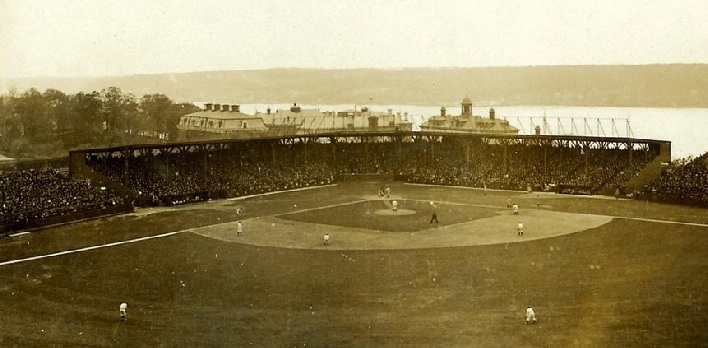
The Polo Grounds, as it looked during the Yankees' tenure, 1913-22

I was able to find a list of all Yankee walkoff home runs, now updated through Neil Walker's valedictory against the Sox on August 28, 2018. but not a corresponding list for the Red Sox. You would think that someone, somewhere, would have, at the very least, compiled a list of Sox walkoff homers just against the Yankees. If there is such a list somewhere, let me know in the Comments section.

May 6, 1915, Polo Grounds. The Yankees beat the Red Sox in 13 innings, 4-3. The losing pitcher was a rookie from Baltimore. But that rookie did hit his 1st major league home run in this game, having previously had 8 at-bats this season and 10 the year before. The Yankee who gave it up was named Jack Warhop. The Boston rookie? Their pitcher that day: George Herman "Babe" Ruth.
Yeah, that Babe Ruth.

Damon Runyon, the great sportswriter whose writings on New York City street life would one day form the basis for the musical Guys and Dolls, wrote this at the time: "Fanning this Ruth is not as easy as the name and the occupation might indicate. In the third inning, Ruth knocked the slant out of one of Jack Warhop's underhanded subterfuges, and put the baseball in the right field stands for a home run. Ruth was discovered by Jack Dunn in a Baltimore school a year ago where he had not attained his left-handed majority, and was adopted and adapted by Jack for use of the Orioles. He is now quite a demon pitcher and demon hitter when he connects."

November 2, 1916, Fenway Park. Joseph Lannin sells the Red Sox to Harry Frazee, who would own the Red Sox until 1923. He liked baseball, but he loved musical theater, and he owned the Longacre Theater in New York. His office was in the same 42nd Street building as the Yankees' offices. (Most teams did not have their offices in their ballparks until decades later.) This would be very significant over the next few years.
Harry Frazee

April 11, 1917, Polo Grounds. The Yankees and Red Sox open the season against each other. Dick Hoblitzell hits a home run, Babe Ruth goes this distance while going 1-for-4, and the Red Sox win 10-3.

April 24, 1917, Fenway Park. A sloppy game sees 3 errors by the Yankees, 4 by the Red Sox, 1 of those making the difference in the top of the 9th inning, as the Yankees win 2-1. The Sox run scores on an error, not a hit, because George Mogridge becomes the 1st Yankee pitcher to throw a no-hitter -- as a lefthander at Fenway Park, no less.

July 30, 1919, Times Square, New York. Frazee trades pitcher Carl Mays to the Yankees for Bob Russell, Allen McGraw (neither of whom ever did much for either club) and $40,000. There was a hell of a to-do about this, as Mays had jumped the Sox and was suspended, and, at the time, the rules said you couldn't trade a suspended player.

This trade pretty much split the American League: Frazee, Yankee owner Jacob Ruppert, and Chicago White Sox owner Charlie Comiskey were on one side; on the other were AL founder and President Ban Johnson and the owners of the other 5 clubs. They were the brothers John and Ben Shibe and Connie Mack of the Philadelphia Athletics, former Yankee manager Clark Griffith of the Washington Senators, Frank Navin and Walter Briggs of the Detroit Tigers, Phil Ball of the St. Louis Browns, and Sunny Jim Dunn of the Cleveland Indians.

The National Commission, which oversaw baseball in those days, ruled in favor of Frazee and Ruppert, and Mays became the 1st major player to go from Frazee's Sox to Ruppert's Yanks. There would be more.
Carl Mays

On August 16, 1920, the Yankees played the Cleveland Indians at the Polo Grounds. Mays hit Indian shortstop Ray Chapman in the head with a pitch. It bounced back to him, and he threw to 1st base, acting as though he thought Chapman had actually hit the ball. But Chapman was taken to a hospital, and died the next day.

Chapman was already widely disliked, including by his teammates, first in Boston (a big reason why he was traded), then in New York. The community of baseball wanted to believe that he had hit Chapman on purpose. He lived another 51 years, insisting that he hadn't.

Nevertheless, Chapman remains the only player who can be definitively said to have died as a result of playing in a Major League Baseball game, and, with statistics saying Mays should probably be in the Hall of Fame, it is probably the only reason he isn't.

December 26, 1919, Times Square. As a result of the Mays contretemps, Frazee, Ruppert, and Comiskey could pretty much now only make deals with each other, as the other 5 AL owners wanted nothing to do with them.

Due to circumstances that Frazee should have been able to control, but didn't, he had to get rid of Babe Ruth, who, in 1918 and '19, had gone from being baseball's best lefthanded pitcher to being the biggest power hitter in the game.

So he sold the Babe to the Yankees, mainly because Ruppert was willing to pay $125,000 (about $1.68 million in today's money) for Ruth's contract; while the other possibility, the White Sox, were run by Comiskey, a notorious cheapstake. (His parsimony led to a problem with that year's World Series, as you may be aware.)
The rest is history... and myth.

So if you're a Red Sox fan, don't blame Frazee for what happened: He didn't have much choice, unless he wanted the press and the public to think Ruth was running the team. From 1918 to the present... Yankees 27, Red Sox 0. Without cheating, anyway.
Yankee owner Jacob Ruppert,
manager Miller Huggins, and slugger Babe Ruth

December 15, 1920, Times Square. Another big trade that helped the Yanks and hurt the Sox. Ruppert sent 4 players, including the decent Del Pratt and Muddy Ruel, to Boston, and perhaps gave up too soon on both of them.

But in return, he got 4 players. Harry Harper and Mike McNally didn't matter much. The other 2 players did. One was Wally Schang. Had there been an All-Star Game at the time, Schang would have been the AL catcher just about every season from 1914 (with the A's) until 1924.

The other was pitcher Waite Hoyt. Only 21 at the time of the trade ,and a native New Yorker (a graduate of Erasmus Hall High School in Brooklyn), Hoyt hadn't done much for the Sox, who gave up him way too soon. He became a Hall of Fame pitcher for the Yankees. Later, he became a beloved broadcaster for the Cincinnati Reds, often telling stories about his days with Ruth and his other Yankee teammates.
Waite Hoyt

This trade wouldn't have been nearly so bad for the Sox if they'd kept Ruel. But in 1923, in one of his last deals, Frazee traded him to Griffith's Senators, and he was the catcher on the Senators' 1st 2 Pennants, 1924 and '25. Pratt at least gave the Sox .300 averages and 188 RBIs in his 1st 2 seasons with them, so it wasn't a total loss. But this was a bonehead trade for Boston.

June 29, 1921, Polo Grounds. Roger Peckinpaugh -- a decent infielder but not known as much of a hitter -- homers in the bottom of the 10th, to give the Yankees a 5-3 win. The winning pitcher for New York: A former Red Sock named Carl Mays. The losing pitcher for Boston: A future Yankee named Bullet Joe Bush.

April 18, 1923, Yankee Stadium, Bronx. The 1st game in the big ballpark, and, depending on whose figures you believe, there were anywhere from 58,000 to 74,218 on hand, with enough people kept outside to push it to 100,000 had there been enough seats.

Governor Alfred E. Smith of New York threw out the ceremonial first ball, and John Philip Sousa conducted the U.S. Marine Band in playing "The Star-Spangled Banner." (In those days, it was played only on special occasions. Not until 1931 did the song become the National Anthem, and not until World War II was it played before every game.)
Babe Ruth said, "Some ball yard," and, "I'd give a year of my life to hit the first home run here." He only lived to be 53, but he did hit the 1st homer in the house. Bob Shawkey outdueled Howard Ehmke. Yankees 4, Red Sox 1.

Shawkey was brought back to throw out the first ball when The Stadium reopened after its 1973-76 renovation. Look up the 1929 World Series to find a nice story about Ehmke.

The Yanks go on to beat the Giants, to win their 1st World Series. Of their 25 players, 11 had been members of the Sox' last World Championship in 1918, including starting pitchers Waite Hoyt, Bullet Joe Bush and Sad Sam Jones. It was trading away the pitching, much more than selling Ruth, that should have earned Frazee the ire of Boston fans.

August 2, 1923, Fenway Park. On the same day that President Warren G. Harding dies, Frazee sells the Red Sox to Bob Quinn. Frazee's musical No, No, Nanette would open on Broadway 2 years later, and the Ruth sale had nothing to do with it -- although it may have helped finance a nonmusical play upon which it was based.

Frazee died in 1929 from nephritis, or Bright's disease, a kidney disorder that was fatal within 5 years of diagnosis then, but is treatable today. Nonetheless, he remains the most hated man ever associated with Boston sports. And not fairly.

April 18, 1929, Yankee Stadium. For the 1st time, the Yankees take the field wearing numbers on the backs of their uniforms. Other teams had experimented briefly, usually on the sleeves. With the Yankees, it is permanent.

At first, it is by place in the batting order: 1, center fielder, Earle Combs; 2, 3rd baseman, but usually a shortstop, Mark Koenig; 3, right fielder, Babe Ruth; 4, 1st baseman, Lou Gehrig; 5, left fielder, Bob Meusel; 6, 2nd baseman, Tony Lazzeri; 7, the shortstop on this day, future managing legend Leo Durocher; 8, catcher, Johnny Grabowski. The Yankees had a platoon behind the plate, so 9 was catcher Benny Bengough, and 10 was rookie catcher Bill Dickey, who would become the starter the next season, and wear 8 full-time for the rest of his playing career.

The pitchers were assigned numbers according to seniority: 11, Herb Pennock; 12, Waite Hoyt; 13 was considered a bad-luck number, and wasn't given out; 14, George Pipgras; 15, Hank Johnson; 16, Tom Zacahary; 17, Fred Heimach; 18, Wilcy Moore; 19, Ed Wells; 20, Myles Thomas.

Then came backup position players and coaches: 21, veteran outfielder George Burns (no relation to the entertainer of the same name); 22, Gene Robertson; 24, Lyn Lary; 25, Ben Paschal; 26, Cedric Durst; 27, Sammy Byrd; 28, Elias "Liz" Funk; 29, former pitcher, now coach, Bob Shawkey; 30, Francis "Bots" Nekola; 31, Roy Sherid; 32, Art Jorgens; 33, coach Charley O'Leary; 34, coach Art Fletcher. Manager Miller Huggins was not assigned a number: The lowest numbers not given out were 13 and 23.

The Yankees play the Red Sox, and win 7-3. Ruth and Gehrig both hit home runs, and Pipgras and Heimach combine for the win. By the 1932 season, all 16 teams then in Major League Baseball will have adopted uniform numbers. Most football and hockey teams had already done so before 1929.

June 18, 1929, Yankee Stadium. Gehrig turns 26, and hits a home run. He becomes the 1st Yankee to hit a home run against the Sox on his birthday. The Sox win anyway, 7-4.

May 6, 1930, Fenway Park. Can't blame this one on Frazee, a year dead and 7 years gone from team management: The Sox trade pitcher Charles "Red" Ruffing to the Yankees for Cedric Durst and $50,000. Ruffing was 39-96 for some bad Boston teams; he would go 231-124 for the Yankees, that win total topped in a Yankee uniform, so far, only by Whitey Ford with 236. (Andy Pettitte got close, with 219.)
Vernon "Lefty" Gomez and Charles "Red" Ruffing,
the Yankees' lefthanded and righthanded aces from 1930 to 1942

How good was Durst? He batted .245 for the Sox the rest of the season, and he never appeared in the majors again. This wasn't about Durst: This was about the cash, as the Great Depression was underway, and the Sox did not have a rich owner. That would change within 3 years.

February 25, 1933, Fenway Park. Quinn sells the Sox to Tom Yawkey, the son of a former part-owner of the Detroit Tigers, who had recently turned 30, allowing him to inherit a lumber mill fortune that, proportionately speaking, made him richer then than George Steinbrenner would ever be.

Told by Tiger legend Ty Cobb -- William and Tom Yawkey were 2 of Cobb's few real friends -- that the Tigers were not for sale, but that the Red Sox might be, Yawkey jumped. For the next 43 years, he would do exactly what Steinbrenner would be criticized for: Trying to buy a championship. He failed. The Sox would win 3 Pennants while he was alive and running them, and a 4th while his widow owned them, but would lose the World Series in the deciding Game 7 all 4 times.

June 6, 1933, Yankee Stadium. The Yankees sweep a doubleheader, 4-0 and 8-4. Dickey turns 26, and becomes the 2nd Yankee to hit a home run against the Red Sox on his birthday.

April 14, 1933, Yankee Stadium. Ruffing, a very good hitter for a pitcher, hits a walkoff home run, a grand slam, and the Yankees win, 6-2. This is the 1st walkoff homer hit by a Yankee pitcher.

August 12, 1934, Fenway Park. A doubleheader is split, with the Red Sox winning the opener 6-4, and the Yankees taking the nightcap 7-1. Babe Ruth goes 2-for-6 with 2 walks over the 2 games.

When Ruth is replaced in left field by Sammy Byrd -- who replaced the Babe so many times in the early 1930s, he was known as Babe Ruth's Legs -- the 46,766 fans who crammed into Fenway give him a standing ovation, suspecting -- correctly, as it turned out -- that this would be his last visit as an active player. Boston fans never held it against the Babe that he was sold, and he always appreciated them in return.

September 8, 1937, Yankee Stadium. Lou Gehrig hits a 3-run homer in the bottom of the 9th, and the Yankees beat the Red Sox, 9-6. It is the 3rd and last walkoff home run of Gehrig's career. Babe Ruth had 11, and Joe DiMaggio 4, but neither ever did it against the Sox.

Part II follows.

Thursday, June 27, 2019

How to Be a Red Bulls Fan In Houston -- 2019 Edtion

This Wednesday night, the New York Red Bulls will play away to the Houston Dynamo.

The Dynamo are a hard team to watch. Not for their style, or the results, but their uniforms. Retina-burning orange. Even the Dutch national team's uniforms aren't that bright an orange.

Before You Go. The heat is often a problem, since, unlike Houston's baseball, football and basketball teams, the soccer team plays open to the elements. Certainly, it will be warmer in Houston than in New York and New Jersey at this time of year. The Houston Chronicle is predicting high 80s for Wednesday afternoon, high 70s for gametime, and scattered thunderstorms all game, possibly even for during the game.

So, if you've been to a Dynamo game before, you might want to skip it this time. If you haven't been, maybe this is one roadtrip where you should wait 'til next year.

Houston is in the Central Time Zone, so you'll be an hour behind New York time. Although Texas was a Confederate State, you won't need to bring your passport or change your money.

Tickets. The Dynamo averaged 16,906 fans per home game last season, down about 600 from the season before. However, this being soccer, it wouldn't matter if they averaged a sellout (22,039), because MLS teams always set aside tickets for visiting fans.

The Dynamo put visiting fans in at the top of Section 230, in the stadium's southeast corner. Tickets are just $15, as cheap as it gets in MLS.

Getting There. It's 1,629 miles from Times Square in New York to downtown Houston, and 1,619 miles from Red Bull Arena to BBVA Compass Stadium. You're probably thinking that you should be flying.

Keep in mind, the day after this game will be the 4th of July, which could cause ticket availability to go down, and prices to go up.

Flying from Newark to Houston George Bush Intercontinental Airport (That's named for the father, not the son) can be done for under $700, nonstop on United Airlines. Bus 102 will get you to downtown Houston in about an hour and 20 minutes.

There are 2 ways to get there by train. One is to change trains in Chicago, and then change to a bus in Longview, Texas. The other is to take Amtrak's Crescent out of Penn Station in New York at 2:15 PM Eastern Time 2 days before you want to arrive, arrive at Union Station in New Orleans at 7:32 PM Central Time the day before you want to arrive, stay in New Orleans overnight, and then transfer to the Sunset Limited at 9:00 AM, and arrive in Houston at 6:18 PM. (In other words, about an hour before kickoff.) The station is at 902 Washington Street, a mile and a half west of the stadium.

No, I'm not making any of that up. And it would cost a whopping $903 round-trip, noticeably more than flying. You don't want that, so let's just forget Amtrak, and move on.

Greyhound takes about 42 hours, requires changing buses at least twice, and $679 round-trip, although it can drop to as little as $436 with advanced purchase. You're better off spending a little extra and flying. The Houston Greyhound station is at 2121 Main Street, a mile and a half southwest of the stadium.

If you actually think it's worth it to drive, get someone to go with you, so you'll have someone to talk to and one of you can drive while the other sleeps.

You'll be taking Interstate 78 across New Jersey and into Pennsylvania to Harrisburg, where you'll pick up Interstate 81 and take that through the narrow panhandles of Maryland and West Virginia, down the Appalachian spine of Virginia and into Tennessee, where you'll pick up Interstate 40, stay on that briefly until you reach Interstate 75, and take that until you reach Interstate 59, which will take you into Georgia briefly and then across Alabama and Mississippi, and into Louisiana, where you take Interstate 12 west outside New Orleans. Take that until you reach Interstate 10. Once in Texas, Exit 770 will get you to downtown Houston.

If you do it right, you should spend about an hour and a half in New Jersey, 3 hours in Pennsylvania, 15 minutes in Maryland, half an hour in West Virginia, 5 and a half hours in Virginia, 3 hours and 45 minutes in Tennessee, half an hour in Georgia, 4 hours in Alabama, 2 hours and 45 minutes in Mississippi, 4 hours and 30 minutes in Louisiana and 2 hours in Texas. Including rest stops, and accounting for traffic, we're talking about a 40-hour trip.

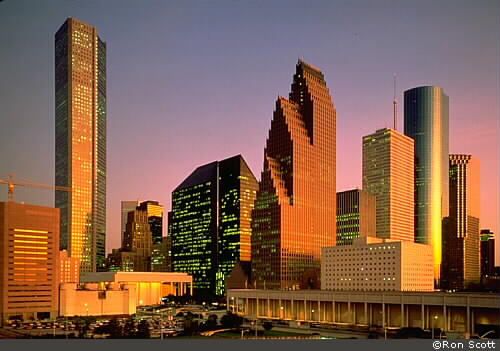
Once In the City. Houston was founded in 1836 as Allen's Landing, and was renamed for Sam Houston, "the Father of Texas." There are 2.2 million people in the city proper, making it the 4th-largest in America, and 6.2 million in the metropolitan area, making it 5th.

The weather in Houston is so bad! (How bad is it?) A "bayou" (BYE-yoo) is a body of water, typically found in a flat, low-lying area, and can be either an extremely slow-moving stream or river, often with a poorly-defined shoreline, or a marshy lake or wetland. And Houston is known as the Bayou City.

When people talk about "the bayou," they usually mean Louisiana. But Southeast Texas is also bayou country, and it frequently leaves Houston hot, humid and muggy. It's a breeding ground for mosquitoes. The Astrodome had to be built not just to promote Houston, or to protect people from the heat, but to protect them from the bugs. Sandy Koufax of the Los Angeles Dodgers said, "Some of those mosquitoes are twin-engine jobs."

Fortunately, just as there's an overhead walkway system in Minneapolis, and an "Underground City" in Montreal, in their cases to protect pedestrians from their cities' notoriously cold Winter, there is a "Houston Tunnel System," begun in the 1930s, and inspired by New York itself, by the system under Rockefeller Center. Regardless of how much this may help, remember to stay hydrated.

The sales tax in the State of Texas is 6.25 percent, but in the City of Houston it goes up to 8.25 percent. The city doesn't appear to have a "centerpoint," where the address numbers start at 1, but there is a Main Street, running northeast/southwest. ZIP Codes in the Houston area start with the digits 77. The Area Codes are 713, with 281, 346 and 832 as overlays.

Houston has not 1, not 2, but 3 beltways: Interstate 610, a.k.a. the Inner Loop; Beltway 8, a.k.a. the Sam Houston Tollway; and State Highway 99, a.k.a. the Grand Parkway.

Like most Texas cities now, Houston has a Hispanic plurality, if not yet a majority: 44 percent. It's about 26 percent white, 24 percent black, and 6 percent Asian. It's mostly white on the west side; mostly black on the south, northwest and northeast sides; and mostly Hispanic on the north, east and southeast sides.

Houston, and South Texas, have had some racial disturbances. On August 13, 1906, in Brownsville on the Rio Grande (the border between Texas and Mexico), a white bartender was killed and a Hispanic policeman was wounded by gunshots. The blame fell on a segregated unit of black soldiers at nearby Fort Brown.

Following a U.S. Army Inspector General's report, President Theodore Roosevelt, in his role as Commander-in-Chief, ordered dishonorable discharges for 167 of those soldiers, costing them pensions and the right to serve in federal service jobs. This is a blot on TR's record, and in 1972, President Richard Nixon pardoned them and rewrote their discharges as honorable.

There were 21 deaths in a riot in Houston on August 23, 1917, when members of the all-black 24th United States Infantry Regiment at Camp Logan fought back against the all-white Houston Police Department. After a series of courts-martial that could only have been a kangaroo court, there were 19 executions, and 41 soldiers were sentenced to life imprisonment.

There was a race riot in Beaumont, about 85 miles east of Houston, on June 15, 1943, with 3 deaths. On May 17, 1967, there was a riot on the campus of the historically-black Texas Southern University, leading to the death of a police officer and the arrests of 500 students. But once it was found that the officer had died from "friendly fire," the ricochet of a fellow officer's bullet, all charges against the students were dropped. And there was a race riot in the Moody Park neighborhood of north Houston on May 7, 1978, with no deaths.

There is a light rail system, called METRORail, but you probably won't need it to get from a downtown hotel to the ballpark. One zone is $1.25, and the price rises to $4.50 for 4 zones, so a daypass is a better bargain at $3.00.
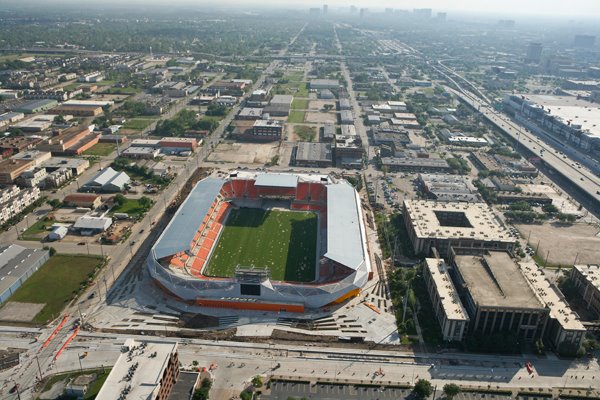
Going In. BBVA Compass Stadium, its naming rights bought by a Spain-based banking corporation, is in the East of Downtown neighborhood, or EaDo, separated from Downtown Houston by Interstate 69, the Southwest Freeway. The mailing address is 2200 Texas Avenue. Parking is $20. It is served by the EaDo/Stadium METRORail station.
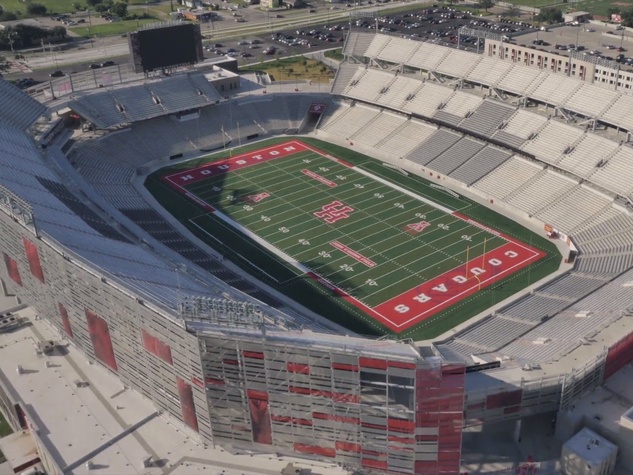
Opening in 2012, the stadium nicknamed "The Oven" is also home to the Houston Dash of the National Women's Soccer League. It is also the home field of the football team at Texas Southern University, which won the National Championship of black college football in 1952 and 2010. This makes the Dynamo 1 of 2 MLS teams groundsharing with a college football team. The University of Houston played football there in 2013, while their new stadium was built on the site of their old one.
Despite the "pub culture" of soccer, this is Texas, this is the South, and the Dynamo organization is one of the few in MLS that actively encourages tailgate parties. They set aside Lot B and Lot C for fans who want to tailgate. (The Red Bulls allow it, but there's a difference between allowing and encouraging. It's part of the culture in the South.)

The field has always been real grass, and is aligned north-to-south -- well, northeast-to-southwest, anyway. It's hosted 10 men's international matches, including a U.S. draw with Canada on January 13, 2013, and a 1-1 U.S. draw with Chile on March 26, 2019; and 2 women's international matches, both U.S. wins: Over China on December 12, 2012, and over Mexico on April 8, 2018. The stadium hosted 2 games in the CONCACAF Gold Cup in 2013, 2017 and this year.

UPDATE: The USMNT played there again on March 26, 2019, a 1-1 draw in a friendly with Chile. It hosted 6 games of the 2021 CONCACAF Gold Cup. And it is now named PNC Stadium.
Food. Being a "Wild West" city, you might expect Houston to have Western-themed stands with "real American food" at its stadiums. Being a Southern State, you might also expect to have barbecue. Being in South Texas, you might expect Mexican food. And you would be right on all counts.

They have Texas Fare at Sections 105, 110, 117 and 136; Pizza on the Pitch at 107 and 138; Taqueria Los Anaranjados (Spanish for "the Orange Ones") at 115 and 135; Extreme Dogs & Nachos at 122; Bayou City BBQ at 125 and 133; and Far Post & East End Grill at 127 and 139;

Team History Displays. The 1996 MLS charter club version of the San Jose Earthquakes (replaced there in 2008) moved to Houston for the 2006 season, and, in shocking fashion -- shocking not just for the bright orange jerseys -- won the next 2 MLS Cups. They also won Conference Championships in 2011 and 2012, although they lost the MLS Cup Finals on those occasions. And they won the 2018 U.S. Open Cup.
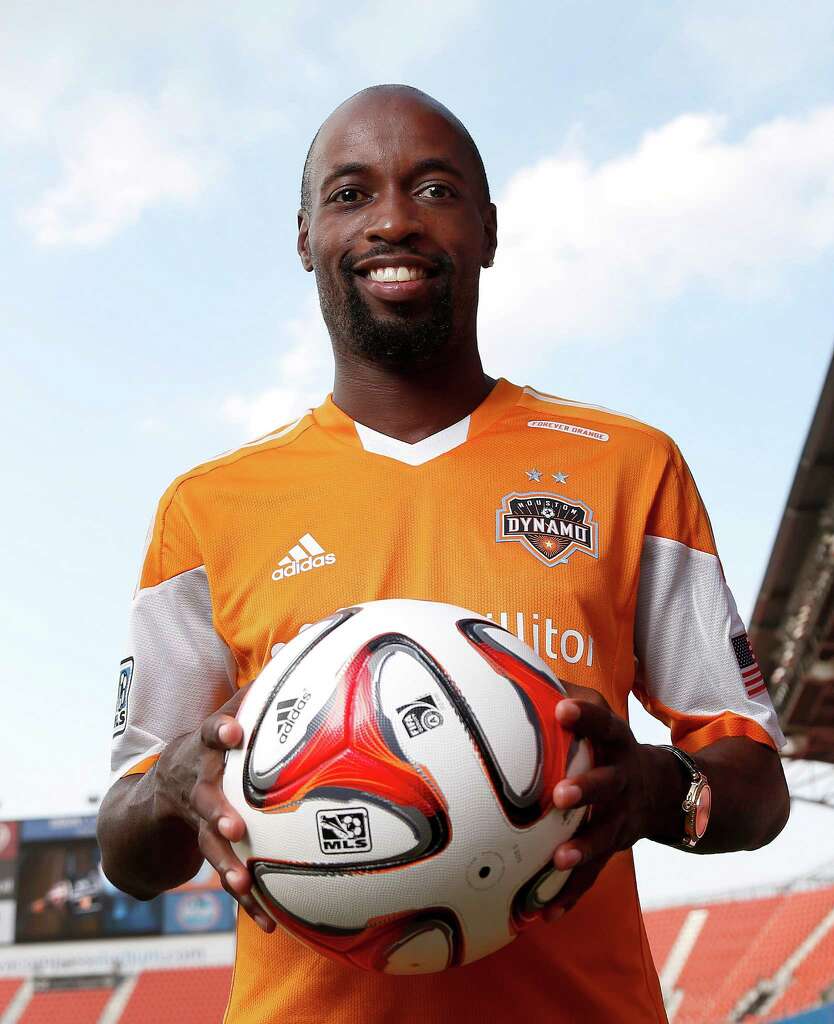
The Dynamo hang banners for their titles under the roof at the south end. They do not have any retired numbers, or a team hall of fame. Nor did they announce a 10th Anniversary Team in 2016. Probably their greatest legend, still with them at age 37, is U.S. national team mainstay DaMarcus Beasley. He's helped the national team win 4 CONCACAF Gold Cups, the 1st of them 17 years ago.
They also contest the Texas Derby with FC Dallas, and have won it 7 of the 13 times it's been played. In total games, it couldn't be much closer: Dallas 14 wins, Houston 13, 13 ties, and Dallas leads in goals 60-59. The seasonal winner gets a trophy named El Capitán, a replica 18th Century mountain howitzer cannon.
El Capitán, at The Oven

And they annually run the Dynamo Charities Cup, a friendly against a club form another country, usually in the middle of the MLS season so that the opposition won't have to interrupt its own league season. They beat Monterrey of Mexico in the inaugural match in 2009, C.D. Águila of El Salvador in 2010, Stoke City of England in 2013, Santos Laguna of Mexico in 2015, and Real Sociedad of Spain on penalties in 2016; while losing to Bolton Wanderers of England in 2011, Valencia of Spain in 2012, Aston Villa of England in 2014, and Mexican teams Cruz Azul in 2017 and Monterrey in 2018.
Brad Davis and Bobby Boswell with the Dynamo Charities Cup

Stuff. The Soccer Shop is located opposite Section 114 on Texas Avenue, toward the northwest corner of the Stadium, and is open for up to one hour before gates open. Fans must have a valid ticket to enter on matchdays. Whether they go along with the Western/Texas theme and sell cowboy hats with the team logo on them, I don't know.

Last year, Bonnie Hinman published the Dynamo's book in MLS' team series. There are commemorative DVDs for their 2006 and 2007 MLS Cup seasons.

During the Game. If you were wearing Dallas Cowboy gear to a Houston Texans game, or Texas Longhorns gear to a Texas A&M Aggies game (or vice versa), or FC Dallas gear to this stadium, you might be in trouble. But Dynamo fans aren't especially hostile to New Yorkers, so safety shouldn't be an issue.

Knock, knock. "Who's there?" Orange. "Orange who?" Orange you glad whoever designed the Dynamo's uniforms didn't design your team's uniforms? They're so orange (How orange are they?), they make the Dutch national team look like men in gray flannel suits! The Dynamo even have "Forever Orange" as one of their slogans. So if you don't antagonize anyone, and you keep hydrated so you don't overheat, the greatest danger at a Houston Dynamo match will be to your retinas!

Upon the move from San Jose, the club was originally named Houston 1836, in a nod to German sports clubs naming themselves after their year of founding. Before the large influx of Mexicans and other Hispanics, Germans were the largest ethnic group in Houston.

Obviously, this soccer team wasn't founded in 1836 -- no existing professional sports team, anywhere in the world, goes back that far -- but the City of Houston was, so it seemed like a good idea at first. But the new team's original fan base, with perhaps a plurality of Mexican-Americans, was infuriated: For them, 1836 was the year that Mexico lost Texas.

So the name was changed. But while "Dynamo" is a name that suggests power, it was also the name of several teams founded by Communist countries for the "company teams" of their secret police units, including in Moscow, East Berlin, Kiev, Tblisi, etc. How did that go over in right-wing Texas? For once, the State's penchant for ignorance helped: Nobody seemed to notice the similarity.

A Mexican citizen named Gabriel Brener is the majority owner of the club, but boxing legend Oscar De La Hoya is a part-owner. The club accepts applications for National Anthem singers, rather than having a regular do it. Unlike most MLS clubs, they have cheerleaders (this is Texas, after all), known as the Dynamo Girls. Their mascot is a fox named Dynamo Diesel, who looks suspiciously like the Car Fox character from the Carfax commercials. And the Dynamo are promising postgame fireworks.
Dynamo Diesel flanked by his pals,
the Astros' Orbit and the Texans' Toro

The main Dynamo supporters groups all sit in the North End, or La Zona Naranja (The Orange Zone), Sections 215, 216 and 217. They include the Texian Army, named for the army that won Texas' independence from Mexico in 1836 (that name doesn't seem to have offended Hispanic locals); La Bateria (The Battery); the Brickwall Firm; and El Batallón (The Batallion).
"Forever Orange"

Many of their songs are in Spanish, including the standby used by the Red Bulls and many others: "¡Vamos, vamos Houston, esta noche, tenemos que ganar!" (Let's go, let's go Houston! This night, we have to win!)

One unpleasant side of Dynamo support was homophobic remarks made on one of the groups' Twitter feeds in the Spring of 2013. They have since accepted the backlash, and cut that stuff out.

After the Game. Houston is a comparatively low-crime city, and not a city known for having particularly nutty fans. As long as you behave yourself, they'll probably behave themselves, win or lose.

Lucky's Pub appears to be the go-to bar for New Yorkers living in the Houston area. It is at 801 St. Emanuel Street at Rusk Street, a block west of the stadium. Stadia Sports Grill, supposedly a haven for Jets fans, is at 11200 Broadway Street in Pearland, but that's 15 miles south of the ballpark.

If your visit to Houston is during the European soccer season (the day after this match will be the season-closing UEFA Champions League Final), and you want to watch your favorite club play, you can do so at the following locations:

* Arsenal: Jack and Gingers, 2416 Brazos Street, just south of downtown. Bus 82.

* Liverpool: Hugh O'Connor's, 7620 Katy Freeway, about 6 miles northwest of downtown. Bus 85.

* Manchester United, Aston Villa and Barcelona: The Richmond Arms, 5920 Richmond Drive, 8 miles west of downtown. Bus 20 to Sage Road & San Felipe Road, then transfer to Bus 32 to Fountainview Drive at Richmond Drive.

* Everton, Manchester City and Celtic: The Phoenix Brewpub, 1915 Westheimer Road at McDuffie Street, about 3 miles southwest of downtown. Bus 82 to Westheimer at Hazard.

* Chelsea and Real Madrid: King's Court Bar & Kitchen, 903 Hutchins Street, across from the stadium's south end.

* Newcastle United: The Backyard Grill, 9453 Jones Road, 18 miles northwest of downtown. No public transit on weekends.

* Tottenham Hotspur and Bayern Munich: BarMunich, 2616 Louisiana Street at Dennis Street, just south of downtown. Light Rail to McGowen. If you can't find your favorite club listed here, this place is probably the best choice, because of its early opening.

* Italian teams: Nick's Place, 2713 Rockridge Drive, at Westheimer Road, about 12 miles west of downtown. Bus 82 to Westheimer & Westerland. Be warned, New York soccer fan: This is also listed as the home base of New England Patriots fans, thus probably also Boston Red Sox fans. Things could turn nasty.

Sidelights. On November 30, 2018, Thrillist published a list of "America's 25 Most Fun Cities," and Houston came in 18th. Houston's sports history isn't all wrapped up in the Astrodome. There are other sites worth checking out.

The Dynamo's 1st home, from 2006 to 2011, was Robertson Stadium. They had their 2006 and 2007 championship seasons there, although they didn't play the MLS Cup Finals there. In 2006, they beat the New England Revolution at Pizza Hut Park, now Toyota Stadium, home of their arch-rivals, FC Dallas. In 2007, they beat the Revs again, at Robert F. Kennedy Stadium in Washington.

Built in 1942 as Public School Stadium, and known as Jeppesen Stadium from 1958 to 1980, Corbin J. Robertson Stadium (named for a member of the University of Houston's board of regents) seated 36,000 people at its peak, and was also home to the University of Houston football team from 1946 to 1950, and again from 1998 to 2012; and was the 1st home of the Houston Oilers, from 1960 to 1964.
The Oilers won the 1960 American Football League Championship Game there, over the Los Angeles Chargers (who moved to San Diego the next year), but lost the 1962 AFL Championship Game there to the Dallas Texans (who became the Kansas City Chiefs the next year). They won the 1961 AFL Championship Game on the road.

TDECU Stadium, the new home of University of Houston football, has been built at the site. 3874 Holman Street at Cullen Blvd. Number 52 bus.
The Oilers played the 1965, '66 and '67 seasons at Rice Stadium, home of Rice University. Although built in 1950 and probably already obsolete, it seated a lot more people than did the Astrodome, and so Super Bowl VIII was played there instead of the Astrodome in January 1974, and the Miami Dolphins won it -- and haven't won a Super Bowl since.

It has been significantly renovated, and Rice still uses it. University Blvd. at Greenbriar Street, although the mailing address is 6100 S. Main Street. Number 700 bus.

Before there were the Astros, or even the Colt .45's, there were the Houston Buffaloes. The Buffs played at Buffalo Stadium, a.k.a. Buff Stadium, for most of their history, from 1928 to 1961, when the Colt .45's made them obsolete.

The Buffs won 8 Texas League Pennants: 1928, 1931, 1940, 1947, 1951, 1954, 1956 and 1957. The stadium was at the southwest corner of Leeland Street & Cullen Blvd., about 2 1/2 miles southeast of downtown. A furniture store is on the site now. Number 20 bus.

In 1965, the Astrodome opened, and was nicknamed "The Eighth Wonder of the World." It sure didn't seem like an exaggeration: The 1st roofed sports stadium in the world. (Supposedly, the Romans built stadia with canvas roofs, but that's hardly the same thing.) The Astros played there until 1999, and then moved into Enron Field/Minute Maid Park for the 2000 season. The Oilers played at the Astrodome from 1968 to 1996, when they moved to Tennessee to become the Titans.
In 2002, the new NFL team, the Houston Texans, began play next-door to the Astrodome, at NRG Stadium (formerly Reliant Stadium), which, like Minute Maid Park, has a retractable roof. Suddenly, the mostly-vacant Astrodome seemed, as one writer put it, like a relic of a future that never came to be. (This same writer said the same thing of Shea Stadium and, across Roosevelt Avenue, the surviving structures of the 1964 World's Fair.)

Once, the Astrodome was flashy enough to be the site of movies like The Bad News Bears in Breaking Training and Murder at the World Series. (Both in 1977. In the latter, the Astros, who had never yet gotten close to a Pennant, played the Series against the Oakland Athletics, who had just gotten fire-sold by owner Charlie Finley.)

The Astrodome also hosted the legendary 1968 college basketball game between Number 1 UCLA (with Kareem Abdul-Jabbar, then still Lew Alcindor) and Number 2 University of Houston (whose Elvin Hayes led them to victory, before falling to UCLA in that year's Final Four), the 1971 Final Four (UCLA beating Villanova in the Final), and the cheese-tastic 1973 tennis match between Billie Jean King and Bobby Riggs, the "Battle of the Sexes."

The Astrodome hosted 3 fights for the Heavyweight Champion of the World, with the defending Champion winning all 3 by knockout: Muhammad Ali over Cleveland Williams on November 14, 1966; Ali over Ernie Terrell on February 6, 1967; and Larry Holmes over Randall "Tex" Cobb on November 26, 1982.

Elvis Presley sang there on February 27, 28 and March 1, 1970 and on March 3, 1974. It hosted Selena's last big concert before her murder in 1995, and when Jennifer Lopez starred in the film version, it was used for the re-creation. In 2004, the same year NRG Stadium hosted the Super Bowl (which was won by... Janet Jackson, I think), the Astrodome was used to film a high school football playoff for the film version of Friday Night Lights; the old Astros division title banners can be clearly seen.

Today, though, the Astrodome seems, like the Republican Party that held a ridiculously bigoted Convention there in 1992, stuck in the past, and not just because they renominated failed President George H.W. Bush. The former Eighth Wonder of the World is now nicknamed the Lonely Landmark, and while it served as a shelter for people displaced from New Orleans by Hurricane Katrina in 2005, since 2008, when it was hit with numerous code violations, only maintenance workers and security guards have been allowed to enter.

On February 13, 2018, the Harris County Commissioners, the Dome's overseers, approved the Astrodome Revitalization Project, which will raise the stadium's floor and use the space underneath as a huge parking garage. Construction is expected to be completed sometime in 2020.
NRG Stadium hosted the Final Four in 2011 (Connecticut beating Butler in the Final), and earlier this year (Villanova beating North Carolina). It hosted Super Bowl LI in 2017, with (take your pick: The Atlanta Falcons choking, or the New England Patriots cheating). It hosted 4 games each in the CONCACAF Gold Cups of 2005 and 2007, and 2 games each in that tournament in 2009, 2011, 2019 and 2021.

It will host the 2023 NCAA Final Four and the 2023-24 College Football National Championship Game, and it has been selected by the U.S. Soccer Federation as a finalist to be one of the host venues for the 2026 World Cup. (UPDATE: FIFA approved it as a venue.)

It was built roughly on the site of Colt Stadium, which was the baseball team's home in their 1st 3 seasons, 1962, '63 and '64, when they were known as the Houston Colt .45's (spelled with the apostrophe), before moving into the dome and changing the name of the team.

The windows in the roof made it impossible to see the ball in the Sun. So they were painted, and then the grass died. So the 1st artificial turf in sports had to be laid down in 1966, known as AstroTurf. Sandy Koufax, he of the mosquito quip, hated the turf, saying, "I was one of those guys who pitched without a cup. I wouldn't do it on this stuff." And Dick Allen of the Philadelphia Phillies, looking at the 1st artificial field in baseball history, said, "If a horse can't eat it, I don't want to play on it."

The Astrodome hosted a 1988 match between the national soccer teams of the U.S. and Ecuador, which Ecuador won. NRG Stadium has hosted 3 such matches, a 2008 draw with Mexico, a 2011 win over Panama, and a 2016 loss to Argentina in the Copa America. The Mexico team has made it a home-away-from-home, playing several matches there.

The NRG complex, including the Astrodome, is at 8400 Kirby Drive at NRG Parkway. Number 700 bus.

For the 2000 season, the Astros moved to Minute Maid Park, at 501 Crawford Street at Texas Avenue, 4 blocks west of BBVA Compass Stadium.

The NBA's Houston Rockets played at the Summit, later known as the Compaq Center, from 1975 to 2003. Elvis sang at The Summit on August 28, 1976. It's been converted into the Lakewood Church Central Campus, a megachurch presided over by Dr. Joel Osteen. 3700 Southwest Freeway at Timmons Lane. Number 53 bus.

The Rockets now play in the Toyota Center, at 1510 Polk Street at Crawford Street. It's 9 blocks south of Minute Maid Park, and a little bit southwest of BBVA Compass Stadium.

The Houston Aeros, with Gordie Howe and his sons Mark and Marty, won the World Hockey Association championships of 1974 and 1975, while playing at the Sam Houston Coliseum, before moving into the Summit in 1975 and folding in 1978. The ABA's Houston Mavericks played there from 1967 to 1969. Elvis sang there on October 13, 1956, and the Beatles played there on August 19, 1965. Before the opening of The Summit, the Rockets played at the Coliseum, and at the Astrodome.

The Sam Houston Coliseum was built in 1937 and demolished in 1998. It replaced Sam Houston Hall, where the 1928 Democratic Convention nominated Governor Alfred E. Smith of New York, who thus became the 1st Catholic nominated for President by a major party.

The Hobby Center for the Performing Arts is now on the site. 801 Bagby Street, at Rusk Street, downtown.

The nearest NHL team to Houston is the Dallas Stars, 242 miles away. If Houston had an NHL team, its metropolitan area would rank 10th in population in the NHL.

There's another notable sports site in Houston: The U.S. Military Entry Processing Station, in the Customs House, where Muhammad Ali, then living and training in Houston, had to report to fulfill his draft obligation. He did report there, on April 28, 1967, and refused to be drafted. (To be fair, they did call his birth name, Cassius Clay, not his legal name, Muhammad Ali.) Ali was convicted of draft evasion and stripped of the Heavyweight Title. He stayed out of prison on appeal, and the case went all the way to the Supreme Court, which overturned the conviction.

The Customs House is still standing, and still used in part by the U.S. Department of Defense. 701 San Jacinto Street. Central Station on METRORail.

In addition to the preceding, Elvis sang at Hofheinz Pavilion on November 12, 1971; and June 4 and 5, 1975. He also sang at the City Auditorium on October 8, 1955 and April 21, 1956. That's better known as the venue where R&B singer Johnny Ace mistakenly shot himself before a show on Christmas Day, December 25, 1955. The Jones Hall for the Performing Arts replaced it in 1966. 615 Louisiana Street at Capitol Street, downtown.

Also, early in his career, Elvis sang in Houston at the Paladium Club (8100 S. Main Street, near the Astrocomplex) on November 26, 27 and 28, 1954; Cook's Hoedown (603 Capitol Street, around the corner from Jones Hall) on November 27 and December 28, 1954, and April 24 and August 7, 1955; Magnolia Gardens (12044 Riverside Street, no public transit) on April 24, May 22, June 19 and August 7, 1955; and Eagles Hall at 2204 Louisiana Street on January 1 and March 19, 1955 (2204 Louisiana Street, downtown). All of these have since been demolished.

Elvis sang near the University of Texas campus in Austin, 160 miles to the northwest, at Dessau Hall on March 17, 1955, the Sportscenter on August 25, 1955, the Skyline Club on January 18, 1956, and the Municipal Auditorium on March 28, 1977. And he sang near the Texas A&M campus, 100 miles to the northwest, at the Rodeo Grounds in Bryan on August 23, 1955 and the G. Rolle White Coliseum in College Station on October 3, 1955;

Elvis also sang in South Texas at the City Auditorium in Beaumont, 85 miles to the northeast, on June 20 and 21, 1955 and January 17, 1956; at the football stadium at Conroe High School, 40 miles to the north, on August 24, 1955; in Corpus Christi, 200 miles to the southwest, at the Hoedown Club on July 3, 1955 and the Memorial Coliseum on April 16, 1956; in Galveston, 50 miles to the southeast, at the City Auditorium on January 16, 1956; at the baseball field in Gonzales, 130 miles to the west, on August 26, 1955; at Woodrow Wilson High School in Port Arthur, 90 miles to the east on November 25, 1955; and at Southwest Texas State University (LBJ's alma mater, now "Texas State"), 165 miles to the west, on October 6, 1955.

There are other places that might be considered "South Texas" where he sang, but I'll include them with "West Texas" when I do this for the San Antonio Spurs.

The tallest building in Houston, and in all of Texas, is the JPMorgan Chase Tower, formerly the Texas Commerce Tower. It was built in 1982 at 600 Travis Street at Texas Avenue, downtown, and stands 1,002 feet tall, rising 75 stories above the concrete over the bayou. It is the tallest 5-sided building in the world.

Houston's version of New York's American Museum of Natural History is the Houston Museum of Natural Science, in Hermann Park, at Main Street and Hermann Park Drive. The Houston Museum of Fine Arts is at 1001 Bissonnet Street, just 5 blocks away. Both can be reached by the Number 700 bus.

Of course, the name "Houston" is most connected with two things: Its namesake, the legendary Senator, Governor and war hero Sam Houston; and the Johnson Space Center, the NASA control center named after President Lyndon B. Johnson, who, as Senate Majority Leader, wrote the bill creating NASA and the Space Center, because he thought it would bring a lot of jobs and money to Houston (and he was right).

Most historic sites relating to Sam, however, are not in the city that bears his name. As for reaching the Johnson Space Center, it's at 2101 NASA Parkway and Saturn Lane. The Number 249 bus goes there, so if you don't have a car, Houston, you won't have a problem.

Although Houston was the post-Presidential home for George H.W. and Barbara Bush, his Presidential Library is at Texas A&M University, 100 miles away in College Station. Both Bushes died in 2018, and were buried at the Library at TAMU. As a former baseball player, Bush is the only President so far who had his Library designed by HOK, designer of several sports facilities including our own MetLife Stadium.

Now that their privacy is no longer an issue, I can tell you that the Bushes lived at 9 South West Oak Drive, in West Oaks, about 6 miles west of downtown. Bus 32. But it's in a gated community, so you still might not be able to see it.

The Alley Theatre, downtown at 615 Texas Avenue, opened in 1968, and in 1976 hosted the Vice Presidential debate between Senators Walter Mondale and Bob Dole. This is where Dole named World War I, World War II, and the Korean and Vietnam Wars as "all Democrat wars" -- forgetting that the Republicans wanted America to get into all but World War II, and didn't want that one because they liked the Nazis' anti-union status; and that it was actually the Republicans who got us into Vietnam.

There have been a few TV shows set in Houston, but the only one that lasted was Reba, starring country singer Reba McIntire. But it was filmed in Los Angeles, so if you're a fan, you won't find the house in Houston.

Congressman Matthew Santos, a Houston native played by Jimmy Smits, was inaugurated as President on the last episode of The West Wing. Of interest to me was Outlaws, in which a sheriff tried to capture his former gang, but all 5 of them were transported from 1899 to 1986. Realizing they needed each other, they teamed up, and, with the gold that was transported with them, they bought what they needed and formed a private detective agency. It lasted just 1 season.

Films set in Houston, in addition to the sports-themed ones, include Brewster McCloud (which also used the Astrodome), Logan's Run (which used the Houston Hyatt Regency for some scenes),
Telefon (set there but filmed in California), Terms of EndearmentReality Bites, and, perhaps most iconically, Urban Cowboy.

*

Houston can be hot, but it's a good sports town, and, best of all, it's not Dallas. So there can be a good old time in the hot town tonight.
Yanks Head to London After Wild Win Over Jays

The Yankees are heading to London, to play the Red Sox, and to show Great Britain, and, really, all of Europe, what baseball is all about. And if either of the 2 games at the London Stadium is as good, or at least as entertaining, as the game they closed their homestand with yesterday, the ticketholders are in for one hell of a ride. (UPDATE: They were.)

James Paxton started for the Yankees against the Toronto Blue Jays, and he got shelled. He allowed 5 runs in the 1st 2 innings, and we all thought the game was over. And you know what they say: A flight is a lot longer after a loss than it is after a win. And this would be the Yankees' longest flight ever, with the exception of their 2004 trip to Japan.

However, keeping with the British theme, as Lawrence Peter, 1st Baron Berra, taught us, 'Tis not over till 'tis over. The Yankees scored 3 runs in the bottom of the 2nd, 1 of them on a home run by Didi Gregorius. A 2-run homer by DJ LeMahieu tied the game 5-5 in the 4th. As they say in English soccer, "Five-nil, and they fucked it up!"

Aaron Boone kept Paxton in the game until the 5th, an inning in which the teams exchanged single runs. A Luke Voit single in the 6th gave the Yankees the lead, 7-6.

That score held until the top of the 9th, but that inning almost turned into one of the sloppiest in recent Yankee history. Zack Britton -- not spelled the same way as the country -- was sent in to pitch, and he allowed a leadoff single to Danny Jansen. Billy McKinney was sent in to pinch-run for him, and advance to 2nd on a passed ball by Gary Sanchez. Then Cavan Biggio, son of Hall-of-Famer Craig, singled him home.

After being down 5-0 and up 7-6, it was now a tie game in the 9th, and the Yankees were far from out of the woods.

Up came another son of a Hall-of-Famer, Vladimir Guerrero Jr. He grounded to 2nd, and Gleyber Torres had the right thought, starting a double play. But a bad throw meant that everybody was safe.

Lourdes Guerriel grounded to short, and Didi was able to start a double play, but Biggio got to 3rd with the tying run. Fortunately, Britton was able to get Randal Grichuk to ground to 2nd, and, this time, Torres made a good throw.

That set up the bottom of the 9th. Nick Kingham was pitching for the Jays. He got Edwin Encarnacion to pop up to 1st. But Didi hit a dribbler that Kingham couldn't get to in time, and beat out an infield single. Aaron Hicks worked Kingham for a walk. Torres had a chance to redeem himself, and he did, singling to right center, allowing Didi to score.

Yankees 8, Blue Jays 7. WP: Britton (not that he deserved it, 3-1). No save. LP: Kingham (2-1).

*

Yesterday afternoon, like the Yankees, the Boston Red Sox blew a 9th inning lead, in their case to the Chicago White Sox. Unlike the Yankees, they fell behind. Unlike the Yankees, they couldn't win the game in the bottom of the 9th, or tie it and send it to extra innings.

But the Tampa Bay Rays, the team actually in 2nd place in the American League Eastern Division, won. Today, while I was typing this, the Tampa Bay Rays and the Minnesota Twins were in deep extra innings, but the Rays finally won the game in the 18th inning.

This means that, going into the Yankees-Red Sox series in London, the Yankees are in 1st place in the AL East, 6 1/2 games ahead of the Rays, and 9 ahead of the Red Sox. In the all-important loss column, the Rays are 7 back, and The Scum 10 back.

The teams have arrived in London. The Saturday game will be broadcast on Fox, and first pitch is scheduled for 1:10 PM our time, with Masahiro Tanaka starting against Rick Porcello. On Sunday, on ESPN, at 10:10 AM, the Red Sox will start Eduardo Rodriguez, while the Yankees are currently undecided, and it's looking like they'll use the "opener" format, possibly with Chad Green.

With a re-aggravation of his injury, Giancarlo Stanton is probably out until August. That's fine with me, the Yankees have gotten this far almost entirely without him.

The MLB All-Star Game will be held at Progressive Field in Cleveland on Tuesday night, July 9. The starting infielders have been selected, including Yankees Sanchez and LeMahieu. The starting outfielders, reserves, and pitchers are yet to be announced.

Personally, I don't care how many Yankees are going to the All-Star Game. I only care about whether 25 Yankees are going to the World Series.