
Kids these days, they look at some 26-year-old singer and call them "iconic." They keep using that word. It does not mean what they think it means.
Ken Dryden, the man, the mask, the pose, was iconic.
Kenneth Wayne Dryden was born on August 8, 1947 in Hamilton, Ontario, Canada, and grew up in Islington, Ontario, then a separate city, but now a part of Toronto. As such, he grew up as a fan of the Toronto Maple Leafs, which would come to seem odd. But then, when he was a young goaltender on the Canadiens, they had Frank Mahovlich, who had been perhaps the greatest player the Leafs have ever had.
He was a first cousin, twice removed, of Murray Murdoch, who played on the New York Rangers' 1928 and 1933 Stanley Cup winners, and was the longtime coach of Yale University's hockey team; and of Andy Blair (Andrew Dryden Blair), who played on the Leafs' 1932 Cup winners.
He had an older brother, Dave Dryden, who played a game for the Rangers in 1962, then 11 for the Chicago Black Hawks in the 1965-66 season, then regularly for the Hawks in the 1967-68 and 1968-69 seasons. He was an original member of the Buffalo Sabres in 1970, was an All-Star with them in 1974, then got lured by the not-so-reliable money of the World Hockey Association, mostly for the Edmonton Oilers, playing one last season in the NHL, 1979-80, after the WHA folded and the Oilers were 1 of the 4 surviving teams admitted. The brothers faced each other 8 times.
After starring in goal for the Etobicoke Indians of the Metro Junior B Hockey League and the Humber Valley Packers of the Metro Toronto Hockey League, Ken was drafted by the Boston Bruins in 1964, but his rights were quickly traded to the Montreal Canadiens. Instead of signing with the Canadiens, he went to Cornell University in Ithaca, New York, helping them win the 1967 National Championship.
He made his NHL debut on March 14, 1971, against the Pittsburgh Penguins at the Civic Arena in Pittsburgh. The Canadiens won the game 5–1, with Dryden stopping 35 of 36 shots. He played only six regular-season games, but rang up 1.65 goals-against average. This earned him the starting goaltending job for the playoffs ahead of veteran Rogatien "Rogie" Vachon.
The Canadiens advanced to the Stanley Cup Finals, against the Black Hawks. (The name was altered to one word, "Blackhawks," in 1986.) Their goalie Tony Esposito. The Canadiens had traded him, and also Vachon, who became a star with the Los Angeles Kings. They also traded the veteran Lorne "Gump" Worsley, who, despite being 41, had something left. They traded 3 future Hall of Fame goalies, 2 of them early in their careers, getting little in return. That's how much they believed in Dryden.
The Canadiens won Game 7, 3-2, and had their 17th Stanley Cup. Late in that game, Dryden made a spectacular toe-save on Jim Pappin, to prevent an equalizer. It was perhaps the most consequential (if not best) save in hockey history.
At this point, Dryden had played in 6 regular-season games, and 7 games in the Stanley Cup Finals. He was awarded the Conn Smythe Trophy as the Most Valuable Player of the Playoffs. The next season, he won the Calder Trophy as NHL Rookie of the Year. He remains the only player in the "big four" North American sports to be named Rookie of the Year after being named a postseason MVP. (Todd Worrell of the St. Louis Cardinals might have been so honored in 1985 and '86, if the Cardinals had hung on to win the World Series.)
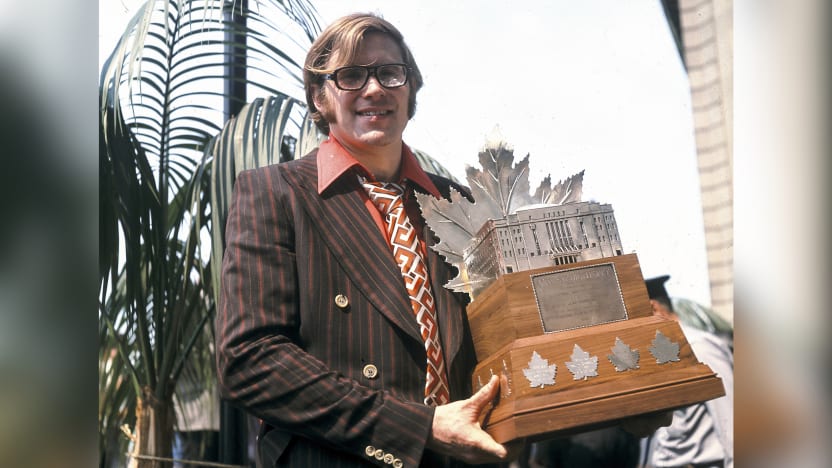
Apparently, in the 1970s, Canadian men had no better taste
in clothing or hair than did American men.
He and Esposito were the 2 goalies selected for Team Canada in the "Summit Series" with the Soviet Union in 1972. Dryden played in Games 1, 4, 6 and 8; Esposito in Games 2, 3, 5 and 7. In a 50th Anniversary interview in 2022, he said, "I feel the history of that tournament, the legacy of that team just as strongly as all Canadian fans do. It never goes away. It's kind of like a good wine, I guess. Actually, the legacy of it grows."
The Canadiens did not win the Cup in 1972, but they did in 1973. Dryden missed the 1973-74 NHL season, so he could earn his law degree from McGill University in Montreal. The Canadiens did not win. He came back for 1974-75. They did not win. But they did for 1975-76, 1976-77, 1977-78 and 1978-79.
Serge Savard, a Hall of Fame defenseman for the Canadiens, said, "We looked at him and we thought he was coming from another planet. We didn’t see hockey players coming into the dressing room with books under their arms. After practice, he was going to McGill University."
As I was writing this, it occurred to me: Given his era, his talent, and his status as a thinking man and a thinking fan's man in his sport, Ken Dryden was the Tom Seaver of Hockey. Maybe he should have worn Number 41, as did a later Canadiens goalie, Jocelyn Thibault.
The "Flying Frenchmen" were so dominant that he could frequently stand in front of his goal, wearing what became the most famous goalie mask design ever, with its red, white and blue ovals, and in his familiar pose of resting his arms on top of his stick.
He then retired, having played 7 full seasons, and playing in the All-Star Game in 5 of them, and winning the Vezina Trophy as the League's top goalie in 5 of them. His Number 1 was retired by Cornell, and his Number 29 was retired by the Canadiens. He was elected to the Hockey Hall of Fame in 1983, named Number 26 on The Hockey News' list of the 100 Greatest Hockey Players in 1998 (5th among goalies, behind Terry Sawchuk, Jacques Plante, Glenn Hall and Patrick Roy), and named to the NHL's 100th Anniversary 100 Greatest Players in 2017.
Having abandoned his famed mask and pose at the age of 31 -- theoretically, he could have been only halfway through a career that would have surely earned him the title of the greatest goalie in hockey history -- he turned to more intellectual pursuits, including writing several books.
The Game, written about his final season and published in 1983, has been called one of the best books ever written about hockey. In 2019, he published Scotty: A Hockey Life Like No Other, a biography of his former coach, Scotty Bowman. No coach has led more Cup wins, 9, the 1st 5 with Dryden. In 2022, for the 50th Anniversary of the Summit Series, he published The Series: What I Remember, What It Felt Like, What It Feels Like Now.
He broadcast hockey for ABC for the 1980, 1984 and 1988 Winter Olympics, including the "Miracle On Ice" game in Lake Placid, New York in 1980. That meant that he was present for, arguably, the 2 most famous moments in the sport's history: The Soviet Union's losses to Canada in 1972 and America in 1980.
From 1997 to 2004, he served as President of the Leafs organization, and they got to within 1 game of the Stanley Cup Finals in 1999, getting back to the Conference Finals in 2002. But they got no closer. After leaving, he never worked in hockey again. With his law practice and his public service, he didn't need the money.

Honored at a 50th Anniversary celebration
of the 1971 Stanley Cup
After leaving the Leafs, he went into politics. He was elected as a member of the Liberal Party to the House of Commons for York Centre, a Toronto district, in 2004, and Prime Minister Paul Martin named him Minister of Social Development. He lost that post when the Conservative Party won the 2006 election, although Dryden was re-elected to his seat. He won again in 2008, but lost in 2011, and has not run for office again. In 2012, he was named an officer of the Order of Canada, the country's equivalent to a knighthood.
He went back to McGill as a lecturing professor. He became a television producer, having co-created and co-produced the six-part CBC-TV series We Are Canada, showcasing young, innovative Canadians to help celebrate the nation's 150th birthday in 2017. He participated in ceremonies honoring the Canadiens' 100th Anniversary in 2009, and the Boston Bruins' 100th Anniversary in 2024, since the Canadiens had been the opponents in the Bruins' 1st game in 1924.
Ken Dryden and his wife Lynda had two children, a son named Michael and a daughter named Sarah; and four grandchildren. Ken died of cancer in Toronto on Friday, September 5, 2025. He was 78 years old.
Canadian Prime Minister Mark Carney: "I am deeply saddened to learn of the passing of the Hon. Ken Dryden, a Canadian hockey legend and hall of famer, public servant and inspiration. Few Canadians have given more, or stood taller, for our country. Ken Dryden was Big Canada. And he was Best Canada. Rest in peace."
Larry Robinson, Hall of Fame defenseman for the Canadiens: "He was one of a kind back then. I was just very honored to play in front of him all those years. He sure as hell made me look a lot better." (Robinson also coached the New Jersey Devils to the 2000 Stanley Cup. Another Canadien teammate, Jacques Lemaire, coached the Devils to the 1995 Stanley Cup.)
Vladislav Tretiak, the opposing goalie in the 1972 Summit Series: "Ken Dryden will always be remembered by me first and foremost as a remarkable person -- intelligent, educated, kind, and open-minded. He represented that generation of Canadians who raised hockey to incredible heights worldwide, taking part in the 1972 Summit Series and shining in goal for the Montreal Canadiens."
See? Not just for Canada, or for North America, but Ken Dryden was an icon for hockey fans all over the world.
No comments:
Post a Comment