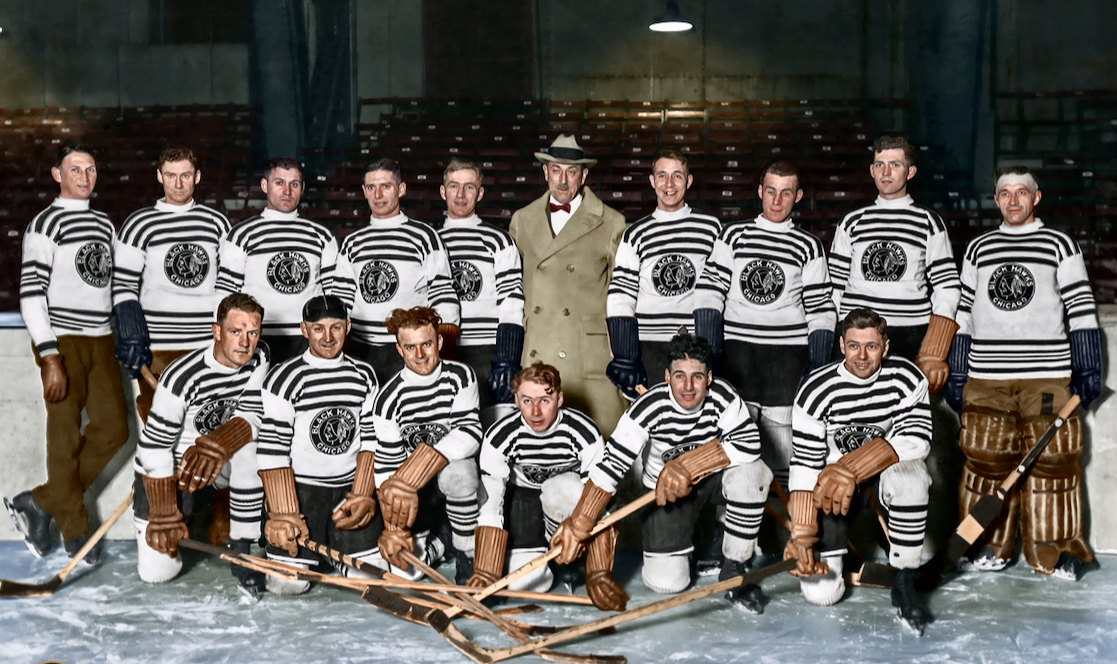
The original 1926-27 "Chicago Black Hawks."
The photo is colorized, but the colors are accurate.
Major Frederic McLaughlin is in the middle, in the hat and coat.
November 17, 1926, 100 years ago: The Chicago Black Hawks, an NHL expansion team, play their 1st regular-season game. They defeat the Toronto St. Patricks, 4-1 at the Chicago Coliseum.
The surviving box score gives only the order of when the goals were scored, not their timing. George Hay scored the team's 1st goal. Then came one by Dick Irvin Sr., later to be one of the NHL's great head coaches, and the father of one of its great broadcasters. Then, Clarence "Hap" Day scored for the St. Pats, then Gord Fraser for the Hawks, and finally Charley McVeigh for the Hawks.
The next season, the St. Patricks would be sold to Conn Smythe. A decorated veteran of World War I, he was a proud citizen of the British Empire, and hated all things Irish. So he changed the team's name to the Toronto Maple Leafs, invoking a beloved symbol of the Canadian nation, and changed the team's color from green to blue. If only he had known that, while green has long been considered the color (or, perhaps I should type, "colour") of Ireland, blue was that of St. Patrick himself.
Like Smythe, the Hawks' original owner had served in World War I. Like Smythe, he was addressed by the rank of "Major" for the rest of his life. Major Frederic McLaughlin was the son of a coffee tycoon, and he named the team after his yacht, the Blackhawk. He had named the yacht after his U.S. Army unit, the 86th Infantry Division, known as the Blackhawk Unit, and now officially named the 86th Training Division, headquartered at Fort Sheridan in the northern suburbs of Chicago.
And the Division was named after Mahkatêwe-meshi-kêhkêhkwa, known in English as Black Hawk, a leader of the Sauk tribe of Native Americans. From April 6 to August 27, 1832, he led tribes against the U.S. Army in what is now the Midwestern U.S., in what became known as the Black Hawk War. Although he had fought the U.S. Army, it considered him an honorable opponent, and later named both the Division and a class of attack helicopter after him.
To this day, the hockey team that bears his name has a Native American man's left profile on the front of its jerseys, and crossed tomahawks over a capital letter C for Chicago as a sleeve patch. The team's mascot is a black bird named Tommy Hawk. Supposedly, the "Indian Head" logo was designed by McLaughlin's wife, Irene Castle, an actress and dancer known for her performance with her previous husband, Vernon Castle, who died in an accidental plane crash while serving in World War I.
After nearly 3 full seasons at the Coliseum, in 1929, the Black Hawks moved into the new Chicago Stadium. Unlike the Toronto team, they embraced their city's Irish-descended citizens, by opening the Stadium on March 17, St. Patrick's Day, although it was for a boxing card, and their 1st game there wasn't until March 20.
McLaughlin died in 1944, at the age of 67. Afterward, the Norris family, owners of the Stadium, but also of the team's arch-rivals, the Detroit Red Wings, bought the Hawks from McLaughlin's estate. This created a conflict of interest, and also the kind of trades that would have made the 1950s New York Yankees and Kansas City Athletics blush.
The Black Hawks won the Stanley Cup in 1934, 1938 and 1961; and reached the Finals, but lost, in 1931, 1944, 1962, 1965, 1971 and 1973.
In 1986, someone in the team's front office found the team's original NHL charter, and discovered that its name had been registered as "Blackhawks," one word -- not "Black Hawks," two words, as it had always appeared in print. The NHL office in New York was notified, and the team has officially been "the Chicago Blackhawks" ever since.
In 1992, the Hawks reached the Finals again, but lost. In 1994, the United Center, a joint venture of the Stadium's teams, the Blackhawks and the NBA's Chicago Bulls, was built across Madison Street from the Stadium, and both teams moved in. The Hawks have since won the Stanley Cup in 2010, 2013 and 2015.
No comments:
Post a Comment