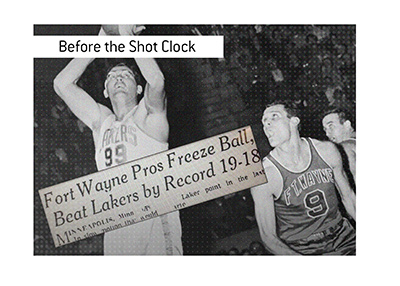
99: George Mikan. 9: Bob Harris.
November 22, 1950, 75 years ago: The worst game in NBA history is played. There were games that were sloppier, and games that had ugly brawls. But as far as quality of play is concerned, nothing will ever top this one -- or "bottom" it, if you prefer.
The Minneapolis Lakers were hosting the Fort Wayne Pistons at the Minneapolis Auditorium. The Lakers were representing Minnesota, the State known as "the Land of 10,000 Lakes," while the Pistons were owned by Fred Zollner, whose Fort Wayne, Indiana-based Zollner Corporation ran a foundry that manufactured pistons, primarily for car, truck and locomotive engines.
Both teams began play in the Midwest-based National Basketball League before entering the NBA. The Pistons won the NBL Championship in 1944 and 1945. The Lakers won it in 1948, then joined the NBA, and won their title in 1949 and 1950.
Coached by John Kundla, a Minneapolis native and University of Minnesota basketball star who wasn't much older than his players, the Lakers were led by George Mikan, at 6-foot-10 the professional game's 1st great big man. Before coming to the Lakers, he had helped Chicago's DePaul University win the NIT (then considered a more important competition than the NCAA Tournament) in 1944 and 1945. Earlier in 1950, despite being just 26 years old, the Associated Press named Mikan the greatest basketball player of the 1st half of the 20th Century.
(The AP's other honorees: Babe Ruth for baseball, Howie Morenz for hockey, Jack Dempsey for boxing, Bill Tilden -- despite his recent scandal -- for men's tennis, Suzanne Lenglen for women's tennis, Man o' War as the greatest racehorse; and Jim Thorpe for football and track and field, and as greatest athlete overall.)
Mikan wasn't fast or graceful: In 1969, longtime New York sportscaster Bill Mazer wrote, "He was more like a stampeding elephant"; while Boston Globe columnist Bob Ryan said on a 1996 ESPN panel, "Great player in his time. Deserved every accolade he ever got. But, today? He's Greg Kite with a hook shot."
The Lakers had other players who would make the Hall of Fame: Jim Pollard jumped around the court so much, he had the nickname "the Kangaroo Kid" years before Billy Cunningham of the Philadelphia 76ers did; while Slater Martin and Vern Mikkelsen were also among the best players in the game. Kundla would also eventually be elected to the Hall, and lived to be 100, outliving each of these players.
The Lakers' game was simple: Find an outside shot, and, if you can't, get the ball to Mikan and let him shoot over everybody. So, Pistons coach Murray Mendenhall decided that the only way to win the game was to make sure that Mikan doesn't get the ball. And the way to do that was to hold onto possession for as long as possible. In other words, or other word: Stall.
A crowd of 7,021 saw this: The Pistons leading 8-7 at the end of the 1st quarter, the Lakers leading 13-11 at the half, and the Lakers leading 17-14 at the end of the 3rd quarter. The crowd, hoping to see Mikan do his stuff, knew what the Pistons are trying, and they booed vociferously.
The Lakers scored only 1 point in the 4th quarter, but were still leading 18-17 with 6 seconds left in regulation, with Mikan having scored 15 of their points, including all of their field goals, 4 in 11 attempts. The rest came from 3 free throws: The other Lakers shot 0-for-6 from the field.
On the game's final play, unable to stall any longer, Pistons rookie Larry Foust took an inbounds pass, and laid it up over Mikan's outstretched arms. Mikan couldn't stop the shot, and it went in. Final score: Pistons 19, Lakers 18.
Point totals: Pistons: John Oldham 4, Curly Armstrong 4, Foust 3, Fred Schaus 3, John Hargis 2, Jack Kerris 2, Bob Harris 0, Ralph Johnson 0; Lakers: Mikan 15, Bob Harrison 2, Pollard 1, and none for Martin, Mikkelsen, Arnie Ferrin, Joe Hutton, and Bud Grant. Yes, football fans, the same Bud Grant who made the Pro Football Hall of Fame for leading the Minnesota Vikings into 4 Super Bowls (but losing them all).
Kundla told the sportswriters, "Play like that will kill professional basketball." But teams found the Lakers' weakness: Hold on to possession, and you can beat them. The 1950-51 NBA Championship was won by the Rochester Royals.
Kundla got his team to bounce back, winning the NBA Championship in 1952, 1953 and 1954. Then Mikan retired, and they didn't win another title until 1972 -- and not in Minneapolis.
Mikan's timing may have been absolutely right: For the 1954-55 season, the NBA adopted the 24-second shot clock. Stalling was no longer possible. Other teams, by necessity, needed faster players to copy the Lakers' now-useless fast break. For that reason, the aforementioned Bob Ryan said that 1954 is the demarcation line: When comparing great players and great teams in NBA history, you shouldn't put pre-1954 entries into the discussion, because they weren't really playing the same game.
The 19-18 game didn't kill pro hoops, but winning it didn't help the Pistons much. Although they reached the NBA Finals in 1955 and 1956, they didn't win either time. In 1957, accepting that Fort Wayne was too small a market in which to compete, Zollner moved the team to Detroit, the Motor City, where the Pistons name still made sense.
Murray Mendenhall lived until 1972, Fred Zollner until 1982, Larry Foust until 1984, and George Mikan until 2005.
Built in 1927, the Minneapolis Auditorium seated 10,545 people, and was home to the Lakers from 1947 to 1959. They played the 1959-60 season at the Minneapolis Armory, which still stands. After that season, they moved to Los Angeles, where the Lakers name didn't make sense. But they became L.A.'s most popular sports team, and remain so.
Since 1980, they have won 11 NBA Championships, the most of any team over that stretch. In total, in Minneapolis and Los Angeles combined, they have won 17, 2nd only to the Boston Celtics, with 18, for the most. One of those Laker titles came in 2002, when a questionable imbalance of fouls gave them the Western Conference title over the Sacramento Kings. That remains the closest the Kings franchise has come to the NBA Finals since... 1951, when they were the Rochester Royals, the team that briefly interrupted the Lakers' Minneapolis dynasty.
Since their respective moves, the Lakers and the Pistons have played each other in 3 NBA Finals. The Lakers won in 1988, the Pistons in 1989, and the Pistons in one of the great NBA Finals upsets in 2004.
Made obsolete by the construction of the Metropolitan Sports Center in suburban Bloomington in 1967, and more so by the plan to build the Target Center downtown (it opened in 1990), the Auditorium was demolished in 1988, and the Minneapolis Convention Center was built on the site. The Minnesota Timberwolves began play in 1989, playing their 1st season in the Metrodome before the Target Center was ready. They have not been a success: Only twice have they made the NBA Western Conference Finals, and they've lost both: 2004, to the Lakers; and 2024, to the Dallas Mavericks.
*
November 22, 1950 was a Wednesday, the day before Thanksgiving. Steven Van Zandt, who played guitar for Bruce Springsteen's E Street Band, and played consigliere Silvio Dante on The Sopranos, was born on this day.
There were 2 other games played in the NBA that night. The New York Knicks beat the Baltimore Bullets, 87-73 at the Baltimore Coliseum. And the Washington Capitols beat the Tri-Cities Blackhawks, 65-60 at the Uline Arena (now the Washington Coliseum).
Baseball was in the off-season. Football was in midweek. There were 2 NHL games played that night. The New York Rangers beat the Montreal Canadiens, 3-2 at the old Madison Square Garden. And the Toronto Maple Leafs beat the Chicago Black Hawks, 5-2 at Maple Leaf Gardens in Toronto. The Boston Bruins and the Detroit Red Wings were not scheduled.
In spite of the next day being Thanksgiving, a day on which the NBA generally doesn't play today, 5 games were played: New York 109, Washington 78; Philadelphia 89, Rochester 71; Boston 94, Tri-Cities 78; Indianapolis 92, Syracuse 85; and, in a rematch in Fort Wayne, Pistons 73, Lakers 63. So the 19-18 game was an aberration: The Pistons proved they could win while playing what then passed for normal basketball.
In the NHL on Thanksgiving 1950: Toronto 2, Detroit 1 in Detroit; and host Chicago 4, Boston 1. In the modern era, the NBA and the NHL avoid playing on Thanksgiving Day, so as not to compete with college and pro football, although there are usually some college basketball games on the day.
Among the college football games on T-Day '50: Number 12 Wyoming 42, the University of Denver 12 in Denver; Number 19 Washington & Lee 67, Richmond 7 in Richmond; Columbia 33, Brown 0 in Providence; Virginia Military Institute 27, Virginia Tech 0 in Roanoke; Missouri 20, Kansas 6 in Columbia; and Utah 46, Utah State 0 in Salt Lake City.
And in the NFL on T-Day '50: Detroit Lions 49, New York Yanks 14 at Briggs Stadium (Tiger Stadium) in Detroit; and Pittsburgh Steelers 28, Chicago Cardinals 17 at Comiskey Park in Chicago.
No comments:
Post a Comment