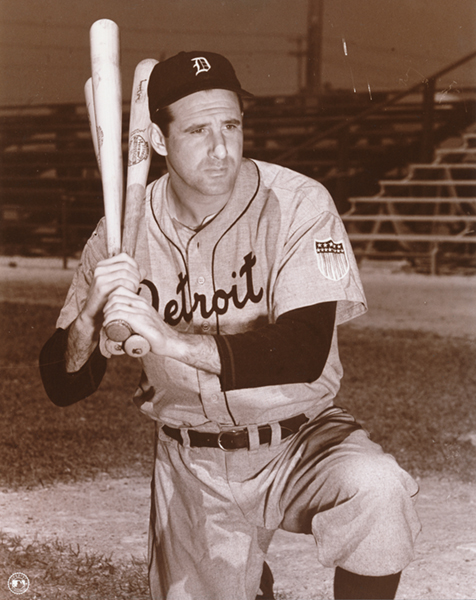
Swinging two bats in the on-deck circle
was a common sight before the Yankees' Elston Howard
invented the "bat donut" in the 1960s.
Hank Greenberg was one of the few players
who was strong enough to swing three bats.
September 30, 1945, 80 years ago: Hank Greenberg, recently discharged from the U.S. Army, hits a grand slam off Nelson Potter in the top of the 9th inning, and gives the Detroit Tigers a 6-3 win over the St. Louis Browns at Sportsman's Park, clinching the American League Pennant, which the Browns had won the previous season, for the only time in their history. The Tigers go on to win the World Series over the Chicago Cubs in 7 games.
The 1st player to go into the service was Philadelphia Phillies pitcher Hugh Mulcahy, drafted on March 8, 1941, and he served for the duration of The War. As my grandmother taught me, she and everyone else who lived through it, even if they never left "the home front," always called it "The War," Capital T, Capital W.
Greenberg had been the 1st major baseball star to volunteer for the U.S. armed forces in preparation for World War II, inducted into the Army on May 7, 1941. So it was only natural that he was the 1st player to return, discharged on June 14, 1945, with Nazi Germany having surrendered, but not, as yet, Imperial Japan. He had scouted bombing targets for B-29 bombers in the China/India/Burma Theater of Operations, and was discharged with the rank of 1st Lieutenant.
Already known as Hammerin' Hank before Henry Aaron was even born, he had lost his seasons of age 31, 32 and 33, and the 1st half of his age 34 season. He finished his career with a lifetime batting average of .313 and 331 home runs. He should have had at least 150 more home runs. He never regretted it, saying, "My country comes first."
Nor did Chief Petty Officer Bob Feller, U.S. Navy, who lost his seasons of ages 23, 24, 25 and most of 26. He won 266 games and struck out 2,581 batters, all for the Cleveland Indians. Based on his 1941 and 1946 performances, he should have had at least another 90 wins and 1,000 strikeouts, which could have made him the all-time strikeout leader, and, with another 98 wins, the pitcher with the most in the post-1920 Lively Ball Era.
He knew The War was more important. He also knew that people like Ty Cobb and Ohio State football coach Woody Hayes, who compared sports to war, were blowhards, saying, "Anybody who says sports is war has never been in a war."
Warren Spahn had appeared in 4 games before going into the service, and was the winning pitcher in exactly none of them. By the time he rejoined the Boston Braves, 1st Lieutenant Warren Spahn, U.S. Army, had missed his age 22, 23 and 24 seasons, and had gotten frostbite in the Battle of the Bulge and been wounded at the Remagen Bridge.
But his wartime experience may have matured him. From age 25 to 44, he did become the Lively Ball Era's winningest pitcher, and the winningest lefthanded pitcher regardless of era, with 363. So maybe his stats didn't suffer.
The stats of Sergeant Joe DiMaggio, U.S. Army Air Force, did suffer, as he lost his age 28, 29 and 30 seasons. He finished with a .325 batting average, and 2,214 hits including 361 home runs. He should have had at least another 550 hits and another 75 home runs.
And then there was Ted Williams, who served as a flight instructor in World War II and a fighter pilot in the Korean War. By the time he left the service for the last time in 1953, Captain Theodore S. Williams, U.S. Marine Corps, had damaged hearing, and had lost his seasons of age 24, 25 and 26, and most of those of age 33 and 34.
He batted .344 for his career, with 2,654 hits and 521 home runs. It shouldn't surprise people who know a little about baseball history that Ted reached 500 homers, only the 4th to do so after Babe Ruth, Jimmie Foxx and Mel Ott. But it is surprising that the man often called "The Greatest Hitter Who Ever Lived" didn't even get close to 3,000 hits. (He also never got 200 hits in a season.) By missing 4 1/2 prime seasons, he may have missed out on as many as 600 hits and 200 home runs, which would have put him past the 714 of Ruth, the record before Aaron reached 755.
In contrast, Ruth only missed 1 month due to World War I, September 1918, and that was because everybody missed at least that much, since the season was cut short. And Aaron was never drafted. Mickey Mantle was classified 4-F, medically unfit for service.
Willie Mays did serve in the Korean War, missing most of his age 21 season and all of his 22, probably costing him around 350 hits on top of his 3,293, and at least 50 homers on top of his 660, meaning he might have gotten to 715 before Aaron did. Yankee pitcher Whitey Ford (1951 and '52) and Brooklyn Dodger pitcher Don Newcome (1952 and '53) also missed 2 seasons serving in Korea.)
Seaman 1st Class Stan Musial, U.S. Navy, the best hitter in the National League while Ted was the best in the American League, only missed 1945, his age 24 season, due to World War II. He had 3,630 hits and 475 home runs, so he may have missed 200 hits and maybe the 25 homers that would have put him over 500.
One man was a veteran of both D-Day and Major League Baseball. In his case, he was just 19 when he was in a U.S. Navy ship off the coast of Normandy, and his service probably didn't delay his entry into the major leagues by much. He may have been the calmest man in the battle, later saying that the exploding shells looked like fireworks. He was Seaman 2nd Class Lawrence Peter Berra. Yogi.
Yankee shortstop and Seaman 1st Class Phil Rizzuto missed his age 25, 26 and 27 seasons due to those huckleberries Hitler and Tojo. His Dodger counterpart, Chief Petty Officer Harold "Pee Wee" Reese, missed his age 24, 25 and 26 seasons. And Army 1st Lieutenant Jack Roosevelt Robinson missed his age 24, 25 and 26 seasons in the Army. Of course, at that point, he had no idea that he would ever play professional baseball in any capacity, much less the one that would make him the most important player of all time.
Bobby Shantz, who just turned 100, is the last remaining veteran of both World War II and Major League Baseball.
No comments:
Post a Comment