I've heard people who are fans of science fiction, including time travel stories, say things like, "We are living in the worst timeline."
I've also heard people who are fans of the TV show The Good Place use that show's Season 1 finale shocker to describe the real world in which we now live: They've come to realize that this is the Bad Place: Hell.
The idea being that, maybe, there's another world where a historical event happened differently, leading to a better timeline, or that maybe we died, and began living in what would be, to us, considered Hell.
There's an old bit:
Heaven is where the police are British, the chefs are French, the mechanics are German, the lovers are Italian, and it is all organized by the Swiss.
Hell is where the police are German, the chefs are British, the mechanics are French, the lovers are Swiss, and it is all organized by the Italians.
And Trump has been President continuously since 2009, because there was a coup after President Black Man was elected.
In the better timeline...
* On November 2, 1968, a plane had mechanical difficulties, and Anna Chennault couldn't get on it to fly to Paris and sabotage the Vietnam War peace talks.
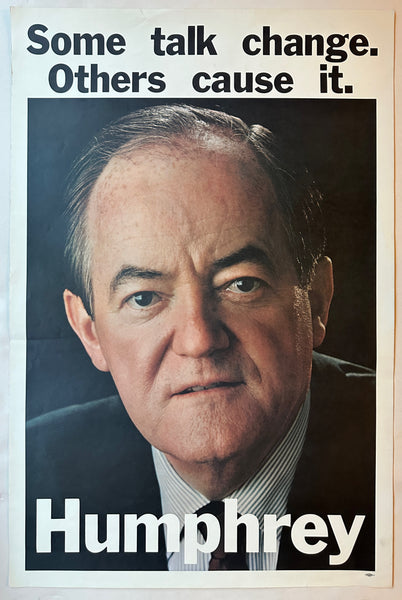
* Hubert Humphrey was elected President. The peace talks continued. Lyndon Johnson got a peace deal by Christmas. Humphrey took office without having to worry about Vietnam. He placed the call to the astronauts on the Moon, not Richard Nixon. There was no Kent State Massacre. Humphrey took us one step closer to universal health care, with MediKid, a children's version of Medicare. He replaces the retiring Chief Justice Earl Warren with former Attorney General Nicholas Katzenbach, the man who, as Robert F. Kennedy's Deputy, got George Wallace out of the schoolhouse door in 1963.
* With Nixon out of the way, Ronald Reagan was free to be the representative of both the traditional conservative movement and the evangelicals, and ended 12 years of the New Frontier and the Great Society. Reagan's Vice President was chosen because he was a part of the "Southern Strategy": Senator John Tower of Texas.
* It was the Reagan Administration that bugged the Democratic National Committee headquarters at the Watergate, and Bob Woodward and Carl Bernstein of The Washington Post got right on it. It was also Reagan and company who orchestrated the coup in Chile in 1973. Mark Felt was still at the FBI, and, as "Deep Throat," he spilled the beans, and Reagan was impeached, and removed on August 9, 1974. The conservative and evangelical movements were struck a blow from which they could not recover in the short term.
* Tower became President, and couldn't stop the recession Reagan's tax cut had caused. The evangelicals abandoned him, because of his apparent womanizing and alcoholism. With the Reagan scandals hanging over him, he had no chance in 1976, and Jimmy Carter was elected.
* As President-elect, Carter met with the new Speaker of the House, Thomas "Tip" O'Neill of Massachusetts, and the new Senate Majority Leader, Robert Byrd of West Virginia. In our timeline, by his own admission, "I treated Congress like the Georgia legislature, and they treated me like the Governor of Georgia." In this timeline, they get off on the right foot, and, with the Kennedy-Harkin Bill, sponsored by Representative Tom Harkin and Senator Edward M. "Ted" Kennedy of Massachusetts, universal health coverage passes on October 18, 1977. (I chose the date because it's the day the Yankees ended a 15-year World Series drought.)
* With Nixon defeated in 1968, Henry Kissinger never becomes a person of influence in the American government. He's not there to, along with others like David Rockefeller, convince Carter to let the Shah of Iran into America for cancer treatment. Instead, Carter is warned by his Secretary of State, Cyrus Vance, and Humphrey's, George Ball, not to do it, and he agrees. While Iran remains a problem from 1979 onward, there is no Iran Hostage Crisis.
* There is still a Soviet invasion of Afghanistan. This time, though, with no hostage crisis, and no resulting OPEC actions that have jacked up gas prices and caused overall inflation, Carter's announcement of a boycott of the 1980 Olympics in Moscow is treated as a principled action, and widely supported. Ted Kennedy sees no reason to run for President, gets his drinking under control, and his separation and divorce from Joan is relatively quiet. Unopposed in the Democratic Primaries, Carter rolls to re-election over former Representative and Republican National Committee Chairman George H.W. Bush.
* In a bipartisan gesture, Carter makes his one and only appointment to the Supreme Court the 1st woman, a Republican, Sandra Day O'Connor.
* Having gotten the Camp David Accords and the Panama Canal Treaty, then a 2nd term, Carter mediates the reunification of Vietnam under a coalition government committed to free elections, and ends the civil wars in Nicaragua and El Salvador. He gets a peace agreement between Israel and Jordan, there is no Israeli incursion into Lebanon, and that nation, Jordan and Egypt work with Yassir Arafat to turn the West Bank into the Republic of Palestine, with a capital to be built in East Jerusalem. It is nicknamed "Israel's Marshall Plan," and Carter is awarded the 1982 Nobel Peace Prize.
* Having achieved several domestic aims in his 1st term, there wasn't a whole lot for Carter to do in his 2nd. His Vice President, Walter Mondale, won a narrow victory over Senate Minority Leader Bob Dole of Kansas. There was no Iran-Contra Scandal.
* In 1986, Chief Justice Katzenbach retired. In his place, Mondale appointed the leading Democrat on the Senate Judiciary Committee, Joe Biden of Delaware. And there was no bitter partisan fight over the nominations to the Supreme Court of Robert Bork in 1987. Because, in 1987, to replace Lewis Powell on the Court, Mondale nominated Laurence Tribe, and the popular Harvard Law School professor was easily confirmed.
* By 1987, the economy had slowed, and the stock market crash that October sends the nation into recession. Complaints about "kitchen table issues" and crime lead to the election in 1988 of the darling of the tax-cut movement, Representative from New York, and former professional quarterback, Jack Kemp.
* It became one of the great ironies of American political history that President Kemp should be best remembered not for the tax cut he signed into law, or the recession it deepened, or for the budget reconciliation bill he signed to alleviate it, raising taxes, and causing those who had once been his foremost advocates to abandon him as "a traitor to the cause."
It was the Persian Gulf War. It could have been worse: He could have been dumb enough to press on to Baghdad, but his Secretary of State -- 1980 Republican Presidential nominee George H.W. Bush -- warned him against it, and he agreed. Kemp also presided over the closing of the Cold War, as first the Berlin Wall, then the Soviet Union, fell.
* There was no bitter partisan fight over the nomination to the Supreme Court of Clarence Thomas in 1991. Because, not desperate to pander to the conservative movement as the elder Bush was in our timeline, Kemp would have considered Thomas' record, and found him to be under-qualified to replace anyone, let alone Thurgood Marshall, the 1st black Justice on the Court.
Instead, he appointed Amalya Lyle Kearse to be the 1st black woman on it. (In our timeline, Carter appointed her to the federal bench, and Reagan thought enough of her to make her a finalist for the seat that went to O'Connor in 1981.) Kemp "crossed the aisle" to appoint her, being strong on civil rights. The joke was, because he'd played pro football, he had showered with more black people than most Republicans had ever actually met.
* Kemp responded to the beating of Rodney King by working with Democratic leaders to come up with a Crime Bill that not only would properly respond to escalating crime in the inner cities, but also hire more and better police officers. He knew it had to be done, but he also wanted to take crime off the table for the 1992 election. The officers who beat King were convicted on the 1st try, and there was no riot in Los Angeles.
* The 1992 Presidential election has been called one of the best ever. Kemp, only 57 and still full of vigor, was opposed by Governor Bill Clinton of Arkansas. It was a conservative idea man vs. a liberal idea man, both very popular with college-age voters, who didn't yet have to go out and get a job. People who did turned to Clinton, because the recession was still going on, and the Republicans' attempts to blame Mondale for starting it weren't working anymore. With Vietnam a non-issue after 1968, Clinton didn't have it as part of his problems. But with universal coverage passed, Clinton couldn't campaign on that, either. The election was very close, but Clinton won a narrow victory.
* Without an evangelical movement to stand in his way, the more ridiculous accusations against Clinton never gained traction. But with much of what our timeline's Clinton wanted to do having already been done, there seemed little for him to do domestically after getting his budget passed. With Israel at peace with every neighbor except Syria and not-so-neighboring Iran, he was able to end the genocides in Rwanda and Bosnia. But while his economic and peace achievement got him a 2nd term in 1996, over Senator Phil Gramm of Texas, there seemed little reason beyond ambition for him to run again. His 2nd term looked like it would be dull.
* It wasn't. Conservative journalists broke the scandal of his affair with Monica Lewinsky. With the country in peace and prosperity, on January 26, 1998, Clinton came clean, and, deciding that Vice President Al Gore could be President, but only he could be the one to work on his failings to his family, he became the 1st President ever to resign the office. He spared the nation a drawn-out story, and there was little celebrating among the Republicans, for whom the evangelical movement was just a quirky memory.
* Gore's environmental and tech initiatives helped, but while he proved an able administrator, he wasn't much of a politician. With the evangelical movement ruined, and the Bush name unable to regain momentum following the defeats for Governor of George W. in Texas and Jeb in Florida in 1994, the Republican nominee in 2000 was Senator John McCain of Arizona. He defeated Gore in a close election.
* On August 6, 2001, McCain read a Presidential Daily Briefing titled "Bin Laden Determined to Attack Inside U.S." He took it seriously. On September 11, he announced to the nation that a major terrorist attack had been foiled. On September 14, he gave a press conference at Austin J. Tobin Plaza at the World Trade Center in New York, one of the saved targets, and warned Afghanistan to turn Osama bin Laden over to the U.S. It did. McCain also worked with Iraqi rebels, and Saddam Hussein was toppled from power in late 2003, without a large U.S. military presence.
* The Democrats thought they had to counter McCain's various foreign policy achievements with their own war hero and foreign policy expert. This was Senator John Kerry of Massachusetts. But, with most of the things our timeline's Democrats wanted already long established in law, and with most of the things our timeline's Democrats wanted prevented already done so, there seemed little reason to vote for him. McCain won in a landslide.
* But the recession that began in 2007 due to the Republicans' deregulations turned into a full-blown crash in 2008. With Hillary Clinton teaching at Yale Law School, and not in the Senate, Senator Barack Obama of Illinois cruised to victory in the Democratic Primaries. The Republican Primaries were a mess, as McCain's Vice President, Senator Dan Quayle of Indiana, was seen as insufficiently intelligent and mature for someone 60 years old. His demand for "a return to honor and integrity" following the 1998 Clinton scandal got him on the ticket, but his actions and words since nearly derailed him in the Primaries. Obama beat him in a landslide, becoming the 1st black President. With Biden on the Supreme Court, his running mate, lending experience and "gravitas," is Senator Patrick Leahy of Vermont.
* Obama solved the recession. But there was no reason to fight for "Obamacare": Something better had already been passed. There was no reason to kill Osama bin Laden: He was rotting away in the "supermax" federal prison in Colorado. What could he run on in 2012? In part, civil rights, including for women, by convincing Congress to codify Roe v. Wade into law and approve a renewal of the Equal Rights Amendment; and gay rights, including replacing Clinton's "Don't Ask, Don't Tell" with an Executive Order allowing openly gay military personnel.
* Obama put Sonia Sotomayor and Elena Kagan on the Supreme Court. With them joining a liberal wing that included Joe Biden, Laurence Tribe, Amalya Lyle Kearse, and Clinton appointees Ruth Bader Ginsberg and Stephen Breyer, the 2 conservative McCain appointees of 2005, John Roberts and Samuel Alito, are all but powerless. The cases of Citizens United v. FEC, Shelby County v. Holder and Burwell v. Hobby Lobby Stores, Inc. go in the liberals' favor; while Obergefell v. Hodges goes the same way.
* In 2011, Donald Trump brings up the issue of Obama's birth certificate. Only this time, every living former President -- Carter, Mondale, Clinton, Gore and McCain (Kemp having died in 2009) -- signs a joint statement denouncing this as the rantings of a bigot, and saying it has no place in 21st Century America.
* With fewer achievements, Obama's win over former Governor Mitt Romney of Massachusetts is a close one. His 2nd term amounts to little more than holding the fort.
* On June 16, 2015, Donald Trump comes down the escalator in the lobby of Trump Tower in Midtown Manhattan, ready to begin a press conference to announce his campaign for President of the United States. When he gets there, he is arrested by the FBI. It seems that Jeffrey Epstein chose to save his own skin as much as he could, and ratted Trump out. Before the 2016 election can be held, Trump is convicted of over 100 felonies, from the "Epstein Island" charges to business fraud.
* Governor John Kasich of Ohio is elected President in 2016, since Obama had no obvious successor, given that Vice President Leahy was 76 years old and not interested in the Presidency himself. Kasich governs as a traditional Republican, with tax cuts, deregulation, and the appearance of a strong foreign policy. There is little about him that is racist, and nothing like the neo-Nazi march in Charlottesville ever happens. Because of earlier policing initiatives by Presidents Kemp and Clinton, many of the victims of police brutality in our timeline live out their lives. There is no Black Lives Matter movement, because nearly everybody in America agrees with that principle.
* Because of previous appointments to the Supreme Court, Kasich gets to make only one, replacing the late Ruth Bader Ginsburg with Neil Gorsuch in 2020. The Heritage Foundation wanted Brett Kavanaugh, but Kasich rejected their choice based on his inexperience and his personal behavior.
* When COVID hits in March 2020, Kasich follows the suggestions in the "pandemic playbook" that the Obama Administration left behind. Over 300,000 people die, but people take his word for it that things could have been even worse than that. By November, because people took him seriously in March, the crisis is over, and Kasich is re-elected over the 1st Jewish nominee for President of any major American party, Senator Al Franken of Minnesota.
* Kasich's 2nd term dealt mainly with the economic fallout of COVID, and the early 2020s are a time of recession. He aids Ukraine in its defense against Russia. He appoints Amy Comey Barrett to replace Stephen Breyer on the Supreme Court in 2022, so the next appointment will decide the 5-4 majority. For this reason, Biden, Tribe and Kearse refuse to retire.
* Noting that these Justices, in 2024, are, respectively, 81, 83 and 87 years old, the Democratic nominee for President made the Court a big issue, saying that abortion rights and gay marriage could be overturned. Her message of "We're not going back" resonates, making Kasich's Vice President, the archconservative Mike Pence, look like the man who would reestablish a rejected old order. Kamala Harris is elected the 1st female President of the United States.

In our timeline, this was her swearing-in as Vice President in 2021.
* In 2025, Justice Kearse retires, and President Harris appoints Ketanji Brown Jackson to succeed her. Later in the year, following his cancer diagnosis, Chief Justice Biden retires, and President Harris appoints Patricia Guerrero, 53 years old and Chief Justice of the California Supreme Court, someone she'd once worked with as California's Attorney General, to be the 1st Hispanic Chief Justice. She joins a liberal contingent with Jackson, Tribe, Sotomayor and Kagan; while the conservatives have Roberts, Alito, Gorsuch and Barrett.
And here we are: A nation at peace, both domestic and foreign. Bigotry has been put in its place: In private, out of the public sector. When Democrats win, progress is made. When Republicans win, it's difficult, but it's not insane.
Less insanity -- in an official capacity, if not overall -- may have been the greatest gifts that Barack Obama and Joe Biden gave us in their time in office. Maybe the next President can do that for us, whoever he -- or she -- turns out to be.
No comments:
Post a Comment