
Actual color photo of Hiroshima after the bombing
It is World War II. Nazi Germany has already been defeated. The Empire of Japan, however, is holding out. American forces have reached Okinawa, just 400 miles from the Japanese home Islands.
President Harry S Truman has demanded that Japan surrender. They have refused. So, at 8:15 AM local time -- 6:15 PM on August 5, U.S. Eastern Time -- the Enola Gay, a B-29 Superfortress, dropped a uranium bomb codenamed Little Boy on the port city of Hiroshima, about 500 miles west of Tokyo. It was a tactical choice that would not only kill as many people as possible, but hurt Japan's war effort.
The bomb had roughly the force of 15,000 tons of TNT -- 15 kilotons. It is estimated that 66,000 people were killed instantly, and another 100,000 or so may have died of radiation poisoning within the next year.
Despite this destruction, Japan still did not surrender. So a 2nd bomb, a 21-kiloton plutonium bomb codenamed Fat Man, was dropped on Nagasaki on August 9. As a smaller city to begin with, about 40,000 were killed at once, and at least that many through radiation sickness.
Finally, on August 14, fearful that the capital of Tokyo, which had already sustained terrible damage as a result of incendiary bombs, would be next, Japan surrendered.
As part of the U.S. occupation of Japan, both cities were rebuilt. Today, Hiroshima is a thriving city of about 1.2 million. Nagasaki is now home to about 400,000.
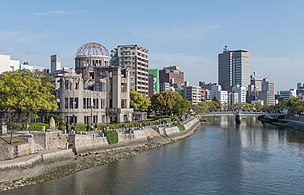
Hiroshima, 2019. The domed building at left
is the city's official memorial to the bombing.
Truman knew that the bombings were necessary. Had they not happened, the Allies were scheduled to invade the home islands on November 1. The estimates Truman had received from the Department of War suggested that the invasion, and subsequent fighting, would kill 500,000 to 1 million Allied troops, and at least that many Japanese troops, and that victory might not be achieved until well into 1946. So, as horrific as the bombings were, they saved lives, and shortened the war.
In spite of a few close calls between America and the Soviet Union, atomic bombs have never been used in warfare again. May that remain so.
August 6, 1945 was a Monday. Andy Messersmith, the All-Star pitcher who helped break baseball's reserve clause, was born on this day.
The use of the atomic bombs was definitely not "necessary". The ongoing fire bombing of Japan was nearly as devastating, although certainly morally debatable as well, and there were those within the administration that were questioning the wisdom of its use before it was used. The Japanese government was, moreover, giving out signs, although somewhat difficult to interpret, that it was nearing the point of surrendering.
ReplyDeleteAdditionally, while we typically don't like to acknowledge it, the entry of the Soviet Union into the war may very well have been the final straw for Japan, not the A bombs.
The bombs were simply the final stage in a moral decay that had occurred during the war in which targeting civilians became seen as normal. The basic thought was that by destroying cities, the Japanese would give in. This was balanced against anticipated military casualties in the upcoming invasion of Japan, and thought worth it. It was a war crime.
Excellent documentary on PBS last night that covered just this issue. The program presents a compelling argument for the deployment of both bombs.
ReplyDeleteI wonder what would have happened had they gone through with the invasion instead. If the Soviets gets involved, we can guess what may happen there considering Germany.
ReplyDeleteJapan's situation may end up more like Korea though.