Tuesday, September 29, 2026

September 29, 1946: The Rams Debut & Desegregate the NFL

Kenny Washington

September 29, 1946, 80 years ago: The Rams, who played in Cleveland from 1936 to 1945, play their 1st home game in Los Angeles, making them the city's 1st real major league sports team. (Previous pro football teams had "Los Angeles" as their name, but their leagues could hardly be called "major.") The defending NFL Champions lose to the Philadelphia Eagles, 25-14.

This game is even more significant than the city's debut on the major league stage, because it is the NFL debut for halfback Kenny Washington and end Woody Strode, both of whom had played for UCLA at the Rams' new home, the Los Angeles Memorial Coliseum. They became the 1st black players in the NFL in 13 years, ending the color bar.
Woody Strode

Marion Motley and Bill Willis of the Cleveland Browns were doing the same in the All-America Football Conference that Autumn, so pro football had "four Jackie Robinsons," a few months before baseball had one. (Robinson had also played football at UCLA, and ran in the same backfield as Washington in 1939 and '40. In between UCLA and the Rams, Washington had played for the Hollywood Bears of the Pacific Coast Professional Football League.)

Washington played 3 seasons in the NFL before knee injuries forced him to retire at age 30. He worked for the Los Angeles Police Department, and when the Dodgers moved to Los Angeles in 1958, he became a scout for them. His son Kenny Jr. played in their farm system.

But Kenny Sr. battled ill health, and died in 1971, only 52 years old. He was elected to the College Football Hall of Fame, UCLA retired his Number 13, and the Los Angeles Memorial Coliseum Commission inducted him into the stadium's Court of Honor.

Strode only played the one season with the Rams, then went to Canada, helping the Calgary Stampeders win their 1st Grey Cup in 1948. He became a professional wrestler and an actor, notable for his role as the Ethiopian gladiator Draba in the 1960 film Spartacus. He seemed to specialize in Westerns, and his last role, filmed just prior to his death in 1994, showed him as an old man watching Sharon Stone walk into town in The Quick and the Dead.

Motley was born in Leesburg, Georgia, but grew up outside Cleveland in Canton, Ohio -- birthplace of the NFL, and eventually the site of the Pro Football Hall of Fame. Willis was from Columbus, the State capital and the seat of The Ohio State University. They both helped the Browns dominate the AAFC winning its title all 4 years, before coming into the NFL and winning their title in 1950, beating the Rams in a classic NFL Championship Game. (By that point, both Washington and Strode were out of football.)

Motley, who had played at the University of Nevada, where his Number 41 was retired, remained with the Browns until 1953, and last played with the Pittsburgh Steelers in 1955. With the Browns, he wore 76 and then 36. He was frustrated by his attempts to gain a coaching job, and worked in various capacities.
Marion Motley

Willis had his Number 99 retired by Ohio State, whom he'd helped win the 1942 National Championship. He was elected to the College Football Hall of Fame. He also remained with the Browns through 1953, usually wearing Number 30. He worked with the City of Cleveland Department of Recreation.
Bill Willis

He and Motley were both elected to the Pro Football Hall of Fame. Paul Zimmerman, the Sports Illustrated pro football expert known as Dr. Z, called Motley the greatest player he'd ever seen. Motley died in 1999. Willis, the last survivor of the 4, lived until 2007.

Canadian professional football also integrated in 1946 -- but might have done so earlier. It has been suggested that Robert "Stonewall" Jackson, a player for the Regina Roughriders (now the Saskatchewan Roughriders) in 1930, was black. But he may have been passing as white.

The first player to be signed by a Canadian football team that knew he was black was Herb Trawick, with the 1946 Montreal Alouettes. He was a two-way lineman from Pittsburgh, who attended what's now named Kentucky State University, an HBCU in the State capital of Frankfort.
Herb Trawick

He played 12 seasons with the Als, made 7 CFL All-Star teams, helped them win the Grey Cup in 1949, had his Number 56 retired and was elected to the Canadian Football Hall of Fame. He lived until 1985.
Monday, September 28, 2026

2026 MLB Regular Season Wrap-Up

Major League Baseball's regular season is over. Some of the developments:

* The Yankees finished 93-68, 4 1/2 games behind the Tampa Bay Rays in the American League Eastern Division.

Since Divisional Play began in 1969, 93 is the average number of wins necessary to win the AL East -- that is, the average number of wins by the teams finishing 2nd is 92, so it usually takes 93 to win it. This time, 93 wasn't enough.

There's no point in providing details for the Yanks' last 6 games of the regular season, especially since they only played 5: The nor'easter that hit, well, the Northeastern U.S. this weekend not only led the Yankees and the Baltimore Orioles to move Saturday's game, and the ceremony honoring new Hall-of-Famer CC Sabathia up to Friday, making for a doubleheader, but flat-out canceled yesterday's game, since it had no effect on the standings.

* ABS, the Automatic Ball-Strike System, allowing a batter to challenge an umpire's ball-or-strike call, was a phenomenal success. The Yankees could have used it a lot over the years, especially since Aaron Judge and his strike-zone-the-size-of-The-Bronx arrived.

I am convinced that ABS resulted in the Yankees keeping enough rallies going to win at least 5 games this year that they would have lost last year. It may even have ended enough opposing rallies to win them a couple. 

I know some people hate instant replay review, because it messes with the flow of whatever sport they're watching, and makes the game longer. I don't care: Getting the calls right matters more than your passion does. Getting the win you deserve, no matter how long it takes, is better than losing an exciting game.

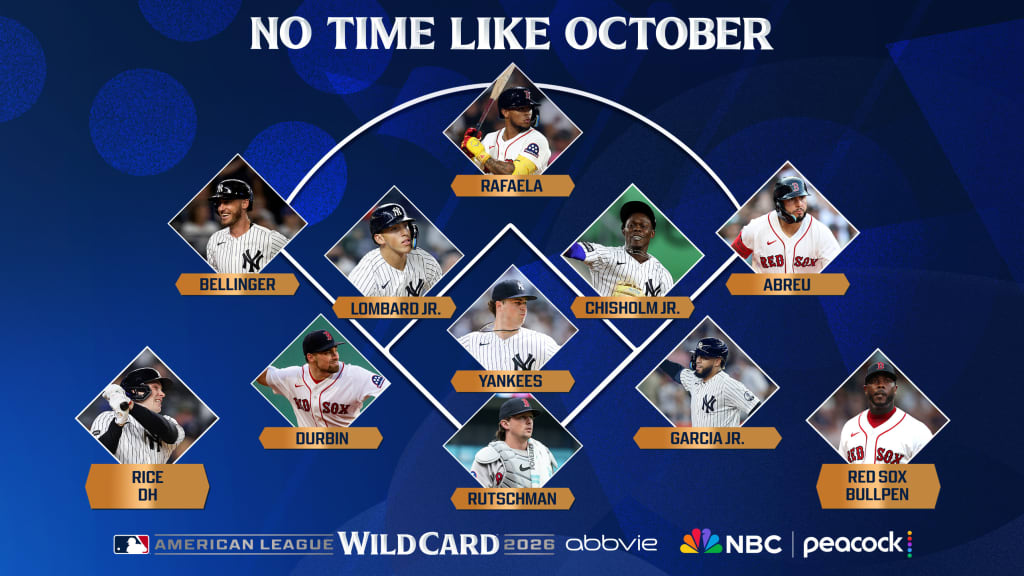
* The Yankees will host a best-2-out-of-3 AL Wild Card Series against the Auld Enemy, the despised Boston Red Sox.

The good news: We go into it with only 2 significant injuries, none of them to our desired pitchers. The bad news: Those injuries are to Aaron Judge and Giancarlo Stanton, 2 men with a combined total of 842 career home runs (Judge 386, Stanton 456). Without those bats in our lineup, it's going to be a lot more difficult to beat the arch-rivals in a postseason series, as we did last year.

* For the Rays, it is their 10th postseason appearance in their 29 seasons, including 5 Division titles and 2 Pennants. That's pretty good. But they still haven't won a World Series, which is bad; or found the support of their local fans, which is very bad; and still play in Tropicana Field -- and so we go from the good to the bad to the ugly.

* The Cleveland Guardians won the AL Central for the 3rd straight season, for the 7th time in the last 11 years. The team previously known as the Cleveland Indians had only finished 1st 9 times in their 1st 115 seasons.

* The Houston Astros finished dead even at 81-81, but that was enough to win the AL West, by 1 game over their rivals, the Texas Rangers. Thus do the Chicken Fried Cheats become the team with the worst record ever to win a Division in MLB.

The previous record was set by the 1973 Mets, 82-79. The Rangers were under .500, but still leading the AL West, when the Strike of '94 hit, but that wasn't a full season, so it doesn't count.

* The Chicago White Sox won the 3rd and last AL Wild Card berth, with an 84-78 record. Last year, they were 60-102; the year before, 41-121 to set an AL record for losses. Improving by 19 or 24 games is really good; to do them both in back-to-back seasons is remarkable.

* It wasn't all good news for the Pale Hose: Colson Montgomery set a new single-season MLB record with 224 strikeouts, breaking the record of 223 set by Mark Reynolds with the 2009 Arizona Diamondbacks. 

* Did I mention the Mets? For the 2nd year in a row, they spent over $300 million and missed the Playoffs. They spent $351 million, and finished in last place, 5th in the National League Eastern Division, at 74-88.

The Mets had a lot of injuries, including to keep players, you say? With what they spent, they should have been able to playen capable of making enough of a difference to reach the Playoffs, anyway. You know, like the Yankees did. Instead, they finished 20 games behind the Atlanta Braves in the Division, and 14 games out of the last NL Wild Card slot.

* The Philadelphia Phillies nearly added to their history of infamous collapses. They needed to win 1 of their last 5 games to win a Wild Cadd berth. They lost the 1st 4. If they lost their regular-season finale, and the Arizona Diamondbacks won theirs, they would have blown it.

But they won it, and made the Playoffs for the 5th straight season. To put that in perspective: In their previous 139 seasons, they only made it 14 times.

* The NL's Divisions were won by the Braves, the Milwaukee Brewers, and the 2-time defending World Champion Los Angeles Dodgers.

* In addition to the Phillies, NL Wild Card berths were won by the Chicago Cubs and the San Diego Padres.

* If MLB had promotion and relegation like most soccer leagues (but not our own MLS), the Mets, the defending AL Champion Toronto Blue Jays, the Kansas City Royals, the Los Angeles Angels, the Cincinnati Reds and the Colorado Rockies would be relegated to Class AAA ball.

* And Justin Verlander has retired, at age 43, with a 266-159 record and 3,560 strikeouts. Not yet having decided on retirement is his former Detroit Tigers and Mets teammate Max Scherzer, 42, who has a 225-126 record and 3,557 strikeouts.

Presuming neither of them is revealed to have bet on baseball, and (this might keep them out, then again, it might not) neither of them is revealed to have used performance-enhancing drugs, both of them will be elected to the Baseball Hall of Fame.

The Playoffs start tomorrow. Here are the starting times and projected pitching matchups for the Yankees and The Scum:

* Tomorrow, Game 1: Cam Schlittler vs. Payton Tolle.
* Wednesday, Game 2: Max Fried vs. ex-Yankee Sonny Gray.
* Thursday, Game 3, if necessary: Gerrit Cole vs. Ranger Suarez.

All games will be on NBC (not Fox, thank you, Commissioner Rob Manfred), with the broadcasts starting at 8:00 PM.

Come on you Pinstripes!


September 28, 1976: Stevie Wonder Releases "Songs In the Key of Life"

September 28, 1976, 50 years ago: Stevie Wonder releases Songs In the Key of Life, on the Motown subsidiary Tamla Records. It is usually considered his greatest album.

And that's saying something. Since releasing The Jazz Soul of Little Stevie, under the name "Little Stevie Wonder" at the age of 12 -- he was born in 1950 with the name Stevland Hardaway Judkins, but his legal name is Stevland Morris, for his mother's family -- with the Motown-billed nickname of "The 12-Year-Old Genius," he had a bunch of hit singles through the 1960s, and then moved on to making great albums, once he and Marvin Gaye were finally able to talk Motown boss Berry Gordy Jr. into letting them write and sing about social issues.

He released Where I'm Coming From in 1971, Music of My Mind and Talking Book in 1972, Innervisions (the title reflective of the fact that Stevie is blind) in 1973, and Fulfillingness' First Finale in 1974. The last 2 each won the Grammy Award for Album of the Year.

He wanted his next album to be a masterpiece, and he took his time to get it right. For 1975, the Grammy for Album of the Year went to Still Crazy After All These Years by Paul Simon. Accepting the award, Simon thanked a few people, adding, "I'd also like to thank Stevie Wonder, for not releasing an album this year." The line got more applause than laughter.

Through early 1976, Stevie would arrive in the recording studio wearing a T-shirt saying, "IT'S ALMOST FINISHED!" When Songs In the Key of Life was finished, it was everything he hoped it would be. The singles "I Wish" and "Sir Duke" hit Number 1 in early 1977. The latter was a tribute to jazz legends, name-checking, in order, Count Basie, Glenn Miller, Louis Armstrong (using his nickname, Satchmo), Duke Ellington ("the king of all, Sir Duke") and Ella Fitzgerald. It began with a line that could have been Stevie's motto: "Music is a world within itself, with a language we all understand."
On February 2, 1975, while the album was in progress, Stevie's 1st child was born, a daughter named Aisha Morris. Her mother was Yolanda Simmons, a secretary at Motown. Stevie said of Aisha, "She was the one thing that I needed in my life and in my music for a long time." For her, Stevie wrote "Isn't She Lovely?", put her baby voice on the recording, and put the song on the album, and it also became a hit single.

As Simon seemed to be predicting, Songs In the Key of Life, like its 2 immediate predecessors, won the Grammy for Album of the Year. In total, Stevie has won 22 Grammys. Stevie, Simon, Frank Sinatra and Taylor Swift are the only people to have won the Grammy for Album of the Year as lead artist 3 times, but Stevie is the only one to do it 3 albums in a row.

While he was one of the most productive performers of the 1960s, '70s and '80s, and continues to perform into the 2020s, his last 3 albums of new material have been the soundtrack to the film Jungle Fever in 1991, Conversation Peace in 1995, and A Time to Love in 2005.

It seems unfair to have expected Stevie Wonder to keep up the pace he set between the ages of 12 and 37 -- 23 albums in 25 years -- but, like his contemporary and fellow keyboard (and harmonica) player Billy Joel, he seems content with being just a touring act in the back half of his life. In 2014, President Barack Obama awarded him the Presidential Medal of Freedom.
His awards also include the Rock and Roll Hall of Fame, the Songwriters Hall of Fame, a star on the Hollywood Walk of Fame, the Michigan Walk of Fame in the State Capital of Lansing, a Messenger of Peace award from the United Nations, and an Academy Award for his 1984 Number 1 hit "I Just Called to Say I Love You," due to its inclusion in the film The Woman in Red, for which he wrote all the songs.

Stevie is currently married for the 3rd time, and has 9 children, with 5 different mothers. His daughter Aisha Morris has sung with him on recordings and tours, and his son Kailand Morris has drummed for him. 

September 28, 1951: A Big Day for Allie Reynolds and Norm Van Brocklin

September 28, 1951, 75 years ago: A sweep of a doubleheader with the Boston Red Sox at Yankee Stadium means that the New York Yankees will clinch the American League Pennant.

They win the 1st game 8-0, as Allie Reynolds pitches his 2nd no-hitter of his career -- and his 2nd of the season, having blanked the Cleveland Indians on July 12. He is backed by home runs by Joe Collins and Gene Woodling.

The part-Cherokee fireballer known as the Superchief was the 1st AL pitcher to throw 2 no-hitters in a season. The only other major league pitchers to do it, through 2026: Johnny Vander Meer of the 1938 Cincinnati Reds (the only back-to-back no-hitters in MLB history), Virgil Trucks of the 1952 Detroit Tigers (one of them against the Yankees), Roy Halladay of the 2010 Philadelphia Phillies (one a perfect game, the other in the Playoffs), and Max Scherzer of the 2015 Washington Nationals.

The last out Allie needed for the 2nd no-hitter was Ted Williams, often called "the greatest hitter who ever lived." Allie got the Splendid Splinter to pop up in foul territory, but catcher Yogi Berra dropped it. Yogi goes to the mound to apologize, but Allie says, "Don't worry, Yogi, we'll get him again." He was right: He induced another pop-up, but Yogi caught this one.

The nightcap was not as spectacular, but no less effective: A Pennant-clinching 11-3 win. Vic Raschi was the winning pitcher, backed by a home run by Joe DiMaggio, the 361st of his career -- and, as it turned out, his last in regular-season play. He would hit 1 more in the upcoming World Series, and then retire.

Also that day, the Philadelphia Phillies beat the Brooklyn Dodgers, 4-3 at Shibe Park in Philadelphia. With the New York Giants not scheduled, this drops the Dodgers, who had been 13 1/2 games ahead of the Giants on August 11, into a tie for 1st place in the National League.

The season will end with them tied, forcing a Playoff. And if you don't know how that turned out, you're too young to know baseball history, and/or you're not the kind of person who would normally be reading this blog.

*

But this was a big day in sports for another reason. There was also a team named the New York Yankees in the NFL. This was not a good day for them.

It was a very good day for Norm Van Brocklin. The quarterback for the Los Angeles Rams passed for 554 yards, an NFL record -- and it still is. The Rams won, 54-14 at the Los Angeles Memorial Coliseum.

A 25-year-old native of Walnut Creek, California, in the San Francisco Bay Area, he excelled at the University of Oregon. From 1949 to 1952, he alternated with Bob Waterfield as the Rams' starting quarterback. But, despite having led the Rams, then in Cleveland, to the 1945 NFL Championship, and becoming one of the NFL's earliest "golden boy" players, Waterfield never had a day like this.

Van Brocklin, nicknamed "Van" and "the Dutch Master," threw 41 passes, completing 27 of them. He threw for 2 interceptions, but also 5 touchdowns. Four of them, ranging from 1 to 47 yards, were to Elroy Hirsch, the receiver known as "Crazy Legs" for his speed. The other was to Verda Thomas Smith, known as V.T. or "Vitamin" Smith. Van Brocklin also ran 1 yard for a touchdown.
Although end Tom Fears, who with Waterfield was one of the NFL's earliest great passing combinations, did not catch any touchdown passes in the game, he caught 7 passes for a game-leading 162 yards, and his longest, 54 yards, was longer than any of Hirsch's. Fears also kicked 6 extra points.

The Rams had lost the NFL Championship Game to the Philadelphia Eagles in 1949, and lost it to the Cleveland Browns in 1950. In 1951, they went on to beat the Browns in the Championship Game. Van Brocklin, Waterfield, Hirsch and Fears would all be elected to the Pro Football Hall of Fame. So would defensive end Andy Robustelli, although that was mainly for his later play for the New York Giants. So would head coach Joe Stydahar, although that was for his performance as a two-way tackle for the 1940s Chicago Bears.

Not in the Hall of Fame, but should be, were the Rams' top 2 rushers, both among the NFL's earliest black stars: Paul "Tank" Younger and "Deacon" Dan Towler. Another running back on the '51 Rams, in the College Football Hall but not the Pro Football Hall, since his Army service and a knee injury meant that he only played 2 NFL seasons, was 1946 Heisman Trophy winner Glenn Davis.

Van Brocklin would become the Rams' sole starter in 1953, after Waterfield's retirement. In 1958, he was traded to the Eagles. In 1960, in his last game before retiring, he led them to victory in the NFL Championship Game. Until Super Bowl 50 in 2016, Van Brocklin was the only quarterback ever to coach 2 different franchises to the NFL Championship. Peyton Manning and Tom Brady * have since joined him in that distinction.

In 1961, Van Brocklin was named the 1st head coach of the expansion Minnesota Vikings. In 1968, he became the 2nd head coach of the Atlanta Falcons. Like many great players, he was not nearly as good as a coach. He died in 1983, after years of battling brain cancer. At one point, he addressed surgery he'd had: "It was a brain transplant. They gave me a sportswriter's brain, to make sure I got one that hadn't been used."

The previous record for passing yards in a game was 468 yards, by Johnny Lujack of the Chicago Bears, against the crosstown Chicago Cardinals on December 11, 1949. The fact that these marks of 468 and 554 yards were set in the early days of the NFL, when the only superstar quarterbacks yet seen were Sammy Baugh of the Washington Redskins and Sid Luckman, Lujack's predecessor with the Bears, is less surprising than the fact that, 75 years later, Van Brocklin's 554 still stands.

Through September 28, 2026, there have been 27 occurrences of a quarterback passing for 500 or more yards in a regular-season NFL game. The 2nd time didn't happen until October 28, 1962, when Y.A. Tittle passed for 505 yards for the Giants against the Washington Redskins. It's been done by 24 different players, including 3 times by Ben Roethlisberger and twice by Drew Brees.

The 2nd-best performance has been 527 yards, and it's been done twice: By Warren Moon, for the Houston Oilers against the Kansas City Chiefs, on December 16, 1990; and by Matt Schaub, for the Houston Texans against the Jacksonville Jaguars, on November 18, 2012.

But nobody else has done 554, or even 528. Not Tittle, Otto Graham, Bobby Layne, Johnny Unitas, or Van Brocklin himself, or any other star quarterback of the 1950s. Not Unitas, Bart Starr, Sonny Jurgensen, Joe Namath or any of the other "mad bombers" in the freewheeling, pass-happy American Football League, or any other quarterback in the 1960s. Not Fran Tarkenton, Roger Staubach, Bob Griese, Terry Bradshaw, Ken Stabler, or any other 1970s quarterback.

Not Joe Montana, Joe Theismann, Dan Marino, John Elway, Phil Simms, or any other 1980s passer. Not Elway, Troy Aikman, Brett Favre, or any other 1990s quarterback. Not any 21st Century quarterback, whether they used Spygates, deflated footballs, the name Manning, or anything else.

Van Brocklin's 554 passing yards in one game isn't like old-time baseball records, such as Cy Young's 511 career wins or Walter Johnson's 113 career shutouts, where changes in rules and styles have made it harder to pursue the record. If anything, the rules and styles should have made it easier to break this record.

After all, Van Brocklin finished with 23,611 career passing yards. At the time, that was a record. As of this writing, the record is 85,193, held by Brady. That's 3.6 times the record that Van Brocklin set. Until Namath in 1967, no pro quarterback had passed for 4,000 yards in a season. That record is now 5,477, by Peyton Manning in 2013.

But most passing yards in a game? Logic would dictate that a record set in the Truman Administration, a time when pro football trailed not only baseball and college football, but boxing and horse racing as America's most popular sport, would have been far surpassed by now. And yet, no one has come within 23 yards of it.

Sunday, September 27, 2026

September 27, 1946: CHARGE!

Tommy Walker

September 27, 1946, 80 years ago: The familiar sports sound of, "Da da da DAT da DAH! Charge!" makes its debut.

Thomas Luttgen Walker was born on November 8, 1922 in Milwaukee. This Tommy Walker is not the character from The Who's rock opera Tommy. But this one also has a musical legacy, connected to sports.

Both a placekicker on the University of Southern California football team and a trumpeter in the school's marching band, he wrote a fanfare that he said was a combination of cavalry charge calls and "The Call to the Post" at horse races.

After playing it, "Da da da DAT da DAH!" he would yell, "Trojan warriors, charge!" That night, at the Los Angeles Memorial Coliseum, USC opened their season by beating Washington State, 13-7. Eventually, the "Trojan warriors" part was dropped, and it is now universally known as "Charge!"

Walker later became the director of events at nearby Disneyland, produced the Opening Ceremony of the 1984 Olympic Games in his adopted hometown of Los Angeles, and died in 1986, shortly after producing the TV broadcast of the Centennial celebrations for the Statue of Liberty.

A New York Yankees legend said that Eddie Layton invented "Charge!" when he debuted as Yankee Stadium organist in 1967. He didn't, and never claimed he did. But, at that time, he did invent the rhythm that gets played there before "Charge!": "DUN dun dun dun DUN dun dun dun... " Mike Burke, then president of the Yankees, heard the fans clapping along with it, and told him to make it a regular thing. He did, and began following it with "Charge!" He remained at the Stadium organ until 2003, and died a year later.
Eddie Layton

Sports Illustrated cleared the matter up in a 1990 article, showing that it was Tommy Walker who created "Charge!"

Saturday, September 26, 2026

Bill Giles, 1934-2026

Who is Mr. Phillies? Maybe it was Richie Ashburn, Hall of Fame player and beloved broadcaster. But Bill Giles oversaw the best years the franchise ever had -- and the years that replaced them as such.

William Yale Giles was born on September 7, 1934 in Rochester, New York, where his father, Warren Giles, was general manager of the Class AAA Rochester Red Wings. He grew up in Cincinnati, while his father was GM of the Cincinnati Reds.

Bill, naturally, was hired to work in the Reds' front office, and did so until he followed his father's successor as GM, Gabe Paul, to be part of the founding staff of the team now known as the Houston Astros in 1962. In Houston, Bill served as traveling secretary, then as publicity director, and then promotions director, including promoting the team's new home in 1965, the Astrodome, as "The Eighth Wonder of the World."

In 1969, he joined the Philadelphia Phillies as vice president of business operations. It was he who hired Astros broadcaster Harry Kalas away, starting in 1971, when the Phillies opened the new Veterans Stadium. With team owner Bob Carpenter giving his son Ruly Carpenter the keys to the kingdom, Ruly allowed vice president Bill Giles, general manager Paul Owens, and farm director, later manager, Dallas Green, from 1976 to 1983, 8 seasons, the Phillies made the Playoffs 6 times, won 2 National League Pennants, and won the 1980 World Series. Giles also created the Phillie Phanatic, baseball's most popular mascot, who debuted early in the 1978 season.

In 1981, the Carpenter family sold the Phillies to a group that included Giles and John Middleton. The Phillies won the Pennant again in 1983. They tailed off, but were rebuilt into Pennant winners again in 1993. In 1997, Giles was named Chairman, and he held that title until his retirement in 2015. This included the building of Citizens Bank Park, which opened in 2004.

When the Phillies lost the World Series in 1993, it was to the Toronto Blue Jays, whose general manager was Pat Gillick. In 2006, Giles hired Gillick to be Phillies GM. He built a team that won 5 straight NL East titles, 2 Pennants, and the 2008 World Series.
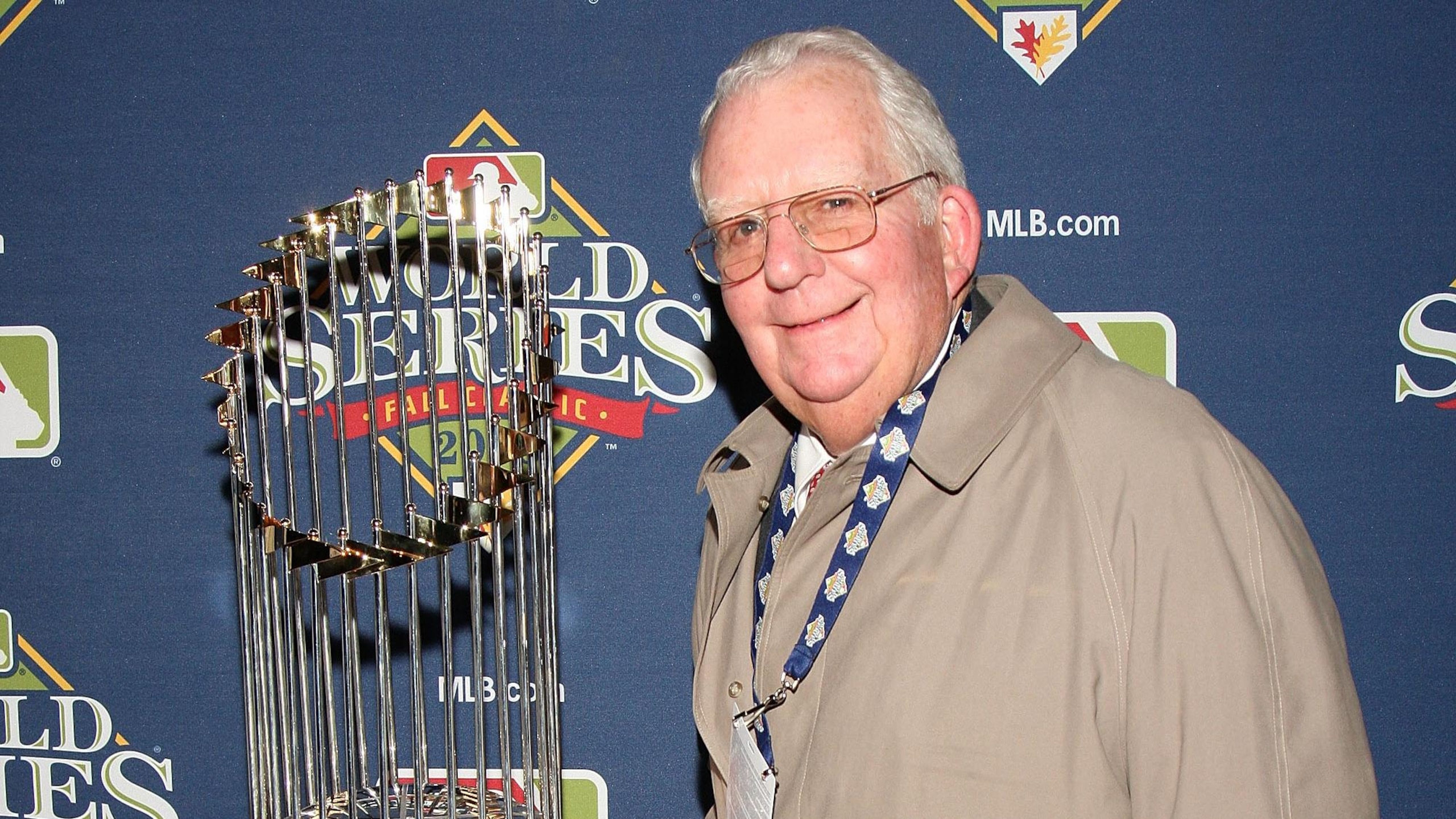
With the Commissioner's Trophy after the 2008 World Series

Giles had owned about 20 percent of the Phillies' stock, but sold his shares in 2013. As his father did from 1951 to 1969, he served as President of the National League starting in 2001. By that point, though the offices of both Leagues' Presidents were pretty much ceremonial only, with their main duty being the delivery of the trophy for winning the Pennant to the winning team's owner. In the case of the NL, Bill Giles handed the Warren Giles Trophy to, among others, his Phillies cohort David Montgomery 3 times: 2008, 2009 and 2022.
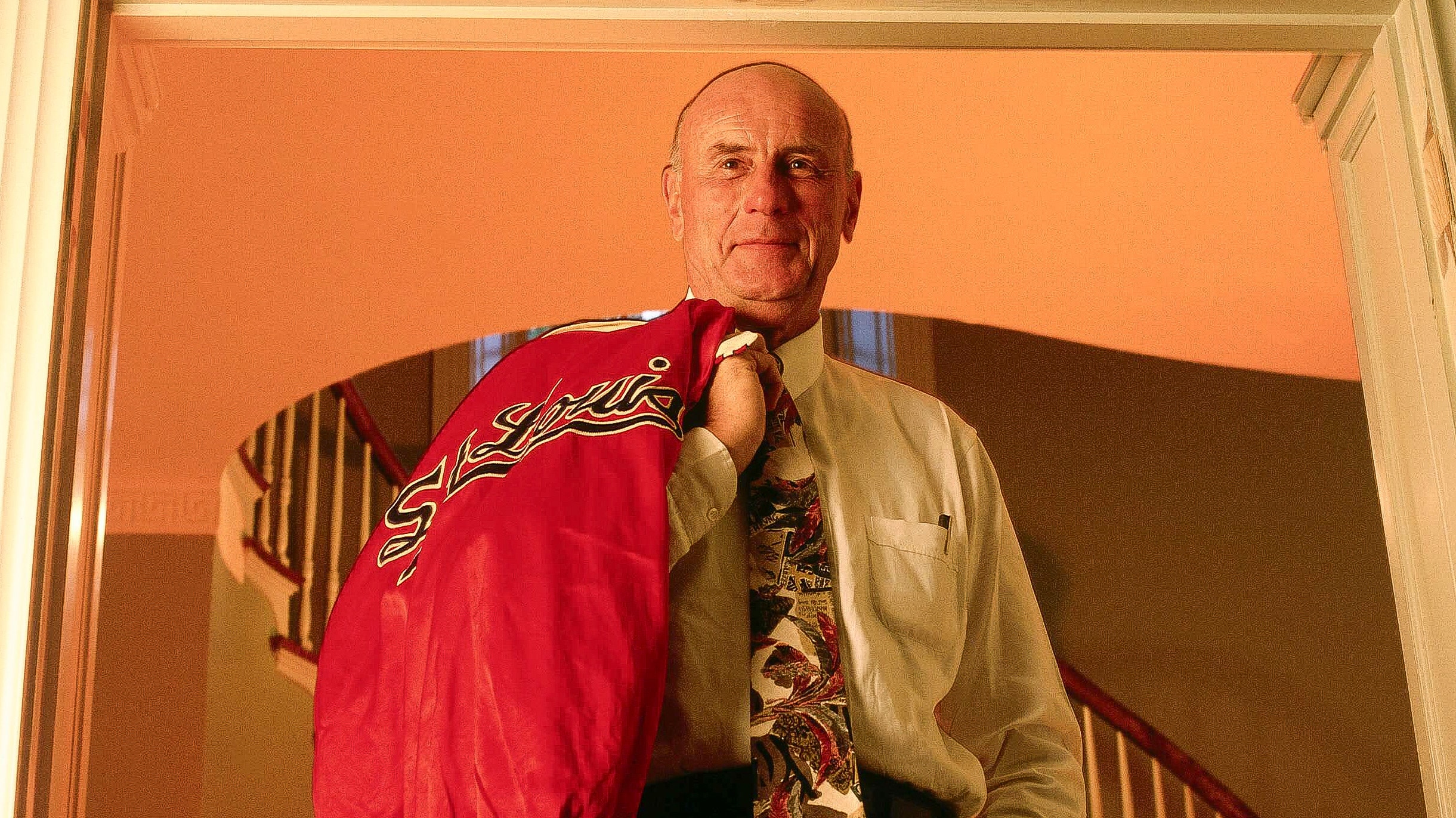
With the trophy named for his father

Bill and his wife, the former Nancy Kirwin, had 3 children: Mike, Joe and Chris; and 8 grandchildren. Nancy died in 2020 -- not from COVID. Bill Giles died this past Friday, September 25, 2026, at the age of 92.

September 26, 1876: The 1st National League Pennant

September 26, 1876, 150 years ago: The Chicago White Stockings beat the Hartford Dark Blues, 7-6 at the 23rd Street Grounds in Chicago. This clinches the Pennant in the National League, in its 1st season of operation.

William Hulbert, the founder of the NL, was the team's owner. Al Spalding, though only 25 years old when the season began, was the manager, and pitched 61 of their 66 games. Cal McVey, one of the 1869-70 Cincinnati Red Stockings, the 1st openly professional team, pitched 11.

The catcher was James "Deacon" White. Adrian Constantine Anson was the 3rd baseman, and the team captain, so he was nicknamed "Cap." He would eventually move to 1st base, which McVey played when he wasn't pitching. Charles Roscoe "Ross" Barnes played 2nd base, hit the 1st National League home run, and won the 1st NL batting title with a .429 average. John Peters was the shortstop. The outfield was John Glenn in left, Paul Hines in center, and Bob Addy in right. Fred Andrus and Oscar Bielaski were backups.

The NL standings ended up as follows:
TeamWLPct.GBHomeRoad
Chicago White Stockings5214.788—25‍–‍627‍–‍8
Hartford Dark Blues4721.691623‍–‍924‍–‍12
St. Louis Brown Stockings4519.703624‍–‍621‍–‍13
Boston Red Caps3931.5571519‍–‍1720‍–‍14
Louisville Grays3036.4552215‍–‍1615‍–‍20
New York Mutuals2135.3752613‍–‍208‍–‍15
Philadelphia Athletics1445.23734½10‍–‍244‍–‍21
Cincinnati Reds956.13842½6‍–‍243‍–‍32
What happened to these teams? Only two still exist. In 1903, the former White Stockings became the Chicago Cubs. In 1912, the former Red Caps became the Boston Braves; in 1953, the Milwaukee Braves; in 1966, the Atlanta Braves. There would later be teams named the Philadelphia Athletics, the Cincinnati Reds and the St. Louis Browns, but they were not holdovers from 1876.

The 23rd Street Grounds, also known as 23rd Street Park and the State Street Grounds, was built after the White Stockings' previous home, the Union Base-Ball Grounds, was destroyed in the Great Chicago Fire in 1871. It was bordered by 23rd, State, 24th and Dearborn Streets. They played there from 1872 to 1877. 
23rd Street Grounds

Hulbert, Spalding, Anson and White have been elected to the Baseball Hall of Fame. White was the last survivor of the 1876 White Stockings, living until 1939. Hulbert, Spalding and Anson were elected to the Chicago Cubs Hall of Fame.

Thursday, September 24, 2026

Bob Pettit, 1932-2026

News flash for kids: The history of the NBA did not begin with LeBron James. News flash for Generation X: It didn't begin with Michael Jordan, or with Magic Johnson and Larry Bird. News flash for Baby Boomers: It didn't begin with Bill Russell and Wilt Chamberlain, either.

Before any of them, there was Bob Pettit. It didn't begin with him, either, but he was one of the earliest great NBA players.

Robert Lee Pettit Jr. was born on December 12, 1932 in Baton Rouge, Louisiana. He was cut from the varsity basketball team at Baton Rouge High School as a freshman, and again as a sophomore. He played in a church league, and then grew 5 inches in a year, reaching 6-foot-7. He made All-City as a junior, and led the school to a State Championship as a senior.

Other notable graduates of Baton Rouge High: Pro Football Hall-of-Famer Jim Taylor, Baseball player Dalton Jones, singers Jimmy Clanton and Johnny Rivers, and Governor Bobby Jindal.

Pettit stayed in town, and attended Louisiana State University, leading the Southeastern Conference in scoring all 3 years he was on the varsity. Upon his graduation in 1954, the school retired his Number 50, making him the 1st LSU athlete so honored in any sport.

He was drafted by the Milwaukee Hawks, and moved with them to St. Louis in 1955. He was named NBA Rookie of the Year in 1955. In 1956, he led the league in scoring and rebounding, and led it in scoring again in 1959. He was named Most Valuable Player both times.

He helped the Hawks reach the NBA Finals in 1957, '58, '60 and '61, and his 50-point performance in Game 6 led them to the Championship in 1958. It remains the only time the Hawks franchise, which moved to Atlanta in 1968, has ever won the title. It hasn't even been to the Finals since 1961. Despite an ABA team in the 1974-75 and 1975-76 seasons, St. Louis has never had an NBA team again.

Pettit was named to 11 All-Star Games, and was named the Game's MVP 4 times. He was the 1st player to score over 20,000 points, although before he retired in 1965, Chamberlain surpassed him as the league's all-time leading scorer. He was named to the NBA's 25th, 35th, 50th and 75th Anniversary Teams. He, Russell, Bob Cousy and George Mikan were the only men named to all 4 of those teams. He was elected to the Basketball Hall of Fame in 1970, and the Hawks retired his Number 9.

During his playing career, he was listed as 6-foot-9 and 205 pounds. In a 1991 interview for Sports Illustrated, he said that if he played in the current era, with its weight training, he might have been a solid block of 270 pounds, and be a power forward on the same level as the man then considered the best at the position, his fellow LSU grad Karl Malone. Given that Chamberlain said that Pettit gave him trouble, I believed him.
After retiring from basketball, Pettit worked in the banking industry in Baton Rouge, and then founded a financial consulting company. He and his wife, Carole, had 3 children and 11 grandchildren. He died this past Wednesday, September 23, 2026, in the New Orleans suburb of Metairie, Louisiana, at the age of 93.

His death leaves Cliff Hagan as the last surviving member of the 1958 NBA Champion St. Louis Hawks.

September 24, 1956: "Peyton Place" Is Published

Grace Metalious

September 24, 1956, 70 years ago: Peyton Place is published by Julian Messner, Inc. Grace Metalious wrote a tale of women challenging views of femininity and sex in a small New England town during and after World War II.

Marie Grace DeRepentigny was born on September 8, 1924 in Manchester, the largest city in New Hampshire, but not a particularly large city. (In the 2020 Census, its population was a little over 115,000.) She acted in local plays, then married George Metalious, had a child, and began writing.

She titled her 1st novel The Tree and the Blossom, but she and George agreed that the book would work better if the title were the name of the town. Near their residence of Durham, New Hampshire, was a town named Potter Place, but she wasn't daring enough to name the book after a real nearby town. She looked through an atlas, and found a town named Payton in Texas.

She changed the spelling, and told her husband, "Wonderful. That's it, George: Peyton Place. Peyton Place, New Hampshire. Peyton Place, New England. Peyton Place, USA. Truly a composite of all small towns where ugliness rears its head, and where the people try to hide all the skeletons in their closets."

Her agent knew it was too racy -- by 1950s standards, anyway -- for a major publisher to touch it. So she showed it to Kitty Messner, wife of publisher Julian Messner, whose company would eventually be bought out by Simon & Schuster.

The story starts in 1937. Constance leaves Peyton Place for New York City at a young age, and meets a man in the fabrics business, named Allison MacKenzie, who already is married with children. They have an affair, and Constance becomes pregnant with MacKenzie's child. MacKenzie dies a few years after his daughter, also named Allison, is born.

Constance and her daughter adopt Allison's last name before returning to Peyton Place as a "widow" and child, and Constance alters her daughter's birth date to make her appear legitimate. In the years after World War II, with the money she's saved as well as what she received from her late lover's will, she opens up an apparel store called the Thrifty Corner. Allison grows up lonely and isolated, idealizing the father she never had, and dreaming of a future as a published author.

The poorer side of Peyton Place is represented by the Cross family, Nellie and Lucas Cross and their daughter Selena, who is Nellie's biological daughter, but not Lucas'. Paul, Lucas's son and Selena's stepbrother, left Peyton Place after accusing Lucas of stealing his money. Nellie and Lucas later have a child together, Joey, who lives with the couple and Selena in "the shacks," a poor section of town being targeted for redevelopment. Selena and Allison become friends, but the drastic difference in their socioeconomic situations ensures the friendship does not last long.

When Selena turns 14 years old, Lucas begins to abuse her, impregnating her and leaving local doctor Matthew Swain in a troublesome situation in which he decides to perform an abortion. The doctor makes Lucas leave town, and after she discovers this, Nellie commits suicide by hanging.

Critics hated the book, but Grace noted the its runaway sales, and struck back, saying, "If I'm a lousy writer, then an awful lot of people have lousy taste." When people complained about how the book discussed sex, she said, "Even Tom Sawyer had a girlfriend, and to talk about adults without talking about their sex drives is like talking about a window without glass."

But 1956 was the height of the Ike Age. "Good people" did not talk about "those things" in public. Actually, that was part of the point of the novel: They talked about them in private, and kept it all under the rug -- until they no longer could. It was the year that Elvis Presley shocked America by shaking his legs and his hips.

But it was also the year that Grace Kelly was married off to a European prince to end rumors of her being a high-class slut. It was the year that Allen Ginsberg's poem Howl, with its profanities and its homosexual references, was banned as obscene. And it was the year the film The Ten Commandments showed "great sin" at the foot of Mount Sinai, but nothing that couldn't be shown to kids even then.

Grace wrote a sequel, Return to Peyton Place, in 1959, and 2 more novels, but heavy drinking led to her death at age 39 on February 25, 1964 -- the day Muhammad Ali first became Heavyweight Champion of the World. She once said, "If I had to do it over again, it would be easier to be poor. Before I was successful, I was as happy as anyone gets."

A movie was quickly made, and Peyton Place the film premiered on December 12, 1957, with Lana Turner as Constance and Diane Varsi as Allison. Because of the Hays Code, some of the more sexually explicit details are altered. For example, while an abortion for Selena is discussed, she overhears this, runs away, falls, and suffers a miscarriage instead. Return to Peyton Place was made in 1961, with Eleanor Parker and Carol Lynley.

ABC aired the prime-time soap opera Peyton Place from 1964 to 1969, with Dorothy Malone and Mia Farrow. In 1985, NBC aired Peyton Place: The Next Generation. Clearly not based on anything new that Grace Metalious had written, Malone reprises her role as Constance. By this point, Farrow had become too big a star to cast in a TV-movie, and the standards for what could be shown and spoken of on television had changed. So Allison is mentioned as having been raped, impregnated, and institutionalized and later murdered in Boston.

Allison's daughter, Megan MacKenzie, goes to Peyton Place, meets her grandmother, and gets involved with Dana Harrington, played by Bruce Greenwood, but breaks up with him after finding out -- incorrectly, as it turns out -- that he is her half-brother. Megan's actual father tries to kill her to silence her, but she survives, and the man who started this round of intrigue gets what's coming to him. Megan recovers, and rejoins Dana, giving the saga something of a happy ending.

In 1968, country singer Tom T. Hall wrote "Harper Valley P.T.A.," and Jeannie C. Riley's recording of it hit Number 1. In the song, the local Parent-Teacher Association complains that Mrs. Johnson, a widow with a daughter in the town's junior high school, is dating again and wearing short skirts. Mrs. Johnson strikes back and, as we would say today, spills all the tea, closing with, "This is just a Peyton Place, and you're all a bunch of Harper Valley hypocrites!"

It all seems so tame now. The 1950s really were a different planet.

Wednesday, September 23, 2026

Yanks Can Only Split, Rays Clinch

The Yankees needed to sweep all 4 of these games with the Tampa Bay Rays at Yankee Stadium II, just to have a chance at the American League Eastern Division title going into the regular-season-ending series at home to the Baltimore Orioles. If the Rays won even 1 of the 4, it was over.

It didn't look good.

Yesterday, because of an earlier rainout, there were 2 games. The opener went well. Ben Rice led off the bottom of the 4th inning with a double, and Cody Bellinger hit a home run. That was all that Carlos Rodón needed, as he pitched 8 innings, and was brilliant: No runs, 3 hits, no walks, 8 strikeouts. David Bednar pitched a perfect 9th. Yankees 2, Rays 0, in front of 41,421 in the big ballyard in The Bronx.

So there was still a chance.

The nightcap ended that chance. A crowd of 38,656 saw Max Fried give up a run in the 3rd. It was still only 1-0 Rays after 6, but Aaron Boone made the opposite of his usual mistake: He left the starter in too long, and Fried allowed single, single, flyout, RBI single to start the 7th. Reliever John Schreiber allowed 2 more runs, and the game was effectively over, even before Ryan Yarbrough and Michael Fulmer allowed 2 more runs in the 8th.

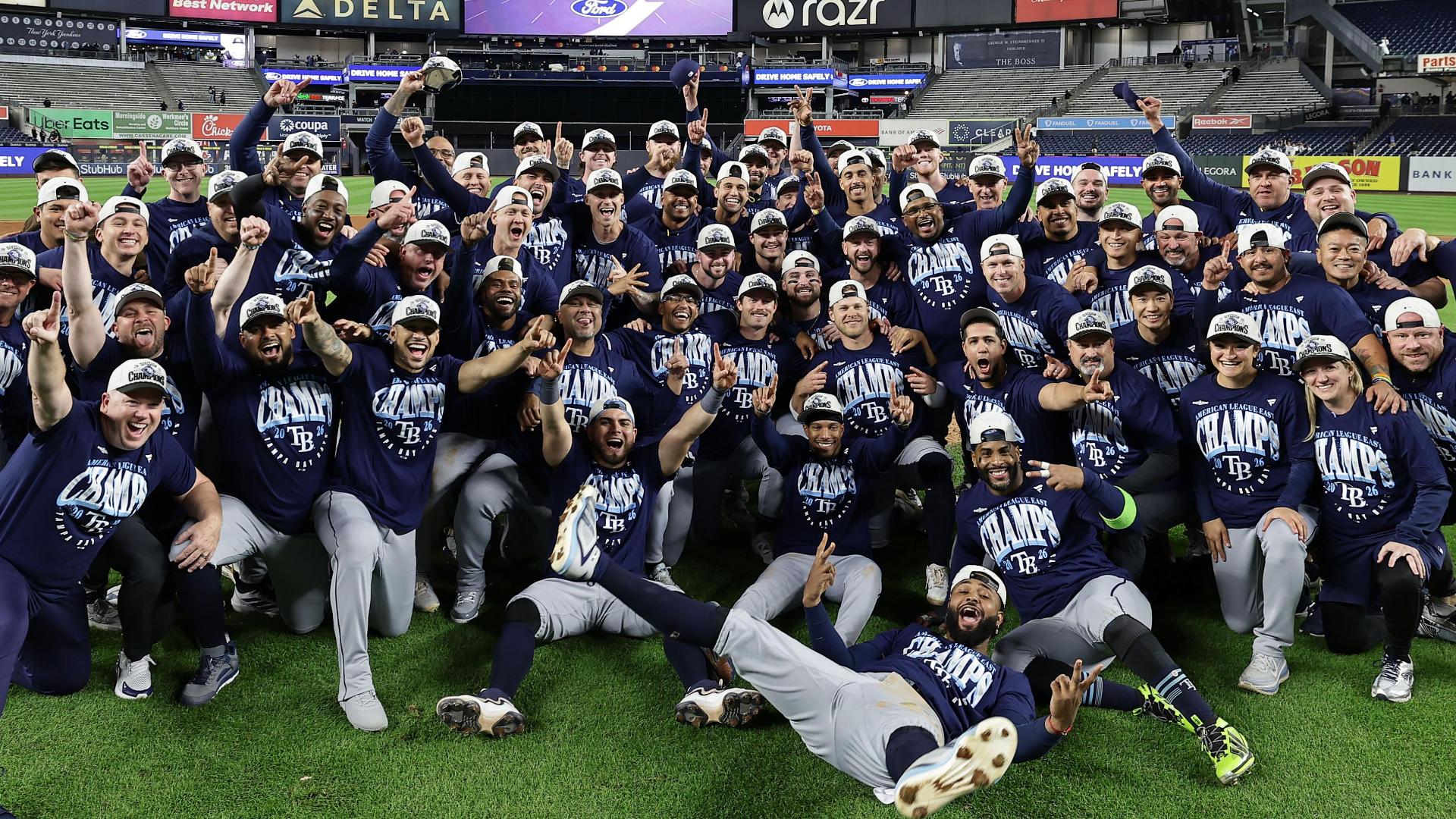
The Yankees scored a run in the 7th, and 1 in the 9th -- how doesn't really matter -- but it was far from enough. Rays 6, Yankees 2. The Rays clinched the AL East title, on our field. It is their 5th AL East title, as they previously won it in 2008, 2010, 2020 and 2021.

To put that in perspective: This is the Rays' 29th season, and they have 5 Division titles, plus 2 Pennants. In contrast, the Mets are in their 65th season -- yes, the organization is now eligible for Social Security and Medicare -- and they only have 6 Division titles, having won the National League East in 1969, 1973, 1986, 1988, 2006 and 2015. Of course, they have 5 Pennants to the Rays' 2, and 2 World Series wins to the Rays' none. The Yankees have won 21 Division titles, and that doesn't count their 1st-place finishes in the single-division American League of 1903 to 1968, or being in 1st place at the time of the Strike of '94.

So the Division title is out. And we found out yesterday that Aaron Judge, due to his calf strain, is not expected back for the length of the AL Wild Card Series.

That series will be a best-2-out-of-3, and will be played on September 29 and 30, and, if necessary, October 1, all at Yankee Stadium, because the Yankees have the 4th seed. They will play the 5th seed, which is yet to be determined, but currently stands to be... the Boston Red Sox. The Chicago White Sox currently hold the 6th seed, but they're 3 games behind the Red Sox, so it's probably going to be The Scum coming in for 2, maybe 3 games.

And we won't have Judge, or Giancarlo Stanton. We will, however, have Cam Schlittler and Gerrit Cole, but we have to give them runs.

Title 28 still seems a long way off.

September 23, 2001: The 9/11 Memorial Service at Yankee Stadium -- and the Jets Make Tom Brady Possible

September 23, 2001, 25 years ago: New York City holds a memorial service to the victims of the terrorist attack that destroyed the World Trade Center, 12 days earlier. It is held at the largest outdoor seating area within the City's Five Boroughs: Yankee Stadium.

In spite of the Stadium's capacity of 57,545, it is believed that just 20,000 people attended. Most likely, it was because only relatives and colleagues of those lost were permitted to attend, rather than that people were still afraid to gather in big crowds.

All 4 major U.S. TV networks broadcast it live. Prayers were offered by Edward Cardinal Egan, the Archbishop of New York, and also from leaders of Protestant, Greek Orthodox, Jewish, Hindu, Sikh, and even Muslim congregations, showing that they were all New Yorkers, that they were all Americans, and that they had all felt the losses of that awful Tuesday morning.

Also speaking were Mayor Rudy Giuliani, Governor George Pataki, U.S. Senator Hillary Clinton, and her husband, former President Bill Clinton. The current President, George W. Bush, did not attend. Former Mayors David Dinkins and Ed Koch, and former Governors Mario Cuomo and Hugh Carey, attended, but did not speak.

On September 11, 2002, the Yankees dedicated a Monument to the victims and rescue workers in the Stadium's Monument Park. As with the other Monuments and Plaques, it was moved to the new Yankee Stadium in 2009.

September 23, 2001 was a Sunday. Major League Baseball had restarted on Monday, September 17, with the week's worth of postponed games moved to the week after the originally-intended end of the regular season.

The Yankees beat the Baltimore Orioles, 5-4 at Camden Yards in Baltimore. The Yankees scored 2 runs in the 8th inning, 1 in the 9th to send the game to extra innings, and 1 in the top of the 10th, when John Parrish walked Bernie Williams with the bases loaded, forcing Nick Johnson home. This made a winning pitcher out of Nick Johnson, in relief of Orlando "El Duque" Hernández.

Cal Ripken, in his last few days as an active player, hit what turned out to be the last home run of his career, his 407th. Johnson homered for the Yankees, going 3-for-5 with 3 RBIs. Derek Jeter got the day off, with Enrique Wilson playing shortstop.

The Mets lost to the Atlanta Braves, 5-4 at Shea Stadium. Brian Jordan led off the top of the 11th inning with a home run, his 2nd homer of the game, making John Smoltz a winning pitcher in relief of Tom Glavine. Joe McEwing hit a home run for the Mets.

*

The NFL also returned to action, after postponing the previous weekend's games. The Giants beat the Kansas City Chiefs, 13-3 at Arrowhead Stadium in Kansas City.

Both of the planes that hit the Twin Towers of the World Trade Center in New York took off from Logan International Airport in Boston. As it worked out, the next game for the New York Jets and the Boston-area team, the New England Patriots, was against each other, at Foxboro Stadium in the Boston suburb of Foxborough, Massachusetts. (The stadium and the town, officially, had different spellings.)

Jets vs. Patriots was a rivalry that began in the American Football League in 1960. But, unlike such other New York vs. Boston matchups as Yankees vs. Red Sox, Knicks vs. Celtics and Rangers vs. Bruins, it wasn't that much of a rivalry until 1993, when the Patriots hired former Giants coach Bill Parcells, who then took his team back into the Meadowlands once a year to face the Jets. This included the 1996 season, when, with Drew Bledsoe at quarterback, the Patriots went on to win the AFC title, before losing the Super Bowl.

Then, in 1997, the Jets hired Parcells away, and that raised the rivalry more. He left, and in 2000, the Jets thought they'd hired former Parcells assistant Bill Belichick as head coach. He lasted one day, then quit to take the Patriots' job, infuriating Jet fans.

In this game, the Jets led, 10-3, with 3 minutes left in regulation, when Jet linebacker Mo Lewis knocked Bledsoe out of the game. At first, it was believed that Bledsoe had a concussion, serious enough to take him out, but nothing more. But he didn't seem right, and was sent to the hospital, where he was treated for internal bleeding. He almost died.

Bledsoe was replaced at quarterback by Tom Brady. Cliché Alert: The rest is history. The 10-3 score held, the Jets won, and the Pats fell to 0-2. Brady, a 6th-round draft choice out of the University of Michigan, became the starter, and went 5-3. Then he led the Pats to victory in their last 6 regular-season games, including a 17-16 win over the Jets at the Meadowlands, and overtime wins over San Diego ad Buffalo.
Then came the postseason. The Patriots beat the Oakland Raiders in the Divisional Round, in a snowstorm in what became known as "The Tuck Rule Game," in what turned out to be the last game in the 31-season history of Schaefer/Sullivan/Foxboro Stadium. What became Gillette Stadium, and the Patriot Place mall, were being built next-door.

Then came a win over the Steelers in Pittsburgh in the AFC Championship Game, when Brady got hurt, and Bledsoe was able to come back and be a part of the championship run. Then came Brady, and Adam Vinatieri's field goal, giving them an inspirational win over the St. Louis Rams in Super Bowl XXXVI. The Patriots were a bunch of plucky underdogs that had captured the nation's admiration.

But, like most teams that unexpectedly start winning and keep going -- the 1970s Dallas Cowboys, and in the 1990s, the Atlanta Braves, the New York Yankees, the Duke basketball team, and English soccer team Manchester United -- people got sick of them once they were no longer plucky underdogs.

It led to Brady and the Patriots absolutely dominating the AFC Eastern Division, and the Jets in particular, ever since.

And it all started with Mo Lewis hitting Drew Bledsoe too hard. What if Lewis had missed that tackle? Bledsoe would have remained the starter. Maybe the Patriots win fewer games. Maybe it's the Steelers who play the Rams in that Super Bowl. Maybe, instead of 6 Super Bowls, the Patriots win none. Or maybe Bledsoe only lasts another couple of years, and Brady takes over from there, and the Patriots' dynasty is merely delayed, instead of prevented.

We'll never know.