Saturday, August 15, 2026

August 15, 1926: The Dodgers Have Three Men On Base

Babe Herman

August 15, 1926, 100 years ago: Legend has it that Babe Herman of the Brooklyn Dodgers tripled into a triple play.

The legend isn't quite true. Ring Lardner, the top baseball writer of the era, wrote, "Babe Herman did not triple into a triple play, but he doubled into a double play, which is the next best thing."

Also, the Dodgers weren't even officially called the Dodgers at this point. I'll get to that at the moment.

Floyd Caves Herman was born in 1903 in Buffalo, and grew up outside Los Angeles in Glendale, California. After starring in the Southern Association for the Atlanta Crackers, the Memphis Chicks and the Little Rock Travelers; in the Texas League for the San Antonio Missions, and the Pacific Coast League for the Seattle Rainiers, he was signed by the Brooklyn Dodgers.

In 1914, the Dodgers hired former star catcher Wilbert Robinson as their manager, and they changed their name to the Brooklyn Robins, in his honor. They won the National League Pennant in 1916 and 1920, and finished 2nd in 1924.

But by the time "Babe" Herman -- nicknamed for a boxer who was from Edmonton, where Herman played early in his career, not for Babe Ruth -- reached the major leagues in 1926, the Dodgers weren't so good anymore. They became known as "The Daffiness Boys." Around this time, a fan known as Abie the Truck Driver was heard to yell, over and over, "Come on, you bums!" and was thus credited with creating the nickname that would stick with the team, first in agreement, and later, as they became good, as a term of endearment: "Dem Bums." And this was despite having Charles Arthur "Dazzy" Vance, the fastest pitcher in baseball at the time, and a future member of the Baseball Hall of Fame.

If the late 1920s Dodgers sound like a precursor to the 1960s expansion Mets, the last team that Casey Stengel managed, there are other parallels, including the fact that, in 1934, the Dodgers became the 1st team that Stengel managed. Come to think of it, in the off-season, Casey lived in Herman's hometown, Glendale.

It would be unfair to compare Herman to "Marvelous" Marv Throneberry. It true that Babe was known as a terrible fielder. While Marv's travails at 1st base were often seen on television, Babe's poor play in right field had to be seen at the ballpark. He always insisted that he was never hit on the head by a fly ball. A writer asked him if he'd ever been hit on the shoulder, and he said, "That doesn't count." With no TV to record his travails and tribulations, his poor fielding remains a legend.

But he was a heck of a hitter. He batted .324 for his career, including .381 in 1929 and .393 in 1930. Twice, he had at least 113 RBIs in a season; 5 times, he had at least 91. Phil Rizzuto, the eventual shortstop and broadcaster for the New York Yankees, grew up in Queens as a Dodger fan, and, even after getting into the Hall of Fame himself after a long wait, believed Herman should also have been elected.

But in his rookie year, no one would have suggested it. On August 15, 1926, the Robins hosted a Sunday doubleheader at Ebbets Field, against the Boston Braves. Vance started the 1st game, and before the 1st inning was over, there was already an unusual occurrence. Prior to striking out, Eddie Brown fouled off a Vance pitch, which hit umpire Eddie Quigley, and he had to leave the game with an injury. Since major league games then had only 3 umpires, this game was now down to 2.

(Quigley shook it off, and umpired behind the plate for the 2nd game. He umpired in the major leagues from 1913 to 1938, including 6 World Series. He was also a respected referee in college football and basketball, elected to the Basketball Hall of Fame. He served as athletic director for the University of Kansas, and the school's baseball complex is named for him.)

The game was scoreless until the top of the 6th, when the Braves scored. Then came the bottom of the 7th. Bear with me: This was complicated. Johnny Butler led off by singling to left. Hank DeBerry doubled to left, scoring Butler and tying the game.

With a runner on 2nd and nobody out, it was an easy choice for Robinson: He allowed Vance to bat for himself, and bunt DeBerry over. Except it turned out not to be a sacrifice: He beat it out. And starting pitcher Johnny Werts hit Chick Fewster with a pitch. The bases were loaded, and there was nobody out. Braves manager Dave Bancroft, a Hall of Fame shortstop, took Werts out, and replaced him with veteran hurler George Mogridge. He got Merwin Jacobson to pop up to him.

That brought Herman up. He hit a drive off the screen in right field. Under the ground rules at Ebbets Field, that meant that the ball was still in play. DeBerry scored easily, making it 2-1 Robins. Vance held up right after 2nd base, to see if the ball would be caught by right fielder Jimmy Welsh. It wasn't. Vance took off for 3rd base, and thought he could score. He probably would have.

But the Dodgers' 3rd base coach was Otto Miller, who had previously managed Herman in Atlanta. He saw Fewster coming in hard for 3rd base, and yelled, "Go back! Go back!" But, being a pitcher, Vance was not used to running the bases, and thought that Miller was telling him to go back to 3rd. So he did. Fewster apparently didn't hear Miller, and kept going, and ended up on 3rd. And so did Herman, who neither heard nor saw Miller. All three men were standing on third base.

The Braves' 3rd baseman, Eddie Taylor, received the ball when it came in from the outfield, and, faced with an unprecedented situation in baseball, did the only thing he could think of: Tag all 3 runners with the ball, even though each of them had a foot on the base, thinking himself safe.

The 2 remaining umpires, John "Beans" Reardon (so nicknamed because he was from Boston, a.k.a. "Beantown") and Charlie Moran, discussed the situation, and applied the correct ruling: Since Vance was the lead runner, he was the only one entitled to the base, so he was safe, and Fewster and Herman had been legitimately tagged out.

Thus, the 7th inning was over, and the Robins were leading, 2-1. Herman was credited with a double and an RBI -- the game-winning RBI, as it turned out. But it entered the public memory as "Babe Herman tripled into a triple play." (It couldn't have been, as there was already 1 out.)

The Robins scored 2 more runs in the top of the 8th, and won, 4-1. They also won the nightcap, 11-3. Over the 2 games, Herman went 4-for-8 with 4 RBIs. But the play took on a life of its own. In those days, prior to regular radio broadcasting of baseball games in New York, the legend grew of a taxi driver who pulled up to the right field corner, at Bedford Avenue and Sullivan Place, and yelled up to a fan in the last row, "Hey, how are the Dodgers doing?"

"Great!" the fan yelled down. "They have three men on base!"

"Yeah?" the cabbie asked. "Which base?"

After the 1931 season, Robinson was fired, and, with the Robins name having never really caught on, the Dodger name, still used by most Brooklynites, was officially restored.

Herman was traded to the Cincinnati Reds, and he bounced around. He had rotten luck: The Chicago Cubs won the Pennant in 1932 and 1935, but he was only with them in 1933 and 1934. The Reds brought him back, but got rid of him in 1936, winning the Pennant 3 years later. The Detroit Tigers won Pennants in 1934 and 1935, and would win another in 1940, but Herman was only with them in 1937.

The Tigers released him in the middle of that season, shortly before his 34th birthday, even though he had batted .300 in 17 games for them. He spent the 1938 season with the Jersey City Giants of the International League, and then went back home to the Pacific Coast League, playing 6 seasons for the Hollywood Stars, batting at least .307 every year.

In 1945, desperate for players due to the manpower drain of World War II, the Dodgers brought him back, at age 42. Appearing in 37 games, mainly as a pinch-hitter, he batted .265, and that was it for him. Having previously played for the Dodgers before uniform numbers were worn, in that season, he wore the Number 4 that would later be retired for Duke Snider, and the Number 32 that would later be retired for Sandy Koufax.

Lawrence Ritter interviewed him for his book The Glory of Their Times, published in 1966. Of the play, Herman said, "If there was any justice, Vance would have been the one declared out because he's the one caused the traffic jam in the first place. But down through history, for some strange reason, it's all been blamed on me."

Who knows, maybe that one play is why Babe Herman is not in the Baseball Hall of Fame. He died in 1987. He outlived Robinson, who died in 1934, while Herman was still playing; Fewster, who died in 1945, during Herman's comeback; Moran, one of the remaining umpires, who died in 1949; Quigley, the umpire who was hurt and couldn't participate in the call, who died in 1960; Vance, who died in 1961; Miller, who died in 1962; and Reardon, the umpire who made the correct ruling, who died in 1984. Taylor, the 3rd baseman who tried to tag everybody out, lived until 1992. And, of course, Herman long outlived the Brooklyn Dodgers themselves, who were moved to Los Angeles after the 1957 season; and Ebbets Field, which was torn down in 1960.

My grandmother, growing up in Queens, was a Dodger fan, but while she told me this story when I was a boy, she wasn't quite old enough to remember it herself. Her favorite poet was Ogden Nash, even though he was a fan of the Dodgers' arch-rivals, the New York Giants. In 1949, Nash, wrote "Line-Up for Yesterday" for Sport magazine, an alphabetical list of star players. For the letter V, he wrote:

V is for Vance
The Dodgers' very own Dazzy.
None of his rivals
Could throw as fast as he.

Friday, August 14, 2026

Yanks Got to Get Them Healthy

The Yankees had a home midweek series with the Seattle Mariners. In 3 games, they allowed 7 runs. Sounds like a sweep, right?

Sadly, that was not the case.

Tuesday night went well. Ryan Weathers went 5 2/3rds innings, allowing 1 run on 2 hits and 3 walks. Tim Hill got the last out in the 6th and pitched the 7th, Brent Headrick pitched the 8th, and David Bednar the 9th; and a 1-out single from Bednar was the only baserunner the bullpen allowed.

But it was 1-0 Mariners at the 7th inning stretch. Then... It's too bad there's no player named Daniel on the roster, because this team could be called "Danny & the Juniors." Luis García Jr. led off with a double, Jazz Chisholm Jr. singled, and George Lombard Jr. struck out. Spencer Jones walked to load the bases, and Ryan McMahon singled García and Chisholm home. Austin Wells singled, and Trent Grisham singled Jones and McMahon home. That was the ballgame: Yankees 4, Mariners 1. Hill was the winning pitcher.

Wednesday night got off to a rough start, as Will Warren allowed 3 runs in the 1st inning, and 1 each in the 3rd and the 5th. But 5 relievers went 5 innings, allowing no runs on 3 hits and 3 walks. The Yankees got a run in the 2nd, and 2 in the 3rd, and tied it up in the 5th, on a home run by Grisham, followed by back-to-back doubles by Ben Rice and Jones.

With 1 out in the 7th, and the game still 5-5, Lombard singled. Grisham doubled him home. Rice singled Grisham home. Jones was hit by a pitch. García struck out. Heliot Ramos, in spite of hitting poorly since the Yankees acquired him, was intentionally walked, so that the M's could face the struggling Chisholm. But he drew his own walk to force Rice home. It was 8-5.

In the 8th, Lombard singled, and Grisham hit one out. That made the final score 10-5. Paul Blackburn, having allowed just 1 walk in an inning and 2/3rds, was the winning pitcher.

Then came the dreaded day game after a night game. Max Fried, still working his way back from injury, was strong for 5 innings, making 1 mistake, a 2nd inning home run to Weston Wilson. Between them, Fried and 3 relievers allowed just the 1 run on 5 hits and 3 walks, striking out 10.

But Logan Gilbert made sure the Yankees got nowhere. They wasted a leadoff double by García in the 2nd, 1-out singles by Ali Sánchez and Grisham in the 3rd, a 1-out single by García in the 4th, and a 1-out walk by Rice in the 6th. José Caballero and McMahon walked in the 7th, but couldn't be brought home, and the Yankees went down meekly in the 8th and the 9th. Great pitching, wasted: Mariners 1, Yankees 0.

*

We have reached the point where one of my annual tropes comes in: If the number of games behind is less than the number of weeks left in the regular season, there's still hope. If you can gain an average of one game a week, you can win the Division.

There are 7 weekends and 6 full weeks left. And the Yankees trail the Tampa Bay Rays in the American League Eastern Division by... six and a half games. 6 1/2. And, Cliché Alert: It's 7 in the All-Important Loss Column. The Boston Red Sox trail by 9 1/2 (10), the Toronto Blue Jays by 16 1/2 (15), and the Baltimore Orioles by 16 1/2 (17). The Yanks still hold the 4th spot the AL Playoff seedings. The Yanks, Sox and O's have 41 games left; the Rays, 42; the Jays, 39.

Here's those remaining 41 games:

* Starting tonight, and running through Sunday: At Toronto.
* August 18 to 20: At Baltimore.
* August 21-23: Home to Toronto.
* August 25-27: Home to Houston.
* August 28-30 (4 games, including a doubleheader on the 29th): Home to Boston.
* August 31-September 2: Away to the Los Angeles Angels.
* September 4-6: Away to San Diego.
* September 8-10: Home to Colorado.
* September 11-13: Home to the Mets.
* September 14-16: Away to Minnesota.
* September 18-20: Away to Arizona.
* September 22-24 (4 games, including a doubleheader on the 22nd): Home to Tampa Bay.
* September 25-27: Home to Baltimore.

But, since the All-Star Break, the Yankees have a team ERA of 2.93, best in the AL; but a team batting average of .210, worst in the AL. That's what happens when you have Judge, Stanton and Bellinger, and all of them are injured at the same time.

Injury updates, in current presumed order of return:

* Carlos Rodón: Had what may be his last minor-league rehab start last night. His next start may be in the series in Baltimore.

* Cody Bellinger: Has been taking batting, running and fielding practice. Three days ago, Aaron Boone said he was at "90 percent of his top speed." He might also be back for the Baltimore series.

* Luis Gil: Began minor-league rehab relief appearances 3 days ago. He probably won't return until at least the next homestand, on August 21. If he pitches at all in the regular season, he could be key to straightening out the bullpen.

* Giancarlo Stanton: Has begun running, as well as hitting and fielding. Could return before September 1.

* Clarke Schmidt: Had cramping in his right forearm during a "live batting practice" session on August 4. Has resumed playing catch, but hasn't yet thrown off a mound again. I wouldn't expect him back before September 1.

* Aaron Judge: Has been "cleared for light exercises," which is vague as hell. Who knows? Maybe they should just shut him down until the last week, and then unleash him in time for the postseason.

Got to get them healthy, especially those hitters.

Wednesday, August 12, 2026

August 12, 1936: The Biggest Baseball Crowd -- In Berlin?

Bill Sayles. The "B" stands for "Brooklyn," not "Berlin."

August 12, 1936, 90 years ago: What was definitely the biggest crowd in baseball history to that point, and may still be, sees a game in... Nazi Germany?

After having been a "demonstration sport," rather than an actual competition, at the Olympic Games in Paris in 1900, and again in Stockholm, Sweden in 1912, baseball returned to Olympic display, though still not yet joining official Olympic competition, in 1936.

There was a single exhibition game, played at the Olympiastadion in Berlin. Since Olympic competitors had to be amateurs until 1992, all of the players in the game were Americans who had not yet played in the minor leagues, let alone in the major leagues. The umpire was Leslie Mann, whose 16-year major league career included playing as an outfielder for the 1914 World Series-winning "Miracle" Boston Braves. He had been among the leading advocates for putting baseball in the Olympics.

The "visiting team," the one batting 1st, was called the "U.S. Olympics." The "home team" was called the "World Champions." The game was set for 7 innings. The game was set for 8:00 PM, and for most of the players, this would be their 1st experience in a night game. (The 1st night game in MLB had been played the season before, at Crosley Field in Cincinnati, but that was still the only major league park with lights.)

Although the Olympiastadion was built for soccer and for track & field events, and didn't have room for a standard baseball field, I can find no reference to whether any accommodation was made for any "short fences."
The Berlin Olympiastadion

A crowd then estimated at 90,000 came out. Officially, the biggest crowd that had ever attended a single Major League Baseball game (rather than a doubleheader) was the 74,217 who were said to have attended the opening game of the original Yankee Stadium in 1923. (And that was almost certainly a lie, exaggerated by around 12,000 or so.)

But the Associated Press reported the crowd as being over 100,000, without getting any more specific than that. If so, then this remained a record for any baseball game until 2008, when 115,300 packed into the Los Angeles Memorial Coliseum for an exhibition game. Regardless of the actual total, neither the Chancellor of Germany at the time, Adolf Hitler, nor any official of the Nazi Party, was said to have attended.

For the U.S. Olympics, 1st baseman Bill Shaw hit a 2-run home run in the 1st inning. At the end of 6 innings, the World Champions led, 5–4. The Olympics scored in the top of the 7th to tie the game, before Les McNeece hit a solo home run, what would now be called a walkoff home run, in the bottom of the 7th, to win the game for the World Champions, 6-5.

Bill Sayles was the starting pitcher for the World Champions. He was the only player in this game who would go on to play in the major leagues: He pitched in 5 games for the Boston Red Sox in 1939, 18 for the New York Giants in 1943, and 5 for the Brooklyn Dodgers in 1943, with a record of 1-3, and an ERA of 5.61. Most likely, he made those 1943 appearances solely because of the manpower drain caused by the war the Nazis started. He lived on until 1996.

Baseball would once again be a demonstration sport at the Olympics in Helsinki, Finland in 1952, and then occasionally, until finally becoming an official competition sport in Barcelona, Spain in 1992. After 2008 in Beijing, it was dropped. It was restored for Tokyo in 2020 (2021), but dropped again for Paris in 2024. It will be restored for Los Angeles in 2028, with a 6-team tournament to be played entirely at Dodger Stadium, during a planned 11-day break in the Major League Baseball season.

August 12, 1676: The Death of Metacomet Ends King Philip's War

August 12, 1676, 350 years ago: Metacomet, the Sachem of the Wampanoag tribe, is killed in battle. This ends what the English colonists in America called "King Philip's War." Which was nasty.

He was believed to have been born in 1638, in Massachusetts. His father Massasoit and his older brother Wamsutta were Sachem before him. But they died in quick succession in 1661 and 1662 and Metacomet believed they were poisoned by the English. Wamsutta's widow, Weetamoo, became a key ally, and let him marry her sister, Wootonekanuske.

In 1660, Wamsutta and Metacomet went to the court of Plymouth, Massachusetts, and requested English names. Wamsutta was named Alexander, and Metacomet was named Philip. This may have been foreshadowing of later trouble, although Alexander the Great was the son of King Philip II of Macedonia; in this case, a Philip followed a relative named Alexander as king.

"King Philip," as the English now knew him, used tribal alliances to coordinate efforts to push European colonists out of New England. Many of the native tribes in the region wanted to push out the colonists following conflicts over land use, diminished game as a consequence of expanding European settlement, and other tensions.

To the west, the Iroquois Confederation of New York was also fighting against neighboring tribes in the Beaver Wars, pushing them from the west and encroaching on Metacom's territory. Finally, in 1671, the colonial leaders of the Plymouth Colony forced major concessions from Metacomet. He surrendered much of his tribe's armament and ammunition, and agreed that they were subject to English law.

The encroachment continued until hostilities broke out on June 20, 1675, when a band of Pokanokets attacked several isolated homesteads in the small Plymouth colony settlement of Swansea, burning several homes, likely against Phillip's approval. 

As the colonists brought their growing numbers to bear, King Philip and some of his followers took refuge in the great Assowampset Swamp in southern Massachusetts, in the area now occupied by New Bedford and Fall River. He held out for a time, with his family and remaining followers.

On August 12, 1676, hunted by a group of rangers led by Captain Benjamin Church, Metacomet was fatally shot at Mount Hope, now part of Bristol, Rhode Island, by John Alderman, a "praying Indian" (a Native American who had converted to Christianity), whose brother had been killed by Metacomet's men. The Sachem was probably 38 years old.

Metacomet's head was severed, and mounted on a pike at the entrance to Plymouth, where it stayed for over 20 years. Alderman was given Philip's right hand as a trophy. Remaining Native Americans that weren't killed during the war relocated to join other tribes or reservations, while many Native American leaders were sold into slavery, including Wootonekanuske and the one son that Metacomet was known to have had, taken to the English colony of Bermuda. The Mitchell family of Middleboro, Massachusetts claimed to be descended from that son.

King Philip's War is considered by many to be the deadliest war in Colonial American history. In the space of little more than a year, 12 of the region's towns were destroyed, and many more were damaged. The economy of the Plymouth and Rhode Island Colonies was ruined, and they lost 1/10th of all men available for military service -- literally, decimated. And they were still better off in the end than their opponents: Hundreds of Wampanoags and their allies were publicly executed or enslaved, and the Wampanoags were left effectively landless.

It was the last-ditch effort by Native tribes to expel the colonists from New England. Instead, it turned out to be the beginning of the development of an independent American identity. The New England colonists faced their enemies without support from any European government or military, and this began to give them a group identity separate and distinct from England.

Disclaimer: Much of this post is taken from Wikipedia's entries on Metacomet and the war.

Tuesday, August 11, 2026

Yankees Pitching Great But Need Their Injured Hitters Back

In their home Interleague series with the Atlanta Braves this weekend, the Yankees' 3 starting pitchers combined to go 20 1/3rd innings, allowing 3 runs on 11 hits and 2 walks, striking out 27.

Unfortunately, in the 1st 6 innings of each game, the Yankees themselves only got 3 runs on 12 hits and 6 walks. That's not enough.

Max Fried was terrific on Friday night: 6 1/3 innings, no runs, 3 hits, 2 walks, 7 strikeouts. But the Braves' Tyler Mahle pitched 6 shutout innings. And because Fernando Cruz and Tim Hill each allowed a run, the Yankees went into the bottom of the 9th trailing, 2-0.

But with 1 out, rookie shortstop George Lombard Jr. hit an infield single. After Ryan McMahon struck out, Austin Wells, who needed a big hit as much as any Yankee has in recent memory, doubled him home. Amed Rosario worked a walk, and Ben Rice singled Wells home. Heliot Ramos was hit by a pitch, and Luis García Jr. grounded out. The game went to extra innings.

David Bednar got the Braves out 1-2-3 in the top of the 10th. With 1 out in the bottom of the 10th, rookie center fielder Spencer Jones was walked intentionally, to set up the inning-ending double play. But Tyler Kinley then walked Lombard unintentionally to load the bases with 1 out. McMahon flew out to right field, a position at which the Braves' Ronald Acuña Jr. probably has the best arm since prime Ichiro Suzuki. But even he couldn't throw Jones out, and the Yankees won, 3-2.

*

Saturday afternoon was Old-Timers Day. From my childhood, Reggie Jackson, Ron Guidry, Mickey Rivers, Willie Randolph and Bucky Dent appeared. From the 1996-2003 dynasty, Joe Torre, Mariano Rivera, Paul O'Neill, Bernie Williams, Tino Martinez, Jorge Posada, Joe Girardi and David Cone were on hand -- but not Derek Jeter. It's depressing to think of the 2009 Yankees as "old-timers," but there were Hideki Matsui and Nick Swisher.

New Hall-of-Famer CC Sabathia didn't come, but he lives in California, and will be back for his Monument Park dedication in September. Alex Rodriguez also did not come, although, as a broadcaster, he may have been working. Same with Don Mattingly, now managing the Philadelphia Phillies.

Also introduced were Diana Munson, widow of Thurman; Kay Murcer, widow of Bobby; and Jill Martin, widow of Billy. Helen Hunter, widow of Catfish, did not attend this time.

It now appears to be too far back for even the last survivors of the 1950s and 1960s Yankees to come, as there was no sign of Bobby Richardson or Al Downing, and Tony Kubek has only come once, and that was when he had a book to promote. And Tommy John, who has been battling cancer, sent a message that suggests that, next year, he'll be among those names read off at the end, as "members of the Yankee family who have passed away within the last year."

When it's Old-Timers Day, or the day of a dedication for Monument Park, I'm concerned that the current Yankees won't live up to the standard that the legends set. Thankfully, my fears were not realized this time.

It was supposed to be a duel of aces, of potential future Hall-of-Famers. Gerrit Cole went 7 innings, allowing 2 runs on 6 hits and no walks, striking out 9. For his career, he is now 159-85, with a 3.18 ERA, a 1.088 WHIP, and 2,338 strikeouts. In contrast, Chris Sale, now 157-95, 2.96, 1.044 and 2,730, was nearly as good, but not quite.

(Justin Verlander, with 266, is the active leader in wins. Max Scherzer is 2nd, with 222. Cole is 3rd, and Sale is 4th. No other active pitcher even has 140 wins. Let that sink in. In strikeouts, Verlander has 3,554, Scherzer has 3,516, Sale is 3rd, Cole is 4th, and only 4 other guys have 2,000, although Jacob deGrom is now 5 short of that milestone.)

Ben Rice hit his 32nd home run of the season. Lombardi hit his 2nd, the 2nd of his career. He hit it to the opposite field, to right field, over the head of Mike Yastrzemski, grandson of Carl. Broadcaster Michael Kay invoked Bill White in the Bucky Dent Game in 1978: "Hit deep to right field, Yastrzemski will not get it, it's a home run!" The Yankees won, 5-4.

*

But Sunday afternoon would be frustrating. Cam Schlittler was brilliant: Over the 1st 6 innings, he allowed just 1 hit, and no walks, striking out 9. But in the top of the 7th, it was still 0-0, and he gave up a home run to Mat Olson. He finished the inning, having allowed 1 run on 3 hits, no walks, and 11 K's. Most days, that would have been enough to win.

But the Yankees couldn't do much against Grant Holmes. They went down 1-2-3 in the 1st, the 4th, 

They wasted a 1-out single by Jazz Chisholm in the 2nd, wasted a leadoff walk by McMahon in the 3rd, wasted a 1-out walk by Jones in the 5th, had Wells on 3rd and Trent Grisham on 2nd with 1 out in the 6th and blew it, and wasted a 1-out walk by Chisholm in the 7th.

With 2 out in the 8th, Grisham hit a home run to take Cam off the hook. But the Yankees went down 1-2-3 in the bottom of the 9th. Extra innings again. The damn ghost runner again. Paul Blackburn gave up a run in the top of the 10th, and the Yankees went down quietly in the bottom half. Braves 2, Yankees 1. The Yankees took the series against the Braves, who lead the National League Eastern Division. But the series ended up being rather unsatisfying.

*

The Yankees come into today at 66-52, a winning percentage of .559, and thus a pace to go 90-72. That's usually good enough to make the Playoffs, but not to win the American League Eastern Division.

The Yankees trail the Tampa Bay Rays by 6 games. The Boston Red Sox trail them by 8, the Baltimore Orioles by 15 1/2, and the Toronto Blue Jays by 16. The Yankees have 44 games to play, roughly the last one-quarter of the regular season.

Cliché Alert: Connie Mack, who managed and owned the Philadelphia Athletics for 50 years, is credited with the saying, "Pitching is 75 percent of baseball." Billy Martin definitely said, "Connie Mack lied."

Well, in spite of all the injuries, the Yankees have, for the most part, gotten superb starting pitching this season. And closer David Bednar has been very good. But the rest of the bullpen has been shaky. (That's almost worth a Cliché Alert right there.) And, except for Ben Rice, the big hitters have gotten hurt, and nobody has really stepped up in a noticeable way.

As to the injuries:

* Carlos Rodón is pitching in minor-league rehab assignments, and the results have been encouraging. He is expected to make one more minors start, and then rejoin the team for the roadtrip starting this weekend.

* Cody Bellinger started taking on-field batting practice last Tuesday. He might also be back this weekend, which would be a big boost.

* Giancarlo Stanton is also taking live batting practice and doing his outfield running. He could be back sometime before August runs out.

* Clarke Schmidt "is expected to resume throwing from a mound in the next several days." It sounds like he might be back by the start of September.

* Aaron Judge has been "cleared for light exercises, including outdoor running and upper-body resistance training." We can be hopeful for a September return for the man who was on pace to be the AL's Most Valuable Player again.

The Yankees close this homestand with 3 games against the Seattle Mariners: Tonight and tomorrow night at 7:05, and Thursday afternoon at 1:35. Come on you Pinstripes!

Sunday, August 9, 2026

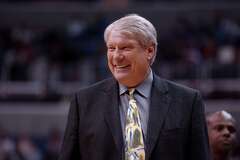
Don Nelson, 1940-2026

Don Nelson was a basketball lifer. He had an interesting career as a player, but he became more interesting as a coach.

Donald Arvid Nelson was born on May 15, 1940 in Muskegon, Michigan, right across Lake Michigan from Milwaukee. He grew up in a farm outside Sherrard, Illinois, in the Quad Cities region that straddles the Mississippi River in Illinois and Iowa. He graduated from Rock Island High School, 2 years ahead of Ken Bowman, a center who helped the Green Bay Packers win the 1st 2 Super Bowls.

Milton "Sharm" Scheuerman was the head basketball coach at the University of Iowa, and a Rock Island High graduate, and recruited Nelson. He also recruited Brooklyn high school star Connie Hawkins, but Hawkins was caught up in a gambling scandal. Despite never being charged with a crime, Hawkins was kicked out of school, and banned from the NBA, playing in the ABL, AAU ball, and the ABA before his ban was lifted.

At a time when the NCAA Tournament only invited 24 teams, and from a conference only the Champion, Iowa finished 2nd to Ohio State team of Jerry Lucas and John Havlicek in 1961, and missed the Tournament. "If Connie had stayed, we would have had a great team," Nelson said. "I feel we could have edged out Ohio State my junior and senior years." Nelson was named a 3rd-term All-America in 1962.

He was taken by the Chicago Zephyrs in the 3rd round of the 1962 NBA Draft. After 1 season, he was waived, claimed by the Los Angeles Lakers. They reached the Finals in each of his 2 seasons with them, but lost both to the Boston Celtics.

He was released, but the Celtics must have liked what they saw, because they signed him as a free agent. He helped them win the 1966, '68 and '69 NBA titles. He remained with them through their rebuilding, and helped them win the title again in 1974 and '76, at which point he retired as a player. In 1973, he was inducted into the Illinois Basketball Coaches Association Hall of Fame as a player. The Celtics retired his Number 19 in 1978.

*

His son Donnie remembers the family sitting in a Maid Rite restaurant in Moline, Illinois (one of the "Quad Cities," along with Rock Island, and Davenport and Bettendorf, Iowa), and Don saying he had three choices: sell cars, become an NBA referee, or accept an assistant's job under Milwaukee coach Larry Costello. They voted 5–0 for the Milwaukee job, which paid $25,000.

The Bucks got off to a 3-15 start in 1976-77, and Costello, despite having led the Bucks to the 1971 NBA Championship and the 1974 NBA Finals, which they lost to "Nellie" and the Celtics, was fired. Nelson was named head coach. At the end of the season, only 37 years old, he was also given the general manager's job. He built a team around speed, and not caring about height, often letting shorter but faster players guard taller but slower ones.

The result of "Nellie Ball" was 7 straight Division titles: 1980 in the Midwest Division; then, after an NBA realignment, 6 in the Central Division, in 1981, '82, '83, '84, '85 and '86. He was named NBA Coach of the Year in 1983 and '85. But the closest he could get to a title was reaching the Eastern Conference Finals 3 times, in 1983, '84 and '86.
In 1985, Jim Fitzgerald sold the Bucks to department store mogul and future U.S. Senator Herb Kohl. Nelson didn't get along with him, but he had gotten along with Fitzgerald. In 1986, Fitzgerald bought a different NBA team, the Golden State Warriors. After a season as a broadcaster, Nellie accepted the head coaching job with the Warriors, and even bought an ownership stake.

Again using a run-and-gun style, he coached them for 6 seasons, building an offense known as Run TMC, after the rap group Run-DMC, for Tim Hardaway Sr., Mitch Richmond and Chris Mullin. He was awarded a 3rd Coach of the Year trophy in 1992. But he only won 2 Playoff series, and resigned during the 1994-95 season.

He was hired to coach the New York Knicks for 1995-96, replacing Pat Riley. But Riley had built a defense-oriented team, and Nellie Ball didn't work with them. When he recommending trading the team's marquee player, Patrick Ewing, so that enough salary cap space would be available to make an offer to Shaquille O'Neal, who was unhappy with the Orlando Magic and wanted to play in a big market, that was the last straw for Knicks management: He was canned on March 8, 1996. Shaq ended up going to the Los Angeles Lakers.

In 1997, he was hired as head coach and general manager of the Dallas Mavericks. It took him 4 seasons to turn them from dreadful to a Playoff team, and in 2003, the Mavs won the Midwest Division and reached the Western Conference Finals. But that was as close as he would get, and he resigned late in the 2004-05 season.
In 2006, Mullin, now the Warriors' GM, brought Nelson back to Oakland. He won 16 of their last 21 games, squeezing into the Playoffs as the 8th seed, and upset his former team, the Mavericks, in the 1st round. This was only the 3rd time an NBA 8th seed had beaten a 1st seed, and the 1st time since the 1st round went to a best 4-out-of-7.

But he never got them into the Playoffs again. On April 7, 2010, the Warriors beat the Minnesota Timberwolves, 116-107 at the Target Center in Minneapolis, giving Nelson his 1,333rd career coaching win, surpassing Lenny Wilkens for the most in history. He held that record until 2022, when he was surpassed by Gregg Popovich. He retired at the end of that season, with a record of 1,335-1,063 (.557).

In all, he coached 17 members of the Basketball Hall of Fame. With the Bucks: Alex English, Bob Dandridge, Sidney Moncrief, his former Celtics teammate Dave Cowens, Nate "Tiny" Archibald, Bob Lanier and Jack Sikma. With the Warriors: Chris Mullin, Ralph Sampson, Mitch Richmond, Tim Hardaway, Šarūnas Marčiulionis and Chris Webber. With the Knicks: Patrick Ewing. With the Mavericks: Steve Nash, Dirk Nowitzki, Dennis Rodman briefly, and Hardaway again. 

He coached 6 of the 9 players to have had their uniform numbers retired by the Bucks: 10, Dandridge; 4, Moncrief; 16, Lanier; 32, Brian Winters, 2, Junior Bridgeman; and 8, Marques Johnson. Only 1 of his Warriors players had his number retired: Mullin, 17. Ewing had his Number 33 retired by the Knicks, and Nowitzki had his Number 41 retired by the Mavs.

He was elected into the Iowa Sports Hall of Fame in 1983, the Quad City Sports Hall of Fame in 1987, the University of Iowa Athletics Hall of Fame in 1989, and the Basketball Hall of Fame in 2012. In 1996, in coordination with the NBA's 50th Anniversary, he was named one of their Top 10 Coaches. In 2021, in coordination with the NBA's 75th Anniversary, he was named one of their Top 15 Coaches.

He married twice, and had 7 children and 15 grandchildren. His son, Donn Charles Nelson, known as Donnie Nelson, played basketball at Wheaton College in Wheaton, Illinois -- making it up to a school that his father had turned down to go to Iowa. Donnie became an assistant to his father the 1st time around with the Warriors, and with the Mavericks, and in between to Dannie Ainge with the Phoenix Suns. From 2005 to 2021, he was the Mavs' GM, helping to build teams that won 3 Division titles, 2 Western Conference titles, and the 2011 NBA Championship.

In 2012, 50 years after leaving the University of Iowa, Don Nelson finally completed his degree there. He settled on a farm on the Hawaiian Island of Maui, where he grew flowers, coffee and cannabis. He hosted poker games, where he was joined by celebrities like country singer Willie Nelson and actor Woody Harrelson, who are also fond of the last of those crops.

"I know how far I've come from being a hog farmer," Nelson said. "I've come a long, long way from being some country kid. I got in the fast lane, and I've stayed there a long time. I've done pretty well."
But his health began to fail, and earlier this year, he moved back to the mainland, to the Dallas suburb of Frisco, Texas. He suffered a stroke, was admitted to hospice care, and died today, August 9, 2026, at the age of 86.

August 9, 1936: His Name Was Sohn Kee-chung

August 9, 1936, 90 years ago: Legendary journalist Lincoln Steffens died in Carmel-by-the-Sea, California. He was 70 years old.

Meanwhile, the marathon race is held in the Olympics in Berlin, Nazi Germany. Officially, it was won by Kitei Son of Japan, a nation that would soon be an ally of the Nazis.

Unofficially, it was a much better story.

His real name was Sohn Kee-chung. He was born on August 29, 1912, in Sinŭiju, in what is now North Korea. Since 1910, however, Korea had been part of the Empire of Japan. And so, any athletes from Korea were forced to compete for Japan, under their flag, and with Japanese names.

Between 1933 and 1936, Sohn Kee-chung ran 12 marathons, finishing in the top 3 in each, and won 9. On November 3, 1935, in the Japanese capital of Tokyo, he set a world record with a time of 2 hours, 26 minutes and 42 seconds.

In the 1936 Olympics, Sohn tried to sign his name in its correct Korean form. But it was not his legal name, and so he was forced to write it in, and compete, as Kitei Son. Another Korean, Nam Sung-yong, entered the marathon, and had to compete under his legal Japanese name, Nan Shōryū. Sohn won the race in 2 hours, 29 minutes, 19.2 seconds, breaking the Olympic record. Nam finished 3rd, winning the Bronze Medal.

The International Olympic Committee, not recognizing Korea as a member, credited both medals to Japan's total. Sohn refused to acknowledge the Japanese national anthem while it was played at his award ceremony, and later told reporters that he was ashamed to run for Japan.

In 1945, Allied forces forced the surrender of Japan, and Korea was free. But, as part of the peace treaty, a line was drawn at the 38th parallel, and Communist forces had control over the northern part, including Sohn's hometown of Sinŭiju. The Korea War resulted, from 1950 to 1953, and the new border was a diagonal across the country, but roughly around the 38th parallel.

Sohn was named the team manager for Korea's national track & field team. In 1947, his trainee, Suh Yun-Bok, won the Boston Marathon, breaking the record that Sohn had set in Tokyo in 1935. For the Opening Ceremony for the 1948 Olympics in London, the entire Korean team chose Sohn to be their flag bearer. In 1950, another Sohn trainee, Ham Kee-Young, won the Boston Marathon.

In 1988, the Olympics were held in Seoul, the capital of the Republic of Korea (a.k.a. South Korea). The final runner in the Olympic torch relay, receiving perhaps the greatest ovation anyone has ever received in an Olympic ceremony, was 75-year-old Sohn Kee-chung. He attended the 1992 Olympics in Barcelona, Spain, and saw Hwang Young-Cho win the Olympic marathon.
Sohn died on November 15, 2002. Nam Sung-young, who had worked with him at the Korean Sporting Association, had died a year earlier. On December 9, 2011, the IOC recognized Korean nationality of Sohn and Nam, and all other Korean athletes under the Empire of Japan, in their official profiles.

August 9, 1526: Slavery Comes to the Americas

A recent aerial photo of the area

August 9, 1526, 500 years ago: Lucas Vázquez de Ayllón, a Spanish magistrate, around 46 years old, founds the San Miguel de Gualdape colony. It was the first European settlement, as well as the first documented occurrence of enslavement of African peoples, in what would later become the continental United States.

Ayllón had previously served as an administrator in Hispaniola, in what would become the Dominican Republic. In 1521, he visited what would become the site of his colony, kidnapped 60 Native Americans living there, and took them back to Hispaniola as slaves.

He reported back to his superiors that the land he had found was not defended militarily, and could easily be taken. He received permission to establish himself as governor there, but only after he completed an audit of Spanish officials in Puerto Rico. It took him until 1526 to do that.

He named the settlement after St. Michael the Archangel, and the local Guale tribe. However, due to the similarity of the name to that of the Spanish city of Guadalupe, it is sometimes written as "San Miguel to Guadalupe."

When he got to his new colony, with some black slaves who had been brought first to Hispaniola, he found bad soil, making it hard to grow anything. And there weren't very many natives left, making trade next to impossible. His town survived less than 3 months, with settlers enduring exhaustion, cold, hunger, disease, and troubles with the local natives. When Ayllón died on October 18, from an unnamed illness, the entire enterprise fell apart. As my father would have said, "Served him right."

The surviving colonists broke into warring factions, including America's 1st slave rebellion. By mid-November, the colonists decided to give up and sail back to Hispaniola. Of the 600-700 people whom Ayllón had brought with him, only 150 survivors reached Hispaniola that winter.

Ayllón's account of the region inspired a number of later attempts by the Spanish and French governments to colonize the southeastern United States. In 1565, Spain would end all French attempts at colonizing the region, and establish St. Augustine, Florida, the oldest continuously-occupied European settlement in what is now the U.S. England would follow with Virginia in 1607 and Massachusetts in 1620. France occupied what became Louisiana, the American Midwest, and eastern Canada.

Today, the place that Spain called San Miguel de Gualdape is called Winyah Bay, in Georgetown County, on the coast of South Carolina. Just to the south is the Tom Yawkey Wildlife Center, on the site of a plantation once owned by Yawkey, as had been the Boston Red Sox, who turned out to be the last team in Major League Baseball to racially integrate. NCIS fans, take note: Some things are just coincidences. 

Friday, August 7, 2026

Yanks Drop 2 of 3 to Redbirds

George Lombard Jr. (left) and Aaron Judge

The  Yankees came home from their unusual weeklong stay in Chicago, and started an Interleague series with the St. Louis Cardinals. On Monday night, Cam Schlittler had the worst start of his young career, going just 3 innings, allowing 4 runs on 4 hits and 5 walks, although he did strike out 6. The bullpen was no better.

Not that the Yankee bats didn't try. Going to the bottom of the 5th, they were down, 6-0, but a single by Ryan McMahon and back-to-back home runs by Austin Wells (trying to show the Yankees didn't need to get a catcher at the trading deadline) and Trent Grisham made it 6-3.

Then McMahon and José Caballero led off the bottom of the 7th with back-to-back homers. After a Grisham double, Luis García Jr. hit his 1st home run as a Yankee, and it was Pinstripes 7, Redbirds 6!

But, as I said, the bullpen didn't get the job done. Angel Chivilli had been fantastic up to this point, but, as C.J. would have said on The West Wing, he compwetewy impwoded, allowing 6 runs on 5 hits and a walk, including 3 home runs. Cardinals 13, Yankees 7.

On Tuesday night, one of my nieces, a former high school softball and tennis player now studying to be a medical assistant, went to her first Major League Baseball game. (Regrettably, I've never had the money necessary to take her and her sisters.) After the previous night's slugfest, she saw a dandy of a pitchers' duel between the Yanks' Ryan Weathers and the Cards' Hunter Dobbins. Weathers pitched 6 shutout innings, allowing 4 hits and a walk, striking out 6. The bullpen was on this time, finishing a 6-hit shutout. Jazz Chisholm hit one out in the 2nd, and George Lombard Jr. hit his 1st major league round-tripper in the 5th. Yankees 2, Cardinals 0.

Good thing she went that night, not the night before, or the night after. Will Warren didn't pitch badly on Wednesday, going 5 1/3rd, allowing 3 runs on 7 hits and a walk, striking out 5. And the bullpen held the Cards scoreless the rest of the way.

But the Yankees just didn't hit. They wasted an error that led to García reach base with 2 outs in the 1st inning, a leadoff double by the newly-acquired Heliot Ramos in the 2nd, a 1-out single by Wells in the 3rd, and a 1-out walk by McMahon in the 5th.

With 1 out in the 6th, Ben Rice and García walked, and Ramos was hit by a pitch to load the bases. This should have been the breakout inning. But Spencer Jones struck out, Chisholm worked a walk to force a run home, but McMahon struck out to end the inning.

And that was as close as the Yankees would get. In the 7th, Paul Goldschmidt doubled with 1 out, but Grisham popped up. Rice drew a walk, but García grounded out. With 2 outs in the 8th, Chisholm and McMahon drew back-to-back walks, bringing the great prospect Lombard to the plate as the go-ahead run, but he struck out. With 2 out in the 9th, Rice drew a walk, but Ali Sánchez struck out to end it. Cardinals 3, Yankees 1.

*

The Yankees are 64-51, a pace to go 90-72 -- almost certainly, good enough to make the Playoffs; almost certainly also not good enough to win the American League Eastern Division. The Yankees currently trail the Tampa Bay Rays in it by 4 1/2 games, with the Boston Red Sox 5 back, the Baltimore Orioles 12 1/2 back, and the Toronto Blue Jays 15 back. In the all-important loss column, the Rays lead both the slumping Yanks and the surging Sox by 5, the O's by 13, and the Jays by 16.

Carlos Rodón will begin a rehab assignment with Class AAA Scranton/Wilkes-Barre on Saturday. Giancarlo Stanton took some swings against him the preceding Monday. And Cody Bellinger "has been doing some outdoor running while also hitting and throwing." It sounds like those men should be back in about 2 weeks.

Aaron Judge "has been cleared to begin light activities," while Clarke Schmidt, according to Aaron Boone, was "expected" to play catch yesterday. This suggests an end-of-August return for them.

Tonight, the Yankees start a 3-game home Interleague series with the Atlanta Braves. Tonight's game is at 7. Saturday is Old-Timers Day, with the ceremony at 1 and the game at 3. The Sunday game is at 1:30. All games will be on YES.

Thursday, August 6, 2026

August 6, 1966: The Beatles "Get Canceled" by America's Religious Right

The Beatles -- left to right: Ringo, Paul, John and George --
on their 1966 World Tour,
looking uneasy, maybe even shellshocked.
Which would have been understandable.

August 6, 1966, 60 years ago: What would later be called "cancel culture" hits the biggest act in world entertainment at the time: The Beatles.

On March 4, 1966, The Evening Standard, a London-based newspaper but, like many, serving Great Britain nationally, published an article titled "How Does a Beatle Live?" written by Maureen Cleave. She had interviewed all 4 group members regularly, and accompanied them on their 1st visit to America in February 1964. She is widely believed to have had an affair with John, and to have been the subject of his song "Norwegian Wood (This Bird Has Flown)."
In her latest interview with John Lennon, she portrayed him as restless and searching for meaning in his life. The year before, he had written the song "Help!" While most American teenagers thought it was just a great rock and roll song, it was more than that: John was physically and mentally exhausted from 2 years of nonstop Beatlemania, and all the money he'd made hadn't reduced his stress. So he really was looking for help and meaning.

He and bandmate George Harrison had been reading about religion. Unlike George, who found a connection with Eastern, especially Indian, faiths, John found no comfort in it, or in any other religion. Cleave quoted him as saying:

Christianity will go. It will vanish and shrink. I needn't argue about that; I'm right and I'll be proved right. We're more popular than Jesus now; I don't know which will go first – rock 'n' roll or Christianity. Jesus was all right but his disciples were thick and ordinary. It's them twisting it that ruins it for me.

People in Britain barely noticed: The article provoked no controversy there. Church attendance there was in decline, and Christian churches were attempting to transform their image, to make themselves more "relevant to modern times."
At first, that was also the case in America. Later in March, Newsweek printed the quote. In May, Detroit magazine printed the interview. On July 3, The New York Times Magazine printed it. Still, there was no reaction worth mentioning.
On July 29, Datebook magazine published the interview, and also Cleave's most recent interview with Paul McCartney, in its September 1966 "Shout-Out" issue, which was dedicated to controversial youth-orientated themes, including recreational drugs, sex, long hair, and the Vietnam War.
Although only Paul was shown on the cover, Art Unger, the magazine's editor, put a quote from Lennon's interview on the cover: "I don't know which will go first – rock 'n' roll or Christianity!" In author Robert Rodriguez's description, the editor had chosen what he thought would be Lennon's "most damning comment" for maximum effect.
Except, while it probably should have been, that wasn't the quote that upset people: It was the line, "We're more popular than Jesus now."
And he was right. Granted, 2,000 years from now, if human civilization survives, there will likely be more Bibles sold than Beatle albums. But, at the time, kids were more interested in 4 young men from current Liverpool than in 1 young man from ancient Israel and his 12 disciples.
The people that freaked out over John's remarks shouldn't have asked, "How dare he say that?" They should have asked, "What can we do to make Jesus, once again, more popular than The Beatles?" (Disclaimer: I don't have an answer now, and I probably wouldn't have had an answer had I been around then.)
In Birmingham, Alabama, WAQY disc jockey Tommy Charles said, on the air, "That does it for me. I am not going to play The Beatles anymore." He destroyed their records on the air. Local UPI reporter Al Benn filed a news report in New York City, culminating in a major story in The New York Times on August 5. Radio stations all over the country, including in supposedly liberal cities like New York and Boston, announced that they would no longer play Beatle songs.
On August 6 came the kind of event that one would have expected in Nazi Germany: In Reno, Nevada, station KCBN announced a public bonfire for that night, where the band's albums would be burned.
Many stations in Southern cities followed. Paul compared it to what the Nazis did with books they didn't like, and called it "hysterical low-grade American thinking."
Brian Epstein, the group's manager, who was Jewish, shrugged it off at first, saying, "If they burn Beatles records, they've got to buy them first." But then the press office at the Vatican -- though not Pope Paul VI himself -- weighed in, issuing this statement: "Some subjects must not be dealt with profanely, not even in the world of beatniks." Now, it wasn't just a bunch of ignorant, bigoted, archconservative Southern Baptists that were angry at the Fab Four: It was, officially, the Roman Catholic Church.
What's more, there were death threats. Now, John was scared: He had put his bandmates, and even their loved ones -- by this point, all but Paul were married, John and Ringo Starr each had one son, and George had a sister and her children living in St. Louis -- at physical risk.
And so, for what turned out to be the only time in his public life, John Lennon ate crow, and apologized for something he'd said or done.
On August 11, the Beatles flew from London to Chicago, where the North American leg of their World Tour was to begin. That night, at the Astor Tower Hotel, at a press conference in front of TV cameras, John said, "I suppose if I had said television was more popular than Jesus, I would have got away with it. I'm sorry I opened my mouth. I'm not anti-God, anti-Christ, or anti-religion. I was not knocking it. I was not saying we are greater or better."
He stressed that he had been remarking on how other people viewed and popularized the band. He described his own view of God by quoting the Bishop of Woolwich, "not as an old man in the sky. I believe that what people call God is something in all of us."
He was adamant that he was not comparing himself with Christ, but attempting to explain the decline of Christianity in the UK. He closed with what could be considered a halfhearted apology: "If you want me to apologize, if that will make you happy, then, okay, I'm sorry." (Shades of more recent "I'm sorry if I offended anyone" statements.)
Most American journalists accepted this. A New York Times editorial said that the matter was over. Even the Vatican's newspaper, L'Osservatore Romano (The Roman Observer), decided that the apology was sufficient.
But it wasn't over. On August 13, in South Carolina, the Ku Klux Klan "crucified" a Beatles record on a large wooden cross, which they burned. On the same night, radio station KLUE in Longview, Texas held a Beatles bonfire. The next day, a lightning bolt struck its transmission tower, briefly knocking it off the air. Maybe this was God confirming that He had accepted John's apology as well.
It still wasn't over. On August 15, The Beatles played District of Columbia Stadium (later renamed Robert F. Kennedy Stadium), in Washington, which was still considered a semi-Southern city at that point, and the KKK picketed the concert. On August 19, The Beatles played their only scheduled concert in the South, at the Mid-South Coliseum in Memphis. The Klan picketed this show, too. During the concert, a spectator threw a firecracker onstage, and all 4 members later said that they thought someone had fired a gun.
(Memphis was, of course, the hometown of Elvis Presley. If anyone asked Elvis for his thoughts on the matter, they've never been made public.) 
To make matters worse, John couldn't keep his mouth shut. On August 17, before their concert at Maple Leaf Gardens in Toronto, he gave his approval to Americans fleeing to Canada to avoid the military draft. At a press conference in New York before their concert at Shea Stadium on August 22, John said the Vietnam War was "wrong." The year before, they had filled all 55,000 available seats at the Flushing Meadow stadium. This time, "only" 40,000 showed up, with pickets both for and against them facing off against each other. (There was no fight between these factions.)
It was their most stressful tour ever, and George said he'd rather leave the band than ever go on another tour. They decided they wouldn't, and would be only a recording band from that point onward, although they did not publicly announce it yet. George agreed to stay -- for now.
The last concert on the tour was at Candlestick Park in San Francisco on August 29. They were supported by The Ronettes, The Cyrkle, Bobby Hebb, and The Remains. (The Cyrkle were also managed by Epstein's company.) Attendance: 25,000, meaning about 17,000 empty seats. (In 1971, the NFL's San Francisco 49ers joined baseball's San Francisco Giants there, leading to an expansion to 69,000 seats.)
As usual, they roared through their set, playing 11 songs in 33 minutes, unable to hear themselves over all the screaming, partly due to the fact that, in spite of having a year pass since their first round of stadium concerts, no one had yet figured out how to stage a rock concert in a ballpark. (By the 1970s, that problem would be solved.) The last song they played was a cover of Little Richard's "Long Tall Sally," sung by Paul.
While they'd decided not to tour again, even the four of them did not know that this would be their last paying concert together, ever. There would be the concert on the roof of the building where Apple Records was based, on January 30, 1969. And each of them would have notable solo gigs, with Paul and Ringo living and continuing to tour into the 2020s. But The Beatles would never have another official concert.
In 1970, for his solo album John Lennon/Plastic Ono Band, John recorded a song titled "God," in which he rattled off things and people he didn't believe in: Magic, the I-Ching, the Bible, tarot cards, Adolf Hitler, Jesus, John F. Kennedy, Buddha, mantras, Gita, yoga, kings, Elvis, Zimmerman (meaning Bob Dylan), and, finally, The Beatles. He said, "I just believe in me. Yoko and me. And that's reality." In 1971, for his album Imagine, he recorded a song of the same title, asking people to imagine there's no Heaven or Hell, "and no religion, too."
In contrast, in 1970, for his solo album All Things Must Pass, George recorded "My Sweet Lord," in which he seemed to want to get to know God better -- but the background singers, after chanting, "Hallelujah," began chanting, "Hare Krishna," and moved on to chanting the names of the Hindu gods Brahma, Vishnu and Shiva.
Maureen Cleave, who wrote the original article, died in 2021, at the age of 87.
*